

Red Alerts Red Alerts Red Alerts
Updated 9/3/18
Go-To:
State level protection for Macedon Ranges 2017
NEW MRRA Submission to Macedon Ranges Localised Planning Statement
(9/3/18 - SP) We said: Here's what's wrong (mmm... everything). Here's how to fix it. And here are maps of the settlement boundaries the community wants: the existing town boundaries with no investigation areas or expansion of towns. It's now or never for the government to stop being patronising, show it's not the growth-promoting ogre behind the LPS and its word is worth the paper it's written on.
The Association's submission included three Appendices, and three Attachments. Appendices are included in the principle submission. You can download from the links below.
Principle submission, including Appendix A (modifications sought to the Distinctive Areas and Landscapes Bill); Appendix B (resolution from public meeting held in Gisborne 13/2/18); and Appendix C (proposed settlement boundaries that are existing town boundaries and do not include "investigation" areas.
Appendix C: Proposed settlement boundaries (existing town boundaries)
Attachment 1: MRRA Assessment of the Localised Planning Statement
Attachment 2: Statement of Planning Policy No. 8 (policy)
Attachment 3: Statement of Planning Policy No. 8 ("Implications" section)
MRRA Says:
Time for submissions closed last Monday (5/3/18). Now we all wait to see if the State government has any intention of listening to the people of Macedon Ranges and honouring its commitment to protection, or if it sticks with the development industry and the massive growth agenda in the draft LPS.
The Association's submission set out a summary of what's wrong with the LPS, objecting to the State government's intention to transform this LPS into a new Statement of Planning Policy for Macedon Ranges without further community consultation, and to any part of the LPS being put into the same sentence as the word "protection".
We asked the question of how did Macedon Ranges Shire go from a hinterland area with no growth centres in 2010, to a Shire with 2 Regional growth Centres in 2017, without the community being aware this was happening, and when Macedon Ranges is a Distinctive Area and Landscape.
We included requirements for the direction the LPS must take, for the Localised Planning Statement (including the requirements of the public meeting resolution in Gisborne on 13/2/18), for settlement boundaries, and for a Particular Provision planning control to be produced for Macedon Ranges so we can say what happens here.
We ignored the LPS' grossly inflated and missing settlement boundaries and produced our own for all 6 towns, with existing town boundaries as settlement boundaries - NO INVESTIGATION AREAS INCLUDED. In the process, we found a whopper of an error in the current planning scheme for Riddells Creek - seems when the Minister for Planning approved Amendment C100 last year, he approved the investigation area south of the railway being put inside Riddell's town boundary. Eww! Now, that's an error that doesn't have a good look about it and needs to be corrected ASAP.
We also included a quote from the then Minister for Planning who introduced Statement of Planning Policy No 8 in 1975, asking why this LPS isn't saying the same thing:
"Any area as attractive as this looks like a great opportunity for the speculator and land developer. Some development is both necessary and welcome, but anyone who is looking for a "fast buck" or to carve up the land for quick profit just because it is there, can pack his bags and get out."
Yet, the powers-that-be still don't seem to get (or want to get) what the community is saying. Macedon MP Mary-Anne Thomas, in her speech to parliament in support of the Distinctive Areas and Landscapes Bill on 20 February said:
"And while I am aware of concern and some confusion amongst some members of my community about the proposed settlement boundaries, let me be clear that this government's intention is to manage growth within our townships in a sustainable way...
Victoria is growing. That fact is undeniable and unstoppable. I know there are people in my community who wish it was not so, but the work this government is leading is to ensure that, where growth occurs, it does so in a planned and considered way."
Concerned? Confused? You betcha. And very, very unhappy. This community was told the government was going to protect Macedon Ranges. Silly us, we thought they meant it. What do we get? A document that suburbanises Macedon Ranges into a metropolitan urban growth area, with towns doubled in size and not even any settlement boundaries provided for Gisborne's and Romsey's secret growth. Manage growth in a sustainable way? Too close for us to "Delivering Melbourne's Newest Sustainable Communities", the slogan the Brumby government came up with in 2008 when it lifted Melbourne's future population to 5 million (Melbourne @ 5 Million), before transferring 43,600 hectares from the Green Wedges into Melbourne's urban growth boundary. Seems we residents have got it all wrong, and the government's got it all right (even if they didn't ask us first). We don't understand, some of us are whingers, and we are all just supposed to cop it. NEVER!
UPDATE MRRA Calls PUBLIC MEETING In Response To The 'Less-Protection-Not-More' Draft Macedon Ranges Localised Planning Statement
(7/2/18 - SP) It's a community meeting for residents from all parts of the Shire: Tuesday 13th February, 7.30pm, Gisborne Mechanics Institute, 8A Hamilton Street, Gisborne
We can now announce that in additional to Professor Michael Buxton, Deb Dunn (local resident, planner, successfully represented objectors at two recent VCAT cases in Gisborne). Amazing people! Protection bulletin
CURRENT MRRA Calls PUBLIC MEETING In Response To The 'Less-Protection-Not-More' Draft Macedon Ranges Localised Planning Statement
(29/1/18 - SP) It's a community meeting for residents from all parts of the Shire: Tuesday 13th February, 7.30pm, Gisborne Mechanics Institute, 8A Hamilton Street, Gisborne Protection bulletin
MRRA has called a public meeting in response to growing community concerns with the Localised Planning Statement, and the accelerated urban growth path it sets Macedon Ranges on for the next 50 years. Professor Michael Buxton is a guest speaker (span class="st">professor of Environment and Planning at the School of Global, Urban and Social Studies, RMIT University).
See meeting flyers: A4 version A5 version PS Would be great if you can email them to your friends and local networks, or print a few off and hand them around in your area!
MRRA 's assessment is that LPS falls over on every front:
Regardless of where you live in the Macedon Ranges Shire, you will be affected by this LPS. MRRA's public meeting on Tuesday 13 February provides an opportunity for Shire residents to send a clear message to Spring Street that the Localised Planning Statement, and the future it sets out for Macedon Ranges, is NOT protection, and NOT acceptable.
Note: MRRA’s public meeting is additional to the focus groups being run by the Forum for Democratic Renewal immediately after drop-in sessions at Kyneton (30th Jan), Woodend (6th Feb) and Romsey (8th Feb).
CURRENT Action and Your Help Required MRRA Assessment Of Proposed 'Macedon Ranges' Protection: Legislation (Tick). Localised Planning Statement (Avoid! Avoid!) Protection Bulletin
UPDATE State Government's "Smart Planning" Project Lurches Into Its Next Step In "Simplifying" Victoria's Planning System - This Is A Comprehensive Dismantling Of The Planning System And Planning Schemes As We Know Them, With Further Changes To Come. Time for Submissions Extended To FRIDAY 1 DECEMBER
(27/11/17 - P) These and other State government changes this year make it impossible to protect Macedon Ranges, as the government promised Smart Planning File
See original MRRA article on this issue List of Smart Planning VPP changes
About Smart Planning - Reforming the Victoria Planning Provisions
The objective is deregulation of the planning system - removing impediments to what development interests want, and allowing development on developers’ terms - to the point that planning is no longer about planning per se, but merely development. It will result in a planning scheme increasingly controlled by State government, comprised primarily of State policy and State provisions that State government can change at will, without consultation – one planning scheme for Victoria.
Despite making major changes that remove permit requirements, prohibitions, residents’ rights, development standards transparency, and accountability, appalling standards of public consultation – if any – are being applied to roll out the Smart Planning program. Because “Reforming the Victoria Planning Provisions” is seen as an exercise in simplifying the planning system for “users" of the system, decisions are being made for all of Victoria by a State government-appointed advisory group of special interests, primarily representing the development industry:
Municipal Association of Victoria
Australian Institute of Architects
Building Designers Association of Victoria
Housing Industry Association
Master Builders Association of Victoria
Planning Institute of Australia
Property Council of Australia
Urban Development Institute of Australia
Victorian Planning and Environmental Law Association
Community groups, the public, and environmental and social issues have been shut out.
Previous attempts at major change to the Victoria Planning Provisions were made in 2013/14 by the Napthine government, and in 2009/10 by the Brumby government. Both times, exhibited documents showed proposed changes to the State and Local Planning Policy Frameworks and both times they fell over (so too, coincidentally, did those governments at the following State election). Changes now proposed go much further.
This current Smart Planning process avoids the pitfalls associated with exhibiting what is proposed, and the public scrutiny and objection that comes with it, by merely describing possible changes. The public is left not having seen or knowing what these latest changes are or will look like, because after submissions close next Friday, and the government’s special interest advisory group makes final changes which then go straight into planning schemes. Comments on Smart Planning by Professor Michael Buxton shed light on why this is happening:
“a Smart Planning presentation to industry organised by the Planning Institute on 31 October, proposed the following reasons for the exclusion of the public from consultation:
The State Government Is Breaking Its Promise To Protect Macedon Ranges
In 2014, the State government promised to protect Macedon Ranges "for good", saying "Labor's plan for the Macedon Ranges will provide the highest level of protection possible against inappropriate development..." On February 14, 2017, the Minister for Planning announced he had accepted all of the Macedon Ranges Protection Advisory Committee’s recommendations, including to provide legislative protection and a Localised Planning Statement as State policy.
But since March, 2017, the State government has progressively made and proposed planning scheme changes that remove or weaken planning controls across the State, leaving Macedon Ranges worse off and far more vulnerable than it was when the State government promised protection in 2014.
In the rush to remove existing planning controls and residents' rights and change policy in order to please development and economic development interests, someone isn't thinking about why these controls and rights are there in the first place. Allowing use and development without permits and removing prohibitions and residents' rights means there is no way of ensuring use and development is compatible with Macedon Ranges’ values, and protecting those values. The proposal to move peri-urban areas from "Regional Victoria" to "Urban Growth" in State policy is alarming, and there is also a very real danger that the ‘cleaning out’ of ‘old’ local policies will see another attempt to remove Statement of Planning Policy No. 8 from Macedon Ranges' planning scheme.
These changes weaken and remove planning controls that were already recognised as not strong enough when in 2014 the State government promised to protect Macedon Ranges "with the highest level of protections possible". The opposite is happening. Macedon Ranges needs more, not less, than we had in 2014. A Localised Planning Statement can't protect Macedon Ranges because the government's changes are taking away the controls and policy needed to implement it, creating a planning system where it is impossible to protect Macedon Ranges. The State government is not only breaking its promise to protect, it's leaving Macedon Ranges worse off than when it made that promise.
How To Make A Submission
The time for submissions has been extended to FRIDAY 1 DECEMBER.
The Smart Planning website wants you to answer its questions with simplistic yes, no, etc. responses. It is strongly recommended you do not make a submission this way but put your thoughts in your own words. You don't have to respond to each issue, you may prefer to address the principles of what is being proposed. Long or short, please make a submission.
MRRA has prepared a summary of key changes. The Association does not support these changes, not least because they are being driven by the development industry, they are not transparent, there has been no meaningful justification or consultation, and these changes sign Macedon Ranges' death warrant in terms of protecting its values.
MAKE A SUBMISSION BY EMAIL MESSAGE OR ATTACHMENT
Email address: Smart.Planning@delwp.vic.gov.au
Subject: Attention Smart Planning Team: Submission on Reforming the Victoria Planning Provisions (including this is critical)
or
UPLOAD A WRITTEN SUBMISSION AT THE SMART PLANNING WEBSITE:
https://engage.vic.gov.au/reform-victoria-planning-provisions
Go directly to the bottom of the page where you can upload a PDF document.
CURRENT State Government Is Removing Existing Prohibitions On Pig, Poultry And Broiler Farms In Rural Conservation, Rural Living and Industrial Zones
(31/10/17 - P) Worse, these uses won't even need a permit in the Farming Zone, and grazing is replaced with intensive 'supplementary feeding'. Thinking of moving to regional Victoria? Don't bother unless you can live with industrial animal production next door... Submissions close November 14 Intensive Animal Industries File Smart Planning File
The State government is proposing changes across rural Victoria to make intensive animal industries "sustainable", saying "the proposed planning reforms will better support animal industries across the state" . These dramatic and far-reaching changes certainly leave no part of the State unscathed. But rather than "sustainable", these changes just make more intensive and more animal production in more places.
Existing long-standing prohibitions on intensive animal husbandry are being removed in the Rural Conservation Zone (Victoria's only conservation zone), and the Rural Living Zone (which has a default minimum lot size of 2ha), with prohibitions only to remain for cattle feedlots and intensive dairy farms. Everything else - pigs, poultry, goats, deer - in fact production of any bird or any mammal (except rodents!) and their resultant animal products, will no longer be prohibited. Prohibitions are also removed from intensive supplementary feeding operations in these sensitive zones (shades of Wagyu beef?). And all of this without restrictions on size, number or type of animals, environmental and conservation sensitivity, setbacks - or location in drinking water catchments.
Same thing is happening in Industrial zones, regardless of whether they are next to or inside towns, except they get cattle feedlots as well.
In the Farming Zone, up to 200 chooks and 10 emus, and either 10 pigs or 3 sows, a boar AND their progeny (22 pigs allowing 6 piglets per sow), are OK without a permit if they are 50m away from the house next door, or a residential zone. Gets worse - your rights to know, object and go to VCAT are taken away for applications for up to 450 chooks, 25 emus/ostriches, and 8 sows, a boar and their progeny (57 pigs) - if they are 100m away from the house next door or a residential zone. Associated structures are free to blight the landscape because they don't necessarily need a permit either.
Grazing isn't what it used to be - it's proposed to become supplementary feeding with grazing on the side, no permit required in the Farming Zone (any number) if feeding structures are 100m from your house or a residential zone (but can be closer with a permit). In the Rural Conservation, Rural Living and Industrial Zones, requires a permit (any number) but with no conditions, restrictions, setbacks.
Proposed changes to zones, and land use definitions, are currently on exhibition, along with three new Particular Provisions for Pig Farm, Poultry Farm and Grazing Animal Production. Submissions close NOVEMBER 14.
Here's a link to make or upload a submission.
Here's a link to the "Sustainable Animal Industries" website.
https://www.planning.vic.gov.au/policy-and-strategy/planning-reform/sustainable-animal-industries
MRRA Says:
This is "sustainable"? What are they thinking...
Pfft! There goes the neighbourhood, and residential amenity, and the environment, and drinking water catchments, and State level landscape and biodiversity significance - and with more blurring of what zones mean, proper planning: WRONG WAY, GO BACK!
Seems nowhere is safe from this industrial animal production mania - anyone for a spot of pig, poultry, goat or deer production on Mount Macedon? Upstream of Lauriston Reservoir? In the 1ha and 2ha Rural Living Zones recently approved in Amendment C110 around Gisborne? On Mount Aitken? In the Industrial 3 zones in Woodend and Romsey? Out in the forest at Bullengarook?
These changes are blunt instruments that crush environmental credibility. Why make these changes at all? No restrictions in forested areas? No restrictions in open drinking water catchments? Unbelievable. No restrictions on setbacks or scale either, so pick a number. And now that so many houses have been approved in Macedon Ranges' rural zones - and particularly the Farming Zone - what an attractive, healthy, safe living environment all this will make - not. Try rural NSW or South Australia instead.
The Rural Conservation Zone is applied to Victoria's most environmentally valuable and vulnerable areas. Rural Living Zones are usually where people want to live "the dream". Think about it... think about it - maybe that's why all forms of Intensive Animal Husbandry are (and always have been) prohibited in these zones. Until now. Hello pig, poultry and broiler farms (up to 400,000 birds), supplementary feeding, and pretty much any other intensive animal use except cattle feedlots and intensive dairy farms. No restrictions in these zones - do what you like.
Changes being made to definitions narrow what's "intensive" to just a few things, and then intensify what's left. The current definition of grazing, 'Extensive Animal Husbandry' is about grazing - where farm animals get most of their food by grazing. That's gone, replaced with 'Grazing Animal Production' where grazing is secondary to seasonal (6 months of the year), and routine, supplementary feeding. Intensive. That's why, unlike grazing, it's proposed to be prohibited in residential and commercial zones.
This package of changes is pocked-marked with errors that make understanding what's being proposed more difficult. Hey Houston, we have a problem: the proposed zones say Pig Farms have to comply with Poultry Farm provisions, and Poultry Farms have to comply with Pig Farm conditions. Even though current definitions, 'Extensive animal husbandry' and 'Intensive animal husbandry' are being deleted from the planning scheme - woooo - somehow they are still there in the Farming, Green Wedge, Rural Activity and Industrial 1 zones. And in a 'take the cake' effort, in the Industrial 1 zone, intensive animal uses are both prohibited - and permit required - at the same time. If anyone can work out what's going on in the Green Wedge Zone - what's in, what's out - give them a prize. As for the new Particular Provisions for Pig and Poultry Farms, and Grazing Animal Production, only some segments of them are referenced in the zones as conditions to be met (mainly how to get a pig farm or poultry farm without a permit in the Farming Zone). The new Particular Provision for Grazing Animal Production isn't referenced in the zones at all, so its requirements aren't conditions to be met in any zone. To be honest, it's a bit of a lottery trying to work out if, what, where and when any of these new particular provision controls might apply, and there's not much point having them, such as they are, unless they are actually used.
The big question for Macedon Ranges is, of course - how is this protecting Macedon Ranges? Add this lot of changes to other recent State government changes, like VicSmart where a CEO can approve a house in a rural zone within 10 days, without anyone else knowing about it (including you and councillors) or meeting any planning scheme policy requirements, and lifting dwelling heights to 11 metres and 3 storeys in the General Residential Zone, and now, changes to the Victoria Planning Provisions - well, this isn't what we think of as protecting this place. How about you?
ACTION REQUIRED: Please make a short submission by November 14th (use the submissions link above). Here's an overview of the changes
The government's thinking is these changes strike 'the right balance'. Tell them they don't. These changes don't respect, let alone protect, Macedon Ranges' environment, landscape and water catchments, residential amenity, or high quality agricultural soils, and they don't respect residents either because they are extinguishing residents' rights. Tell the State government this is not protecting Macedon Ranges, and it's not on. Make sure you let Macedon Ranges' councillors, Mary-Anne Thomas (MP for Macedon) and Richard Wynne (Minister for Planning) know your views. .
CURRENT Action Required State Government's "Smart Planning" Project Lurches Into Its Next Step In "Simplifying" Victoria's Planning System
(31/10/17 - P) When it's full of weasel words like 'streamline', 'review', 'simplify', 'rationalise', 'lower risk applications' and 'modern planning scheme', and it's talking about reducing permit and performance requirements - WATCH OUT! This step - review of the Victoria Planning Provisions (planning schemes) to make development approvals easier - is out for comment now. Submissions close 24 November now extended to FRIDAY 1 DECEMBER Smart Planning File
The State government is persisting with its quest for what it calls "Smart Planning", the name being given to some of the most shocking changes to planning in Victoria since Jeff Kennett's introduction of the Victoria Planning Provisions in the early 1990s.
This latest, "Reforming the Victoria Planning Provisions", is about major changes to all Victorian planning schemes, reprising a 'consolidated' Planning Policy Framework put forward by the previous Liberal government, where State, Regional and Local policies for a planning theme are located together and - surprise, surprise - local policy is to be 'thinned' to avoid having too much. Changes are extensive and not just to content, including:
So far this process seems to be more about making changes to wind back 'red tape' that was supposed to already have been wound back, and to please people who use the planning scheme the most - mainly council officers, and developers - rather than getting responsible and fairer planning outcomes all round (forget the environment). It aims to be the minimum 'rules' required to adequately address planning risks, and that's not enough in Macedon Ranges.
There's a Discussion Paper. To make or upload a submission: https://engage.vic.gov.au/reform-victoria-planning-provisions
WARNING: THE TIMELINE AT THIS LINK SUGGESTS THIS IS YOUR LAST CHANCE TO HAVE YOUR SAY - FROM HERE, THESE CHANGES GO TO ADVISORY AND TECHINCAL GROUPS THEN STRAIGHT TO GAZETTAL (INTO PLANNING SCHEMES) WITHOUT ANY FURTHER PUBLIC CONSULTATION.
MRRA Says:
Ah... who can ever forget Mr. Kennett's Rural Zone - a zone where only three things were prohibited, and one of those was a brothel. This "Smart Planning" thing is turning out to be right up on that level. And just as introduction of the Victoria Planning Provisions screwed over Macedon Ranges (a fact we have been trying to recover from ever since), so too do these changes. Whoever thinks it's OK to remove permit requirements for houses in Significant Landscape and Environmental overlays in rural zones has distinctly lost the plot, never had it in the first place, or lives in Melbourne.
The Green Wedges are losing their "Green Wedge" particular provision (Clause 57), which doesn't bode well for Macedon Ranges where the Macedon Ranges Protection Advisory Committee recommended we have one of our own. If the Green Wedges can lose theirs, what hope does Macedon Ranges have?
Here in the 'to be protected' Macedon Ranges, we've already had grossly expanded VicSmart forced on us (VC135 and VC137), where a CEO alone can make decisions within 10 business days for planning permit applications worth up to $1 million, and councillors' rights to make a decision, and your rights to even know about it, are removed. The icing with VicSmart is that decisions by a CEO don't have to comply with the planning scheme, either, particularly Localised Planning Statements and policy in rural zones (including applications for houses). Nice work if you can get it! Nothing to do with planning - or protection - but everything to do with development. Some serious issues with transparency and accountability are in there as well.
Then there was the State-wide increase in allowable building heights in residential zones (VC110). In Macedon Ranges, that made it OK to apply for 11 metres and 3 storeys in most towns. Macedon Ranges Council has asked the Minister for Planning, who introduced expanded VicSmart, to provide Macedon Ranges with an interim protection retaining maximum residential heights at the previous 9m and two storeys (no news on that yet).
Add to that the planning disaster that is the intensive animal industries review, where the push is on to remove prohibitions on intensive animal production to allow pig and poultry farms, supplementary feeding and any other form of intensive animal husbandry/production in Rural Conservation, Rural Living and Industrial Zones (they cannot be serious!). Submissions close 14 November.
Now there's this - the Victoria Planning Provisions. Believe us, if it's being "simplified" and "streamlined", it ain't going to be better for Macedon Ranges. Getting rid of permit requirements and diving into tick-box type assessments just means more Rafferty's Rules and rubbish development that kills what's special about this place. And if that's not enough, limiting permit approvals to only staff making decisions, and extinguishing the community's rights to know, object and go to VCAT, ain't transparency either. All of that's just promoting development and development interests over sound planning and democratic principles. With all of this, you have to start to wonder, why bother pretending to have a planning scheme at all - just call it a development scheme, and be done with it. Make a submission by 24 November, and whatever else you say, ask them how any of this spells P-R-O-T-E-C-T-I-O-N for Macedon Ranges.
CURRENT State Level Changes To The Bushfire Management Overlay in State Amendment GC13
(31/10/17 - P) Who's in, and who's out of the overlay is changed, and some new planning provisions are introduced Red Alerts Fire File
State amendment GC13 was introduced to all planning schemes in Victoria on 3 October 2017, and these changes affect Macedon Ranges Shire.
Overall, there are winners and losers with these mapping boundary changes, but generally application of the Bushfire Management Overlay (boundaries) has been mainly increased with concurrent reduction of the overlay's application in some places. It comes down to individual properties as to whether (a) you are affected by any change, and (b) a change brings you into, or takes you out of, the overlay.
Other changes are made to existing bushfire provisions, and new schedules to the BMO are introduced. In Macedon Ranges, two new schedules come in for Macedon/Mount Macedon/Woodend, setting specific requirements for BAL-12.5, and for Macedon/Mount Macedon BAL-29 high risk areas. You can check it out in detail by going to the approved amendment documentation at:
MRRA Says:
Haven't checked a lot of it but noticed this:
You might want to check your property and whether it is affected. Click the following link to go to Amendment GC13, scroll down to Approved Documents, go to 'GC13 Amendment Maps M', go to 'Macedon Ranges'. http://planning-schemes.delwp.vic.gov.au/updates-and-amendments/amendment?id=714364C2D5D64F96CA257CBC0020A8F9
CURRENT State Government's "Smart Planning": First It Was The Horror Expansion of VicSmart, And Now It's The Shrinking Of The Victoria Planning Provisions. A Survey, Such As It Is, closes 10 July
(9/7/17 - P) So far it has been an exercise in removing residents' rights and "simplifying" development into lower standards, accountability and transparency. This isn't on anywhere in Victoria, and we can't see how this "protects" Macedon Ranges at all Smart Planning file
There's a survey about “Smart Planning”, which is what the State government calls the dramatic changes it is making/proposing to all aspects of planning in Victoria. Sorry for the short notice, but even if you don't get around to the survey, this is something YOU need to know about.
First, in March 2017, it was expanding “VicSmart”, so that it allows a Council's CEO (including Macedon Ranges’ CEO) to approve planning applications up to $1 million in value, within 10 business days, without having to involve councillors or consult community, or give notice to affected residents, or comply with State and local planning policies (including the Localised Planning Statement proposed to protect Macedon Ranges). The State government did not consult the community about these changes, only some targeted councils and industry groups. Here's MRRA's VicSmart overview, which was circulated to all Macedon Ranges councillors. It confirms VicSmart is completely out of alignment with transparency, accountability, and democratic government - and protecting Macedon Ranges Shire. There's no point having a Localised Planning Statement if it's prohibited from being used in decision-making. Major changes are also made to rural zones, which has strong ramifications for sensitive and Green Wedge areas alike.
Now the government is changing the "Victoria Planning Provisions (VPP)". These are the provisions, zones and overlays that make up a planning scheme. So far mostly “industry” people have had a say, which has resulted in a focus on “streamlining” permit requirements or removing them. Which suggests these changes aren’t being proposed to improve the VPPs and planning practices and outcomes per se, but to improve them for development interests.
Please have a look at the survey. Most of the questions are about whether existing controls and provisions should be unwound and relaxed. This isn’t about getting better planning controls, it’s about reducing existing standards (which aren’t that high anyway).
The survey https://smartplanning.typeform.com/to/rqxHIA should only take a few minutes. Really important to let the government know Victoria consists of more than planners and developers – community counts too. The survey closes at close of business Monday, 10 July.
MRRA Says:
Definitely not happy, Jan.
Overall this is about squeezing more people in, faster, and removing the obstruction of people who might object. What doesn't seem to be understood is most in the community think planning in Victoria isn't strong enough now to provide the certainty and outcomes the community wants. All of these changes seem aimed at going in the opposite direction.
The questions for Macedon Ranges’ residents are, how does VicSmart, and removing permit requirements and making changes to fast-track development, fit with protecting Macedon Ranges? How does it allow residents to have a say on what happens next door, or to places and things they value? Remember, if a permit isn’t required, it saves applicants time and money but you aren’t notified and you can’t object.
In addition, as with most planning changes a (any) State government makes, the changes will inevitably relate to what’s happening or what’s wanted in Melbourne, with little thought given to how changes will - or won’t - work outside Melbourne, in places like Macedon Ranges.
We raised our very strong concerns with VicSmart with local MP Mary-Anne Thomas some time ago. You might want to ask how all this is in alignment with protecting Macedon Ranges.
CURRENT Woo-hoo. Stunning Outcome For 2017/2018 MRSC Budget. What A Difference An Election Makes!
(9/7/17 - C) New Council puts changed priorities, and new savings, on the table Budget file
At the June 21 Special Council meeting called to consider adoption of documents associated with the 2017 budget, Councillors voted to adopt the Council Plan (minutes show some interesting changes - moved Cr. Radnedge, seconded Cr. Mees) and Councillor allowances, but deferred a decision on the Budget and Strategic Resource Plan until the Ordinary Council meeting on 28 June. Councillors flagged that additional Budget savings and changes in spending priorities could be made, and the deferral gave Council administration an extra week to address this.
Roll forward to 28 June, where the officer's recommendation included a range of amendments to the budget. But the real changes started when Cr. Anderson moved, and Cr. Bleeck seconded, more amendments that changed those already in the officer's recommendation. Highlights include:
| Officer's Recommendation | Councillors' motion |
| Reduce the amount for CEO recruitment by $15,000 | Reduce the CEO operational budget by $15,000. |
| $42,000 to the autumn leaves festival | Deleted. |
| $25,000 to an equine industry economic development plan | Deleted. |
| $55,000 to the IR Robertson Reserve Gisborne | $65,000. |
| $80,000 for change rooms at Gardner Reserve Gisborne to be taken from the Public Open Space - South Financial Reserve | $80,000 be taken from general revenue. |
| That officers amend the budget after council adoption to correct some minor typographical errors | Deleted |
Then some new projects were added:
That council work with the Kyneton Pony Club to develop a fully costed design for the Club's learning centre.
That currently allocated funding for "planning resourcing" deliver outcomes for:
and be coded NP (new project) rather than NS (new staff) in the budget.
Then... along came Cr. Twaits (seconded Cr. Mees), with further amendments to the motion before council.
Amend the budget, as follows:
Here's the link to the 28 June 2017 meeting agenda and (draft) minutes, Item CX5. http://www.mrsc.vic.gov.au/…/Meeting_Agendas_…/28_June_2017…
MRRA Says:
Bang! We're all being taken in a different direction. This wasn't the rubber-stamping exercise we've all come to detest. Dare we say it - could it be so - these councillors may have actually read the budget documents? An oasis blooms after years of desert, no less.
One of the gratifications MRRA keeps hugging to itself is that next year, with a new CEO on board and a whole year to contemplate (ah, and thoroughly audit) Council's finances, next year's budget should be a doozy. Sorting out the rats'-nest of Council borrowings would be a grreat start - things like working out how the Shire came to be in so much debt so rapidly, how much is actually owed, what the borrowings ended up being spent on, and why this Shire is repaying debt with money it borrows.
While MRRA didn't get the change we asked for in our submission, we're going to claim some credit for deletion of the ability to make changes after the budget was adopted, without further reference to Council. About time too, after years of motions across Council business with get-out clauses that allowed adopted documents to be changed without scrutiny. Maybe now documents going to Council will be in their finished form, or will only be able to be changed/corrected/amended/tidied up as specified in a resolution of Council. There's also "savings are not to directly impact key community services, delivery of new budget initiatives or proposed capital works", at least not without consulting Council first. Ahhh. Now that's what we call PROGRESS. Well done, and don't spare the horses!
CURRENT 2017 Community Satisfaction Survey: Well, Look At That. The Community Is Saying There's A Problem With Population Growth In Macedon Ranges
(9/7/17 - C) Plenty of work still to be done to lift satisfaction and standards, but the change of councillors already shows because this survey tells us the tide has at least stopped going out Survey file
In a nutshell, after the darkness of last year's litany of worst performances, someone's turned on the light. And there are some truly interesting results.
Community satisfaction with what Council does showed a general improvement, with significant increases in Overall Direction (+4) - yes!, with Lobbying, Advocacy, Making Decisions and Emergency Management all up by 3. But... satisfaction with Sealed local roads dropped 3 points, Maintenance of unsealed roads dropped 4, and Roadside slashing and weed control fell a whopping 7.
The talking point of this survey, though, was the result for "planning for population growth". It surged 5 points to be of top importance for the community (tied with Emergency management) out of all Council issues surveyed, while rating only 47% satisfaction for how it has been handled. 45% of people surveyed said this issue was 'extremely important' and another 37% said it was 'very important' - that's 82%. Planning for population growth, along with Unsealed roads, and Roadside slashing and weed control, are the three areas identified as most needing improvement.
Here's the link to the Survey results: http://www.mrsc.vic.gov.au/Council_the_Region/News_Media/Latest_News/Council%E2%80%99s_overall_direction_receives_positive_community_ratings
MRRA Says:
Well done to Macedon Ranges councillors for making a difference so early in this term.
No matter how hard the previous Macedon Ranges Council tried to make it so, this Shire is NOT a metropolitan growth area and the community doesn't want it to become one. All State and Federal political parties please take particular note.
CURRENT MRRA Submission on Kyneton South Framework Plan
(9/7/17 - P) This plan redefines the term "investigation" Kyneton South Investigation File
Here's the link to MRRA's submission.
CURRENT MRRA Submission To The 2017/18 Council Budget
(19/6/17 - C) We've asked for a $3 million error to be corrected Budget file
Next week Council decides on its final 2017/18 budget. During the budget's exhibition, MRRA took the opportunity to make a submission highlighting how, in the 2015/16 budget, almost $3 million in a Council Financial Reserve was re--assigned, without notice, from funding works on council land, to funding economic activities. We've asked for these millions to be put back where they can be used, as intended, to improve facilities on council land.
We've also asked for explanations about why there are some major differences between the closing balances of Financial Reserves on 30th June 2017, and opening balances on 1st July, 2017, for example, why is the total amount in Financial Reserves over $300,000 less on 1 July than it was on 30 June? Please explain...
It's not a long read, but we think it's an enlightening one! Here's the link to our submission: MRRA submission to 2017/18 Macedon Ranges' Budget
CURRENT High Alert For Kyneton Area: Is Kyneton Being Set Up To Double In Size? Submissions close June 23
(19/6/17 - P) It's outrageous, sneaky and unacceptable. The “Draft Framework Plan – Kyneton South Investigation Area, May 2017” takes growth for Kyneton way, waaay past what the Shire's Settlement Strategy says, and silently balloons the town's boundary out towards Malmsbury and north towards the airfield. Haven't been told? Not what you want for Kyneton? Make a submission.
The Framework Plan is “investigating” Farming and Low Density Residential zoned land south of the river for new residential development - all the way to Pleasant Hill Road on the east and Springhill Road on the west - supposedly to accommodate growth out to 2036. There's 310 ha of land under "investigation", which is almost 45% of the area counted as Kyneton township in the 2011 census. It's additional to the controversial 341 lot development plan south of the river approved without community consultation in 2015, and it's additional to Amendment C110's planned conversion of 265ha (mostly Farming zone) into 2ha lots.
Most of the Framework Plan's "investigation" area is outside the Kyneton town boundary. That boundary changed last Thursday when the Minister for Planning approved Amendment C99. * In C99, the previous council – without asking or telling residents – changed Kyneton’s town boundary, adding 35ha north of the industrial area, and rearranging the boundary in the south to – wait – better define Kyneton’s "outer suburbs”. The Framework Plan shows a vastly expanded town boundary for Kyneton, which no-one has been told about, adding yet another 350ha of rural land inside the boundary, and additional to all of the above. Click here for maps showing pre-C99 town boundary, the boundary approved in Amendment C99, and the Kyneton South Framework Plan's town boundary.
Together, C99 boundary changes, Amendment C110's 2 ha lots, the Kyneton South investigation area and the expanded Framework boundary pretty much double the size of Kyneton. Who's driving it, and why, when the town has sufficient existing land to accommodate growth out to 2036? Why are our rates being wasted on something that's not needed?
Make a submission by June 23 (doesn't have to be long) registering your concern/objection. Tell the new council (aall councillors, please) this has to be stopped. This “Plan” has missed a step – it isn't asking if this is the Kyneton that residents want, it's planning for how accelerated growth will happen, and expanding the town boundary without telling anyone that's happening. Ask the new Council to stop this Plan now, and instead stick with its already-adopted Settlement Strategy. By the way, this doesn't just affect people near the investigation area - plans to divert traffic through Carlsruhe and hinterland areas around Kyneton affect people who don't even know it, and then there are the people who shop in Kyneton as well.
TThe em>“Draft Framework Plan – Kyneton South Investigation Area, May 2017” has been out for comment for a while (submissions close June 23). There's also a survey on council's website (which seems to be some sort of de facto /em>census, asking strange questions like how much you earn, the language spoken at home), and a submission form prepared by Council (about which we have received some negative feedback). Here's the link on Council's website: http://www.mrsc.vic.gov.au/Council_the_Region/News_Media/Media_Releases/Draft_framework_plan_for_Kyneton_south_open_for_comment
* Amendment C99 was approved by the Minister for Planning last Thursday, June 15 2017. The amendment was intended to implement the Kyneton Structure Plan’s recommendations into the Macedon Ranges Planning Scheme.
MRRA Says:
Feeling suckered? You should be. There is no justification or need to investigate or rezone any more land in Kyneton, and definitely not on this scale. The changed town boundary is a slippery deviation, slid in when it was thought no-one would be looking. Maybe someone thought it worked with C99, let's try it again.
There was apparently an Issues and Options Paper before the Framework Plan which seems to have been something done in-house, based on information provided by council and the State government. Anyone out there remember the community being consulted on this?
We strongly suggest you don't go along with council's survey or its submissions form. Just write a page of comments saying what you want to say - not what council wants you to say. Try to avoid falling into the trap of looking at the features of the plan - you only get those with this much growth: the biggest issue is that this type of growth is happening at all.
The Kyneton South Framework Plan is a project started under the previous council, not the new one. This is an accelerated growth agenda that has been characteristic of the current administration and the previous council, and not just in Kyneton. For example, last Thursday approval of Amendment C100 gave Riddells Creek 250ha of new residential land when the Riddells Creek Structure Plan said around 50ha was needed in response to the Settlement Strategy population projections for that town.
Here are some key points:
Here is some background information:
MACEDON RANGES SETTLEMENT STRATEGY 2011
Council’s official population growth document, the Macedon Ranges Settlement Strategy 2011, says Kyneton could grow by 2,900 persons between 2006 and 2036 (or around 100 persons a year over 30 years), and this growth could be accommodated within the town without rezoning any additional land. The 2011 census shows Kyneton township grew by 174 people between 2006 and 2011 (let's be generous and round that up to 40 per year).
The Macedon Ranges Settlement Strategy used Study Areas that were bigger than the towns to count population, and included the towns and all Low Density and Rural Living zoned land around them. The population in Table 1 below the Settlement Strategy's population and projections for the Kyneton Study Area which shows “Kyneton” with a population of 5,700 in 2006. Based upon the growth assigned to Kyneton in the Settlement Strategy, Kyneton was projected to have a population of 8,600 in 2036, an increase of 2,900 people.
The Settlement Strategy determined there was sufficient existing unconstrained land supply to accommodate 2036 growth without rezoning any new land. This included some medium density development within 400 metres of the town centre i.e. High and Mollison Sts.
Settlement Hierarchy
The Settlement Strategy established a hierarchy for all settlements in the Shire. Kyneton was defined as a “District Town” (between 2,000 and 6,000 persons) in 2006, and was projected to grow to a “Large District Town” (6,000 to 10,000 persons) in 2036. Although the town oof Kyneton had 4,460 persons in 2011, council has used ABS Kyneton State Suburb population of 6,629 in 2011 (which includes part of Mount Alexander Shire), which mis-represents and inflates the town's population. Based on this, Clause 21.13-2 in Amendment C99, now in the Macedon Ranges planning scheme, prematurely elevates Kyneton to “Large District Town” status in 2011.
Level of Growth In Kyneton
The Settlement Strategy evaluated different growth options for Kyneton, including growth at the low growth rates historically experienced in Kyneton. Between 2006 and 2011, the Urban Centre (town) of Kyneton itself grew from 4,286 to 4,460 persons, an additional 174 persons. Although in the end the Settlement Strategy recommended a high growth scenario for Kyneton (i.e. 8,900 persons in 2036), it wasn't confident that rate of growth would occur, saying:
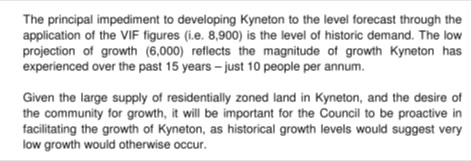
Growth Proposed Exceeds Sustainable Growth
The Kyneton South Investigation Area (along with Amendment C110 and the Framework Plan's expansion of the town boundary) is additional to, and will produce population growth in excess of, the Settlement Strategy growth projections for the town. Settlement Strategy Executive Summary said:

KYNETON STRUCTURE PLAN
The Structure Plan affirmed the Settlement Strategy’s findings for population growth and no further land being required, but then made a recommendation that an investigation area (the same area now being investigated) be identified to ensure 15 year supply of land. The Structure Plan set requirements for such future investigation, as below. The key focus of the Kyneton South Framework Plan seems to have skipped over the basics of souls, environment, agriculture, landscapes, and leaps straight into what would be needed to support the growth proposed.
The Kyneton Structure Plan merely identified the Kyneton South area for future investigation. Amendment C99 accelerated that and put timeframes for development on the investigation area, saying sufficient progress in investigations had occurred to do this. When asked by MRRA to produce the investigations that had occurred, Council said the investigations had been done by landowners.

KYNETON TOWNSHIP BOUNDARY
The Kyneton Structure Plan made no recommendations to change the township boundary. Only in the Amendment C99 Explanatory Report did Council admit changing the town boundary in the south when not recommended by the Structure Plan. The reason given was:
“The town boundary has been modified to include all existing residential zoned land as well as the low density residential and farm zone land west of Trentham Road proposed for low density redevelopment in the short term. This provides a clear distinction between the town’s outer suburbs and the farming and rural living surrounds.”
The Kyneton South Framework Plan shows a vastly expanded Kyneton Township Boundary, which includes around an additional 350ha of mostly Farming Zone to the west of the Campaspe River. Note that only about one-third of the Kyneton South Investigation Area is currently included in the town boundary. Click here for maps
CURRENT Action Required Can You Spare 8 Minutes To Complete A University Of Melbourne Survey?
(19/6/17 - O) It's about bushfire arson and Crimestoppers, and researchers are asking for your input. Crimestoppers file
Here's the message MRRA received from Dr. Paul Mead of the University of Melbourne:
I've been conducting bushfire arson research in conjunction with Crime Stoppers since 2009. This research has involved surveying people in the communities of some bushfire prone areas of Victoria, specifically Yarra Ranges, Surf Coast, Nillumbik, Murrindindi, City of Knox, City of Latrobe and Macedon Ranges. I was wondering if you could post the following link on your facebook page and twitter feed so that people can do this 8 minute survey at their convenience rather than me hassling them at shopping centres! Thank you so much for your help.
And here's the link to the survey (it goes through Facebook first)
MRRA Says:
If you can help out, please do.
CURRENT Outcome of Macedon Ranges 8 March Special Council Meeting For Rescission Motions
(17/3/17 - C) Cr. Jukes' rescission motion, to reverse Council's decision to withdraw support for Council's expired equine strategy, was defeated 8-1. Cr. Mees' rescission motion to reverse approval of a 2 lot subdivision and 2 dwellings in Woodend, was carried Council Performance file Equine file
There was a large gallery at the 8th March Special Council Meeting, which was called to deal with two rescission motions arising from the 22 February ordinary council meeting. Many in the gallery represented equine interests supporting Cr. Jukes' rescission motion. Mayor Jennifer Anderson began the meeting with a clear explanation of the purpose of the meeting, agenda items, what the results might mean, local law protocols, and expectations for gallery behaviour.
Cr. Mees' rescission motion (seconded Cr. Radnedge) was carried 5-3, reversing previous approval of a permit application for 2 dwellings and a 2 lot subdivision at 129 High Street, Woodend. Mayor Anderson declared a conflict and left the chamber while the motion was considered (Cr. Bill West temporarily took the chair). In support of her rescission motion, Cr. Mees cited the quality of the development outcome and impacts on heritage and character within a heritage precinct, adding the Macedon Ranges Protection Advisory Committee's report's emphasis upon protecting heritage values created a need to stop and think about heritage and character in the Shire. She added that the applicant has indicated a willingness to work with council to resolve remaining issues. Cr. Jukes opposed the rescission motion, seeming to think it meant a more 'mock heritage' outcome was sought. He said although the development was approved on 22 February it was still open to being brought back to council for changes. Cr. Mees then closed debate saying the rescission wasn't about wanting 'mock heritage' but new development being sympathetic to the heritage precinct and character, and the rescission motion allowed remaining issues to be resolved, before approval.
Next up, Cr. Jukes' moved his rescission motion to overturn the 22nd February motion to withdraw the Equine Strategy and Equine Centre as strategic and funding priorities. For a long moment it looked like he might not get a seconder until Cr. West did the honours to allow discussion. Defending his rescission motion, Cr. Jukes argued the original motion was bad for council, and lacked consultation and transparency. He spoke of costs, how important the 5 year [equine] plan was, and added that work on protection of Macedon Ranges will bring in equine. He referred to claims that 'mainly horsey people' were involved in consultation on the equine program, then said many community facilities, including pools, had been driven by clubs associated with those activities. He said the 22nd February decision totally lacked transparency, because no-one knows where it comes from. He added that to remove a 5 year plan (i.e. the 2012-2016 Equine Strategy) from the planning scheme was not heard of before, then closed by announcing an Olympic champion was present at the meeting in support of the rescission motion.
Crs. Twait and then Gayfer spoke against the rescission motion, between them raising points including that there appeared to be some mis-understanding of Council's 22 February motion - it didn't mean undoing what had already been done; equine's recreational and economic contribution was and would continue to be recognised, particularly leisure activities which seemed to have been missing out and warranted being fully addressed in the Shire's Leisure Strategy; acknowledging work done but concerns with the equine feasibility study; and noting careful consideration is needed of all aspects of Council functions, particularly after the Macedon Ranges Protection Advisory Committee's report. In closing Cr. Twaits reminded the gallery Council is presently inviting community comments and feedback for the Council Plan.
The vote was taken and Cr. Jukes' rescission motion was defeated 8-1. The 22 February motion stands.
MRRA Says:
Well done to the eight councillors who voted to remove the expired 2012-2016 Equine Strategy from Council's strategic and budgeting priorities, a move that reflected the views of the majority of Macedon Ranges Shire residents who definitely didn't want the equine centre, or ratepayers footing the bills, or Council's continued single-minded focus on it.
In simple terms, the equine centre mainly benefited a relatively small group of interests and businesses within the Shire - and interests external to the Shire - while the option chosen by the previous council failed to provide promised facilities for local recreational riders. This council's decision re-aligns council's focus from 'equine' to 'equity', and puts 'equine' in a Shire-wide context: while horses are an important activity and interest, they are neither the only nor the most important activity or interest in the Shire. The decision will now see MRSC's request for $40 million funding for the equine centre through the 2016 Loddon Mallee Prospectus withdrawn, opening up new and more opportunities for funding applications for projects benefitting the broader Macedon Ranges' community.
Cr. Jukes' arguments for supporting his rescission motion deservedly fell flat, and little wonder.
No-one knew where the original (22nd February) motion came from...
Seriously? Firstly, even the tremulous Equine Centre Feasibility Study recognised an equine centre as a significant financial risk, with potential to harm existing Shire businesses.
Many might also say there were some wee clues in last year's Community Satisfaction Survey where the community caned Council for what it was doing, or when the community voted for dramatic change with 7 new councillors out of 9 last October, or just out there in the community where, over the past few years, residents were saying they didn't want the equine centre almost as often as they said they hated the Council pushing it - and that was pretty much all the time. Broad community opposition was unmistakeable and un-missable, to those who looked and listened.
No consultation...
Could this be the same Cr. Jukes who dismissed community calls for consultation on the 2015 Kyneton Development Plan for a 341 lot subdivision? Who thought one meeting run by the developer, and consultation about five years earlier on a different development plan, was sufficient consultation? Who said 'the community had been consulted and those who want to know, know about it'?
Not transparent... Removing a strategy from the planning scheme without consultation hadn't been done before...
Not a smart move going here. Lack of transparency? Let's talk about how the Equine Strategy got into the Macedon Ranges planning scheme in the first place. The draft Equine Strategy was exhibited over Christmas 2011 with submissions closing mid-January 2012, timing that automatically rings alarm bells. By the 28 March 2012 council meeting, the Strategy was up for adoption as agenda item PE7 but was moved up the agenda and adopted in a hefty 'en bloc' motion (no debate) at the start of the meeting. Just as well, really, because after that, up bobbed a motion at item PE4 for council to send Amendment C84 to a planning panel. Amendment C84 was said to be a policy-neutral reformatting of, but surreptitiously rewrote, the Macedon Ranges planning scheme. And guess what? Even though adopted only a few minutes before, the Equine Strategy was already in Amendment C84, both as a reference document and in policy saying implement it.
Subsequently, the planning panel to which Amendment C84 was sent said 'no' to the Equine Strategy. It hadn't been exhibited with - and wasn't part of - Amendment C84, so take it out. But the council of the day disagreed and made no such change, saying exhibition of the draft Equine Strategy (over Christmas, before its adoption by council) was sufficient consultation to justify putting it in the planning scheme - and saying 'implement it'.
The C84 planning panel again said 'no', and that "the implications of responding to 'planning constraints' identified in the [equine strategy] could be significant. It is not appropriate to indicate in the MSS that this un-exhibited document will be implemented in the planning scheme." Although the Equine Strategy ended up being included in the planning scheme as a reference document, the main policy that said 'implement it' was removed. Undaunted, the previous council implemented the Equine Strategy anyway, using it amongst other things to launch the equine centre, and as a primary justification for Amendment C110 - the rural living carve-up along the Shire's southern boundary and at Romsey and Kyneton. Implementation on steroids!
And you could only call the claim, that strategies hadn't before been removed this way from the planning scheme, a walk on the very wild side! The previous council turned this practice into an art form throughout the many iterations of Amendment C84 - adding and deleting dozens of strategies and reports from the planning scheme with, or without, consultation or exhibition. This feast of arbitrary changes made it almost impossible to understand what was in, what wasn't, and why. The council of the day also declined to implement a C84 planning panel recommendation that would have assisted transparency and accountability with these documents.
The surprise is that, even though he voted for it, Cr. Jukes seems to have overlooked all of this.
That just leaves us to mention that some equine interests are blaming MRRA for the new council's decision (oops, heavy overtones of 'shooting the messenger' there!), and also that ex-councillors Letchford and Hackett were at the rescission motion meeting. Ex-councillor Letchford also attended the 22 February meeting, aligning himself at both meetings with equine interests. What can we say but amen... rather them than us.
CURRENT A Big Step Forward By State Government Towards Protecting All Of The Macedon Ranges Shire, But... (pdf version of this report)
(6/3/17 - SP) Council gets to write the protection policy. While our new group of councillors is much, much better than the previous group, the 'accelerated-growth-and-economic-development' obsessed administration hasn't changed...
The Minister for Planning released the Macedon Ranges Protection Advisory Committee's report and recommendations for protecting Macedon Ranges in mid February, at a well-attended Community Forum he hosted in Gisborne. He has accepted the Advisory Committee's finding that the form of protection to be applied will be new 'Macedon Ranges' legislation, and a Macedon Ranges' Localised Planning Statement [LPS] (a State-level policy framework about what is important and significant in Macedon Ranges Shire, why, and the primary policy to be applied to protect it).
The Minister has also accepted all of the Committee’s 12 recommendations, which include setting aside Macedon Ranges Council's 2014 draft Localised Planning Statement and writing a new one; protecting the whole Shire; and identifying in the Localised Planning Statement new Settlement Boundaries around towns within which urban and rural living development will be confined. Other recommendations include strengthening planning controls for protection of landscapes, vegetation and Mount William, identifying biolinks, and meaningful consultation with Aboriginal owners and parties.
The Advisory Committee found that Macedon Ranges is a "special" place in Victoria facing unique pressures from population growth and urban expansion, and that "the protections provided by Statement of Planning Policy No. 8 have been gradually eroded". (p44) The Committee found that a form of legislative protection is warranted, and recommends legislation that requires parliament's consent to change the new Settlement Boundaries. The policy and planning framework in Macedon Ranges Shire also needs to be strengthened. Tellingly, the Committee concluded Council's 2014 draft Localised Planning Statement's language was "aspirational" in nature, and the LPS did not provide sufficient guidance to ensure planning decisions will have enough of a 'protection focus', or contain sufficiently clear direction or guidance to assist planning decisions or to help planners resolve competing policy objectives. The Advisory Committee has recommended Council's 2014 draft LPS be set aside [the broader Macedon Ranges' community also rejected the draft LPS in 2014].
The Advisory Committee's report provides a recommended Localised Planning Statement at Appendix B, which includes Committee text changes that (amongst other things) prioritise the environment in decision-making, and bind the LPS on a range of decision-makers (including servicing and other authorities). The Committee says Appendix B is by no means the absolute and final version - rather, changes "highlight the intent of how the Committee thinks the LPS can better achieve protections for the Macedon Ranges". The Localised Planning Statement is to be further revised, and the Committee's report provides directions at 6.4.1 that revisions are to:
Statement of Planning Policy No. 8 is to be retained as a Reference Document for the Localised Planning Statement.
The State government is providing $70,000 to Council which will be working 'in partnership' with the Victorian Planning Authority * and Department of Environment, Land, Water and Planning. The Minister said the government was hoping to have legislation before parliament by the end of 2017. Amendments C98, C99 and C100 (Structure Plan amendments for Woodend, Kyneton and Riddells Creek respectively) are presently before the Minister for final approval. Amendment C110 (i.e. the rural living carve-up amendment) will be considered at a later date, and against the finalised Localised Planning Statement.
You can access the full Advisory Committee Report at http://www.planning.vic.gov.au/policy-and-strategy/macedon-ranges-protection
* The Victorian Planning Authority has charge of, amongst other things, planning for metropolitan growth corridors (such as the Sunbury Growth Corridor).
MRRA Says:
Our appreciation goes to Minister Wynne, Mary-Anne Thomas, the Advisory Committee and Departmental contributors for getting protection for Macedon Ranges to this stage.
However, the Association has concerns with where the process goes from here. Recent announcements of new suburbs to be created in close proximity to Macedon Ranges Shire brings Melbourne's sprawl even closer, deepening already intense development pressures on the Shire. Rural properties in Macedon Ranges Shire have already been advertised and sold as "land-banking opportunities".
In 2014 the State government recognised that in Macedon Ranges "inappropriate development risks destroying the area", and promised:
Labor will legislate to protect this iconic and historic region...
We will use SPP No. 8 as the basis for legislative protection...
Labor's plan for the Macedon Ranges will provide the highest level of protection possible against inappropriate development...
Under Labor, the beauty, heritage and unique characteristics of the Macedon Ranges will be protected for good."
MRRA has always said to the State government, "we will be holding you to that".
The protection being proposed is high-level, long-term, and legacy-making. It must be excellence, and it must indeed maintain Statement of Planning Policy No. 8, provide the highest level of protection, and protect "for good". The Advisory Committee and Minister have provided the foundation to achieve these outcomes, although significant work and a great deal of expertise, commitment, care and objectivity will be required to get there.
However, revision of the Localised Planning Statement has been handed back to Macedon Ranges Shire Council. While there is a new and refreshingly different councillor group, it has only been in place for a couple of months. Councillors rely on advice from the Council administration that produced the failed 2014 Localised Planning Statement, and appears still intent on implementing its long-held agenda: replacing Statement of Planning Policy No. 8 with its own accelerated growth and economic development program, with environment relegated to merely being a backdrop. Consequently, potential exists for undesirable administrative influence, and this reduces confidence in the Localised Planning Statement process.
The Association believes confidence would be heightened, and the councillor group would be greatly assisted, if the councillor group took charge of the project and engaged an independent, highly-experienced expert planner, to write new policy and provide councillors with sound, objective planning and policy advice.
Macedon Ranges' Localised Planning Statement
The Committee accurately identified many of the 2014 draft Localised Planning Statement's short-comings, which primarily arose because it was mis-used as a vehicle to promote and justify the then Council’s pet projects: accelerated growth; subdivision of rural land and increased rural living development; the equine industry and equine centre; rezoning to make smaller lots for people to have horses and pursue a form of agribusiness; and large tourism development and commercial uses in rural and environmentally-sensitive areas - and this priority set remains in the draft LPS.
Concurrently, the Shire's high-significance values were either not recognised or their importance was downgraded to sit as a peripheral issue, subservient to growth, rural subdivision and economic development priorities (e.g. high-significance features, attributes and resources are reduced to "attractive", "interesting", "scenic") - and this prejudice remains in the draft LPS.
These priorities and prejudices also drove the previous Council's contribution to the Loddon Mallee South Regional Growth Plan, and changes to the Macedon Ranges planning scheme by Amendment C84. They have also permeated other policy and strategic work, for example, Environmental Management Plans, where less really is less.
Some specific and broader issues relating to the protection process that are of concern to the Association include:
# Assumptions that major planning documents are sound:
# Errors, misrepresentation, and exaggerations in the draft Localised Planning Statement. Examples include:
# Inadequate recognition of the role and relevance of the Federal Environment Protection and Biodiversity Conservation Act, the State Flora and Fauna Guarantee Act and other identified environmental and heritage significance in the Shire.
# Insufficient recognition that the local community must be consulted, and that local values and interests are to carry equal weight as any others.
# Over-emphasis of equine matters including two full paragraphs promoting and justifying the equine industry and equine centre in discussion of agriculture and rural land use. The LPS also fails to distinguish that equine-related land use is a rural activity, not (productive) agriculture.
# The former "Range and the Rock " policy area (i.e. the "immediate" surrounds of). While the policy area is to be abandoned, the name persists in the LPS. Both policy area and name were invented for the draft 2014 LPS by the previous council to replace the larger, long-recognised Statement of Planning Policy No. 8 - Macedon Ranges and Surrounds policy area. Replace "Range and the Rock" with "Macedon Ranges and Surrounds" when describing significance in the Shire's central areas.
# Inadequate description of implementation actions e.g. Implementation action: identify and manage biolinks. Also inadequate identification of outcomes sought.
# Inadequate recognition of the roles and importance of townships in the Shire's overall significance, and provision of commensurate policy to justify application of strong design and development controls that prioritise protection of rural character in township development proposals.
# Insufficient attention to public land, and no implementation requirements to review public land zoning to ensure zones reflect the land's role and function.
# Implementation does not include review and expansion of permit triggers in Environmental Significance overlays applied to Special Water Supply Catchment.
Additional Matters
# The form of protection proposed will maintain application of existing State policy (which often results in metropolitan policies being applied in Macedon Ranges Shire) and standard State zones and overlays. Without specific further clarification, this situation will (continue to) create uncertainty:
Macedon Ranges' Legislation
Legislation is essential, and very welcome, and will be prepared after finalisation of the Localised Planning Statement.
The legislation proposed requires parliament's consent for expanding or creating new settlement boundaries, which are to be identified in the Localised Planning Statement (Framework Plan).
# There is a lack of certainty and clarity about whether settlement boundaries are intended to be permanent boundaries. Additional concerns include:
# The Association considers it essential that Macedon Ranges' legislation also include requirements for parliamentary approval for:
A "Macedon Ranges" Particular Provision
At page 46, the Committee's report supported but stopped short of formally recommending introduction of a State-level Macedon Ranges' Particular Provision to provide additional direction for policy objectives for agricultural land. Similar Particular Provisions already exist (Clause 57 for Green Wedges, and Clause 53 for Yarra Ranges). The Advisory Committee champions Clause 53 as a model for Macedon Ranges.
A Macedon Ranges Particular Provision would provide additional strength to protection, and is considered essential.
Clause 53 is an appropriate and desirable model, adapted to Macedon Ranges' specific issues and conditions. Critically, it includes a highly desirable statement that Clause 53 provisions prevail over other parts of a planning scheme where a conflict occurs.
As Macedon Ranges-specific rural zones are not proposed to be introduced as part of the protection process (as they were when Green Wedges were introduced), there would also be merit in including a Clause 57-style Table of Uses that provides for incompatible uses in current standard State rural zones to be restricted through prohibitions and/or limitations on scale.
This is an exciting and epoch-making time for Macedon Ranges, where some of the most important decisions in the Shire’s history are about to be made. Those decisions will determine the Shire’s long-term future.
As MRRA said above, the output of the protection process must be excellence, to satisfy community expectations and provide the highest level of protection for our towns and rural land. Consequently, whatever is needed to fully realise that objective, must be done.
CURRENT 22nd February 2017 Council Meeting: Welcome To The World Of Changing Council Priorities
(6/3/17 - C) Cr. Jukes lodges rescission motion against Council withdrawing formal support for the Equine Strategy - Special Council Meeting Wednesday 8 March, Gisborne, 6.00pm. Councillor Performance File Equine File
The Council meeting on February 22 was something to behold - with some surprising alternative motions, this new Council is doing things differently (and better).
Councillor Jukes (the only councillor who voted against the motion to delete the Equine Strategy, Equine Centre and associated funding and priorities for same, has lodged a rescission motion to overturn the 22 February Council decision.
A Special Council meeting will be held on Wednesday March 8 at 6.00PM at the Gisborne Administration Office, and is open to the public.
MRRA Says:
This 'difference' is what the community voted for last October, and it's beginning to be reflected in some significant Council decisions. At last, more thought, questioning, research, consistency, accountability, transparency, higher standards, strategic thinking, compliance with the planning scheme, and a much better grasp of wider community perspectives and priorities.
The day after the Council meeting (and the 8-1 vote on the Equine Strategy), the Bendigo Advertiser somehow ran the headline "Macedon Ranges Shire councillors divided over equine centre". Divided?? 8-1?? Wait. Cr Jukes was well-quoted in the story... OK, that works in making sense of why anyone would say "councillors divided".
Council Asks For Comments By 28 February On Enormous New Equine "Shed" Proposal At Woodend's Racecourse Reserve
(25/2/17 - C) Offer to donate a 64 x 30 x 6 metre indoor equine arena for Woodend's pony club conflicts with environmental, open space and public land values. Council says a planning permit is not required, so this is your only opportunity to have a say. Woodend Racecourse Reserve file
Council is seeking comments by 5.00pm on Tuesday February 28 on an offer it has received to donate a very large indoor equine arena to be built on Woodend's Racecourse Reserve for the Woodend Pony Club.
The arena would operate 7 days a week, from 9am til 6.00pm weekdays and an hour longer on weekends, a substantial increase in activity over current occasional pony club use of the Reserve.
Apparently only the shed would be donated to Council, and no information is provided about management or staffing, or costs for connection to electricity/sewer/other services, lighting, works, on-going maintenance, traffic/car parking or purchase of equine equipment.
At 64 metres x 30 metres, this cream-coloured indoor equine arena is even bigger than the proposed Olympic-sized arena at Mount Macedon (60 metres x 20 metres) that was refused by Council on 22 February 2017. From plans on Council's website it also seems to have a bigger footprint than Buffalo Stadium.
To find out more about the proposal: http://www.mrsc.vic.gov.au/Council_the_Region/News_Media/Latest_News/Community_feedback_sought_on_Pony_Club_shed_proposal. See also a letter sent to residents.
MRRA Says:
With the previous council, the outcome would have been pre-ordained. With the new council, we and many others are hoping 'greater good', 'proper process', 'public interest' and 'public land' will prevail.
The Woodend Racecourse Reserve is Crown land, managed (but not owned) by Council, and operates under the Crown Land (Reserves) Act, which requires a Committee of Management. Is there a management plan or masterplan for the Reserve? If there is, why isn't it publicly available, and is such an indoor equine arena endorsed by the plan? If it isn't, or there isn't a plan, how can this proposal even be considered?
The Reserve itself is zoned Public Conservation and Resource Zone [PCRZ], the most restrictive zone applied to public land in Victoria. PCRZ confirms and prioritises the Reserve's conservation values, including highly significant native grasslands, Five Mile Creek and other ecological values. Environmental Significance and Vegetation Protection overlays are also applied.
The Reserve is also an important public space for broader community use, including active and passive recreation.
Although a specific interest group would benefit from this leviathan indoor equine arena, other interests and values need equal (or more) consideration. It's a game-changer, and it's on public land - public open space, in fact. Issues with the proposal are self-evident:
Council says this large development doesn't need a planning permit. Why not? The Purposes of the Public Conservation and Resource Zone promote the land being used to prioritise environmental outcomes - they don't include 'providing very large sheds for indoor equine arenas'.
Whether for equine or any other use, a proposal such as this would significantly alter the appearance, role and function of public land, just because somebody wants it. To accept this ad hoc offer would also put specific interests over the public interest, without a plan or appropriate process, consideration of impacts and costs, or full consultation with and agreement from the community. There must be higher standards than this.
Short notice, but please put in comments by 28 February (next Tuesday) asking councillors to put the broader public interest, the environment and proper process first by saying 'thanks, but no thanks' to this gift. Note: comments can only be forwarded by email: mrsc@mrsc.vic.gov.au
CURRENT Decision To Allow Ed Sheeran Concert ON Hanging Rock Breaks Faith And Process, And Totally Disrespects The Rock
(25/2/17 - C) Macedon Ranges Shire may have new councillors but this decision - apparently without approval from new councillors - shows the rot at Council still goes deep Council Performances file Hanging Rock file
EEd Sheeran's recent gig in Macedon Ranges Shire made history - by violating the cultural and environmental values of Hanging Rock with a concert ON the Rock itself. Other artists that have performed "at Hanging Rock" have in fact performed on the East Paddock AT Hanging Rock.
Someone at Council approved it, ignoring undertakings given to the community that concerts would only be held at the East Paddock, ignoring the Hanging Rock Strategic Advisory Committee, and ignoring the State-government supported strategic and environmental planning currently being done for Hanging Rock. The event would have taken time to organise, but those in the know kept their secret, even from councillors.
A recent letter to the Midland Express asked all the right questions about the concert, then finished with "one fundamental question that needs to addressed: "Who is running the Macedon Ranges Shire Council, the council officers or the newly elected councillors?" What a most excellent question.
MRRA Says:
Some say because it was Ed Sheeran, it's OK. We say it's not. It's Ed Sheeran today, but there have been so many other examples - Daly Nature Reserve, the Equine Centre, etc., and who will ever forget Council's gross development proposal to commercialise Hanging Rock, without community consultation? The common thread with these is that even the most basic principles of governance and accountability were ignored to indulge in behaviour that is not acceptable under any circumstances. What happened with the Sheeran concert cuts to the core of the relationship between a Council and the community it is supposed to represent.
Previous councillors gave the Shire's CEO delegated authority to finalise the contract with Frontier Touring for concerts at the East Paddock. After what's happened, either the finalised contract somehow included concerts ON Hanging Rock without a resolution of council, or didn't include them and Mr. Sheeran's foray onto the Rock itself is a breach of that contract. Either way, the contract with Frontier Touring must now be made public, as must those who authorised the Sheeran event.
The arrogance of not putting the matter before the new councillors for decision is yet more evidence of the dark culture that remains in the Council's administration, symptoms of which seem to include a preference for decisions made in corridors and corners instead of chamber, operating and making decisions without proper (or any) process and light, and disdain for community, policy and environment. Nor does Frontier Touring emerge from the Sheeran 'coup' unscathed - why should the Macedon Ranges' community feel confident the company will behave in a transparent and respectful way in future?
When trust is gone, heads and delegations - if not contracts - must roll.
CURRENT Amendments C114 (Macedon) and C115 (Mount Macedon). These are Implementing "Design Guidelines" To Protect Character?? Not on your nelly!
(23/12/16 - P) How does this sound: zero front setbacks, two storey development, no preferred character, planning requirements able to be waived by council, street trees a minor consideration - in both towns. And this: a Special Use Zone at Mount Macedon allowing McDonalds, and 'pole signs', with "small scale" development deleted. That's what you are getting with C114 and C115. Submissions close 30 January, 2017. Macedon-Mount Macedon Archive File
Amendment C114 at Macedon includes a draft Design and Development overlay (DDO26), and changes to the Macedon Township Policy at Clause 21.13-6.
Amendment C115 at Mount Macedon includes a draft Special Use Zone schedule (SUZ6), and changes to the Mount Macedon Township Policy - and Framework Plan - at Clause 21.13-7.
Amendment information is available from Council's website although, as has happened before, some is missing: neither of the towns' Village Centre Studies or Design Guidelines documents, which underpin the amendments, are with the amendment documentation.
MRRA Says:
As a principle, enshrining strong development and design standards in the planning scheme, to preserve and protect character, has merit. Alas, that's not quite what these amendments are doing.
A project of the previous council, the C114 (Macedon) and C115 (Mount Macedon) planning scheme amendments have their genesis in Village Centre studies adopted for both towns in late 2014. The amendments are claimed to be putting the Design Guidelines that derive from those studies into the planning scheme. Well, that's the theory, at least.
The previous council wasn't going to exhibit any Design Guidelines - officers' recommendations for both towns were to just leap from adoption of Village Centre studies straight to amendments that would put unseen Design Guidelines into the planning scheme without further consulting council or community. The big surprise came in late 2015 when a majority of the previous council voted against doing this for Mount Macedon. As a result, draft Design Guidelines for both towns, along with a very incomplete draft Special Use Zone for Mount Macedon, were put out for community comment last May.
Problems with the exhibited Design Guidelines included excessive use of "should". Problems with the exhibited 'half' of a Special Use Zone schedule were obvious: it allowed currently prohibited uses, and most of the zone schedule's provisions and requirements were missing. Something that zone schedule did include were statements authorising council to reduce or waive planning permit application requirements for everything except signs.
In September 2016, the previous council voted to prepare planning amendments to put the Design Guidelines into the scheme, via a Design and Development Overlay at Macedon and a Special Use Zone schedule at Mount Macedon. As was that council's habit, it gave council officers authority to make changes, without further consultation or council endorsement, prior to exhibiting the C114 and C115 amendments. The Design Guidelines and zone schedule were then whisked off into council's back room to be translated into the amendments currently on exhibition, which have emerged with at times unrelated and unrecognisable content. Yes, a lot of the former "should" language is gone, particularly at Macedon, but not all. Some of the original "musts" have been wound back, replaced with new "should", "minimise" or "discourage" language. Shifts in emphasis and issues being addressed dilute requirements for development, and too many of the original Design Guidelines are omitted and just aren't there at all in the amendments.
Yet council's official line remains the same, continuing to misrepresent these altered and weakened amendments as being good for Macedon and Mount Macedon. However, as with other recent amendments (for example, Structure Plans at Riddells Creek and Kyneton), the previous council's habit of watering down or deleting anything that put standards or the environment first, and of fudging policy to be less onerous and more 'flexible' for development/developers, is indelible. Some of the changes made to the Design Guidelines in their translation into the C114 Design and Development Overlay and the C115 Special Use Zone certainly seem to favour potentially largish pub expansion at Mount Macedon, and diluted development standards for 19 Victoria Street, Macedon.
These amendments are not delivering the protective planning that most of the community wants, and is being told it is getting. MRRA can't see how, in their current form, these amendments are 'good' for either town. Here are some of the issues with the amendments MRRA has detected to date:
C115 Mount Macedon:


C114 Macedon:
The consequences of these amendments won't only impact local communities. Does anyone really want a Maccas-style development at Mount Macedon? Or large apartment-style development at Macedon? Or street trees removed to accommodate (over-) development?
Everyone can help by putting in submissions by 30 January, objecting to Amendments C114 and C115. This is a formal planning scheme amendment process, so clearly mark your submission with the amendment number (C114 Macedon, C115 Mount Macedon), objecting to the amendments as they have been exhibited, and requesting that neither be progressed. The new Macedon Ranges council has the option of abandoning all or part of the amendments, or of reviewing, rewriting and re-exhibiting them.
Minimum objectives for any rewriting would be to replace the favours, 'flexibility' and weaknesses in C114 and C115 with strong, unambiguous standards, 'starting points' and requirements (with no waivers), that prioritise and are genuinely sympathetic to protection of character and environment, and result in limited, small scale, low key, high quality development. Nothing less will do in these extremely sensitive towns.
CURRENT Application For 29 Dwellings (yes, 29) On 7,000 Sqm In Calthorpe Street, Gisborne
(23/12/16 - P) 'Over-development' and 'out-of-character' have just reached new heights
Planning application PLN/2015/412 has been made (on behalf of the Robinson Family Trust) for 10 townhouses, 1 single story dwelling and 18 apartments. One street tree in Fisher Street is also to be removed. The site is just under 7,000 square metres and currently vacant, and comprises four titles located at the south-east corner of Calthorpe and Fisher Streets in Gisborne. The Gisborne Main Drain (aka Bunjil Creek) forms the eastern boundary of the site.
A previous permit was granted in 2006, but was not acted on and expired (the developer's planning report at page 2 says 14 dwellings were approved in 2006; local residents say the approved development was reduced to 13 dwellings). The planning report for the application claims the main difference between the 2006 proposal, and the current one, is the inclusion of a "modest" apartment style development in the centre of the site instead of townhouses / dwellings. That "modest" apartment block is three floors and 18 apartments, including underground car park, and a lift.
The design and planning team of Bill Jacobs Pty Ltd (Keilor Park), and G2 planners (Gattini) at Moonee Ponds that are associated with this application also gave Gisborne the Nexus Call Centre. Bill Jacobs Pty Ltd has also been associated with other developments including the Helensville townhouse/unit development (at the Howey Street corner 'gateway' with Melbourne Road), and the very large supermarket proposal at Riddells Creek. All of these attracted strong community resistance, and objections to over-development, poor design characteristics, and lack of compatibility with rural town character.
Although the Macedon Ranges planning scheme supports a diversity of housing types for the 22 Calthorpe Street site and parts of the broader area around it, DDO17 (Design and Development Overlay, Schedule 17) is applied to the site and requires all development to (amongst other things):
"Protect and enhance the established semi-rural and village character of the residential area surrounding Gisborne Township"
"Ensure that new development has proper regard for established streetscape and development patterns in terms of building design, height, form, scale, siting and fencing" and
"Ensure new development respects its natural and built environment and does not dominate the landscape."
There's medium density appropriate to Gisborne, then there's the proposal at 22 Calthorpe Street.

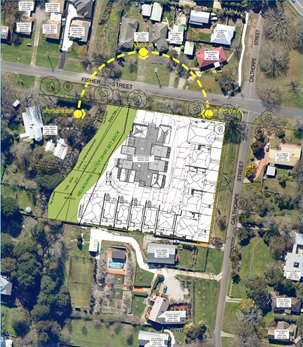
The aerial view shown (above left) shows existing development surrounding the site is relatively low density, with ample garden and grass space around dwellings. Photo source: Site Analysis and Context page 3 Top is north.
The design response shown (above right) shows that the proposed development is basically wall-to-wall dwellings around two boundaries, with a large apartment block in the middle, and these separated by an internal concrete driveway. Only the mandatory green-coloured creek/drain buffer area suggests a "green" space. Photo source: Drawing TP01 Site description and design response Top is north.
Here are some issues that have been identified to raise in a submission:
Development proposed along the site's southern boundary Note: the fence in this drawing seems to be shown on the wrong (i.e. northern) side of the dwellings, when it is to the south (i.e. along the southern boundary).
Although the formal notice period for making submissions has now passed, submissions/objections can be made up until the time council makes a decision (likely next year).
There are some 28 documents associated with this application. Go to Council's website to inspect or download them:
https://eservices.mrsc.vic.gov.au/athway/Production/Web/GeneralEnquiry/EnquirySearch.aspx type 'Calthorpe' at "street", and 'Gisborne' at "suburb" and click "Search".
MRRA Says:
Some understandably horrified local residents alerted MRRA to this awful proposal: development so jammed in it can't be done without putting one of the dwellings IN the floodplain, knocking off a street tree, short-changing character and existing residents on setbacks, moving tons of dirt, producing "walls" of two-storey development and creating a concrete-dominated environment.
Not good enough - never was, and never will be. This is truly damaging development, and is what greed, and suburban, look like. It's time the community pushed back against this substandard type of development that so many of us hate so much. If you can find a moment to pen a short objection, would be fantastic! Make sure you send a copy of submissions to all councillors, as well as lodging submissions with council.
CURRENT Woo-hoo. Our New Council Is Actually Asking Residents What They Think! Survey About 'What's Important To You' - Closes February 12, 2017
(23/12/16 - C) Feedback will inform the Shire's Council Plan. Council Plan file
What a difference an election makes - instead of us being told what we will get, we are being asked what we want. Go here, to do that.
MRRA Says:
MRRA almost needed 'a Bex and a lie down' after hearing this latest good move by the new Council. Be part of it.
CURRENT Ombudsman's Report Into Transparency In Local Government Shines A Light Where The Light Hasn't Been Shining
(23/12/16 - SG) Findings confirm the Macedon Ranges' community wasn't just whinging when it said the previous council lacked transparency and accountability. The ball-biter recommendation is that all council meetings should be (at least) audio recorded - including confidential meetings... and briefings! Ho, ho, ho, ho ho. Ombudsman File
The Ombudsman's office targetted 12 pilot councils for this report (not Macedon Ranges) and the result is a whopping 184 pages, but it's a good read. The report looks at whether transparency is being achieved across a range of council areas - including meetings, delegated decision-making, confidential decisions, briefings, motions, and committees of council.
Conclusions are at page 138, Recommendations are at page 148, and "What a transparent council should look like" - a most delicious and enlightening read - is at page 150.
MRRA Says:
What a Christmas gift!
So the 4% of us that the former Mayor (Hackett) said were wrong, weren't.
The report makes recommendations including: (at a minimum) audio recording not only open council meetings but also closed 'confidential' sessions - and councillor brieifings; not using en bloc motions; reporting on delegated decision-making; making public the members and minutes of Council's Special and Advisory committees and enforcing conflict of interest requirements for these, and introducing a State-wide Councillor Code of Conduct.
The Ombudsman concluded that recording of confidential council forums - when council closes the chamber to consider confidential items, and councillor briefing sessions - would engender a heightened awareness in participants of the need for transparency and accountability. Although these recordings would not be available to the public, they would exist. The Ombudsman's point is that the mere fact these meetings are recorded would deter unaccountable, untransparent and unofficial decision-making, particularly in council briefings, which are not supposed to be decision-making forums at all. The Ombudsman disagrees with the change proposed to the Local Government Act to allow councils to run briefings as they see fit, saying "further deregulation will only increase the likelihood of substantive decisions being made in briefing sessions and merely being ratified in the chamber." To date Macedon Ranges council has declined all community requests to record (audio, video or live stream) council meetings. Both MRRA's written request in 2010, and a recent petition, both calling for recording/streaming of council meetings, went nowhere.
According to the Ombudsman’s report, the infamous en bloc motion approving multiple agenda items in a single motion lacks transparency: transparent... councils... don't... use... it.... Macedon Ranges Shire has indulged in en bloc motions since 2010, where without prior notice, at times the bulk of meeting agenda items have been approved in a single en bloc motion, pointing to decisions repeatedly being made in confidential briefing sessions. The previous council may have seen it as a way of conveniently shortening the length of meetings, but this practice has been the subject of long and strong community complaint.
It was therefore disappointing, at last Wednesday's (21 December) council meeting, to hear the CEO's response to a question from the gallery asking if council and councillors were aware of the Ombudsman's report. The CEO said that as Macedon Ranges Shire only determined 2.65% of its decisions in camera, while other Large Rural Shires average 10%, Macedon Ranges Shire operates transparently. That response missed the Ombudsman's point about a range of practices that contribute to lack of transparency. It would be interesting to know where Macedon Ranges' percentage goes if decisions made in briefings and approved en bloc were included...
The thought of public reporting of decisions made under officer delegation - what a sensible recommendation to improve transparency. Macedon Ranges Shire could get the ball rolling, for example, with some reporting on decisions the CEO makes in exercising his hefty delegated authority to award contracts of up to $1 million without consulting council.
Accountable and transparent local government - are we there yet? With this Ombudsman's report, and some improvements mooted for the Local Government Act, and with a new council that seems to be pushing back on some of the unsavoury practices of the recent past (and hasn't used the en bloc motion in its first two council meetings), Macedon Ranges might, just might, be starting the long slow turn back towards the 'right track'. To all who are trying to achieve that, more power to your elbow.
CURRENT Last Council Meeting Of The Term Shocks: Mayor Says "What This Council Has Done, Can't Be Undone"
(27/10/16 - C) It seemed a familiar enough pattern: yet another house in the Farming zone; 75% of the agenda items approved "en bloc"; a councillor or two absent; self-congratulations; CEO and staff executive praised, community criticised. Then came the pointers to where and what the rot is on council. Councillor performance file
At last Wednesday's council meeting in Gisborne, there weren't many in the public gallery. Three of the four items for decision on the agenda were approved together at the same time in the controversial "en bloc" motion so favoured by council (on this occasion moved Cr. Letchford, seconded Cr. Ellis). Councillors Anderson (attending council business elsewhere) and McLaughlin were absent.
Despite council being in caretaker mode, at this meeting - only days before current councillors went out of office - decisions were made that bind an incoming council.
Contracts Awarded:
Five contracts were endorsed to be awarded under officer delegation (approved in the "en bloc" motion), including a contract (C17.840) to "establish a panel of suitably qualified and experienced contractor/s for the provision of sports ground maintenance and associated works" within the Shire (this is a 2 year contract, with an option to extend for an additional year).
2015/16 Annual Report:
After its adoption in the "en bloc" motion, the Annual Report was applauded (Cr Jukes)... and applauded (Cr Hackett)... and applauded (Cr Letchford). All launched into grandiloquent* acclamation, with effusive appreciation of the council executive, and the Auditor-General's report (also adopted as "noted" in the "en bloc" motion).
* (synonyms: pompous, bombastic, magniloquent, pretentious, ostentatious, high-flown, high-sounding, rhetorical, orotund, fustian, florid, flowery)
Cr. Jukes said the Annual Report was a very, very good document, a great outcome for council and Macedon Ranges Shire, and another great achievement: "give it a big wrap", he said. He rambled off a raft of statistics, pausing to focus on the Kyneton saleyards, and waste management (he said this last would be a "challenge"), before announcing council was already working on next year's budget.
Mayor Hackett scrolled through even more statistics, saying the Annual Report Summary booklet is a "great little document" as is, of course, the larger Annual Report. He commended council, executive, staff, and people working under them.
Cr Letchford thanked Crs Hackett and Anderson for being on the Audit Committee before saying the Victorian Auditor General's Office (VAGO) commends the document; that it has a lot of substance, and shows a lot of activities that have been done. He especially mentioned the Environment Strategy; monitoring flora and fauna; planning documents representing "monumental" work over 4 years: "a large body of work, and incredible thinking"; economic development, and Hanging Rock is still moving forward, which points to council doing good work looking after the Rock. He applauded both the Manna Gum centre, and the strong positive leadership of the CEO. He finished saying the Annual Report was a "fantastic document", recommending it to the community.
Item PE1 - House in the Farming Zone:
Cr. Connor moved, and Cr. Jukes seconded, an alternative motion that overturned the officer's recommendation to refuse a permit. The alternative motion to issue a permit was also supported by Crs. Hackett, Letchford and Ellis. Crs Piper and Mowatt opposed. The basis for approving yet another dwelling in a Farming Zone in a potable water supply catchment was that the dwelling was needed on this 8ha property to supervise 5 brood mares, 10 agisted horses, unspecified miniature horses and a small flock of sheep, an orchard and vegetable garden.
It was argued there were sufficient "Red Dots" (representing existing houses) in the Farming Zone in this area to justify another house, despite there being larger farming properties in close proximity (as pointed out by the officer). In addition, approval of a dwelling would help clear up the property's considerable gorse. The argument was again bandied around that a house might have been put there 20 years ago, and the same "rights" would apply if only the planning scheme hadn't changed to what it is today.
Cr Connor gave a history of the owner and ownership of the land, the owner's current location (oil-rig west of Perth) and current residence (Swan Hill). In Cr Connor's mind, the previous Rural Land Review (2002) wasn't comprehensive. The Farming Zone didn't prohibit a house, and approval of a dwelling and intensive animal husbandry gives the opportunity for the applicant to "become a part of the Macedon Ranges community and his children a chance for a rural lifestyle". He said the applicant had built a $25,000 shed [and had a tractor?], and that was a reasonable investment in infrastructure, sufficient to support the application. He referred to the current planning scheme as a "dream crusher", stating (with reference to an article in the local press on 22/9/16) that approving this dwelling was an opportunity to extend the "This Farm Needs A Farmer" project which received funding from local member Mary-Anne Thomas and the State government. He closed by saying council "needed to look beyond the square to help get these people into this area".
In supporting the dwelling, Cr. Letchford commented there were "Red Dots" (existing houses) all around already that were doing this agricultural pursuit [i.e. horses], emphasising "it [i.e. horses] is an agricultural pursuit". He also said the Rural Land Review is coming, and he hopes it picks this up; with the 2003 "back-zoning", this has always been flagged. Cr Jukes said "there is no right or wrong, a house can go where council believes it should go". Crs. Mowatt and Piper considered the proposal was hobby farming, not farming, and opposed the motion.
UPDATE: Cr. Anderson has lodged a rescission motion which means this matter will come back for a new decision by the new council.
End of Term Speeches:
The last council business having concluded, councillors then spoke in recognition of the end of the 2012 - 2016 council term.
Cr. Mowatt said 4 years had gone in the blink of an eye. There had been significant visionary change, and significant investment outcomes for South ward [listed them]. He praised the skills of the council executive, and wished retiring councillors McLaughlin, Piper and Connor all the best for the future.
Cr. Jukes thanked Peter [Johnston] and the team for the last 8 years, saying what a great privilege it had been to represent West ward and Macedon Ranges, plus 2 terms as Mayor. He said a highlight of the journey was the start of council's strategic work - the Settlement Strategy got underway with the help of councillors. He noted there is a certain group contributing nothing to the community. He said the future is growth although there are some who give direction to the Planning Minister for zero growth. He said our towns are set up to continue to grow, and we will see people come here to "live the dream", and Macedon Ranges is held up as a template for how to do it [strategic planning]. He spoke of the Kyneton saleyards [i.e. how council retained them], and of Kyneton airfield which he said had sat idle since 2002/03 with just complaints and no direction. He worked towards getting it moving, and there is still considerable work to do. Negativity in papers - he said the group working on the airfield vision were very put off by the negativity of those saying there had been poor consultation. He closed by saying this council "has left a good legacy for the Shire".
Cr. Letchford said it had been great to be there for the last 4 years, although disappointing that some retiring councillors would not be returning, which broke the continuum. He spoke of the Settlement Strategy - a lot of negativity but Macedon Ranges was the first to come up with a Settlement Strategy. The Environment Strategy - council is forging ahead. Recycling/waste management. Hanging Rock - an iconic entertainment area - East Paddock. It had needed income generation. Well thought-over plans are underway. Council needs independent sources of income to support public places. Regarding council's sister-city relationship with Tokai, he said the Japanese ambassador held Macedon Ranges and its natural environment in high regard. The Loddon Mallee Regional Growth Plan - we need to be sure we have strategies ready for the future, that ensure we direct our growing communities to the right places. Kyneton stock yards - these, which were destined to go, now are blooming. This council had done some of the big and hard decisions - closed the caravan park, then supported the Manna Gum centre. He said "we do it well". Thanks to officers. Had barrages of negativity from negative people who never come up with the solutions. He thanked families of councillors, and the Mayor, noting it was unfortunate Cr. Anderson was not there but - this is her dedication - she was representing council elsewhere.
Cr. Piper announced she wasn't going to go on and on. She is inspired by the new breed of candidates. She had taken an ethical approach to good governance, and said at times it had been lonely. She thanked two standout people, her husband, and her mentor, Deb Dunn. She looked forward to the election process.
Cr. Eliis said he had only been there 2 years. It was great working with everyone. Officers were always helpful, and he hoped he gets the chance to continue.
Cr. Connor said he was going to miss the team. Congratulations to the CEO, officers, customer service team. Thanks and all the best.
Cr. Hackett, the Mayor, thanked councillors, executive, managers, gallery and candidates. He said being a councillor wasn't an easy job, it had been four years of learning curve, with more still to learn. He said there had been some fantastic times, but it was sad to have 3 people retiring, and he was hoping at least 3 new councillors are elected. He is really looking forward to starting the new term, and said what a fantastic job the the CEO had done.
Cr. Hackett then said the Shire has 600 volunteers and if the organisation wasn't working well it wouldn't have them; that more people in the Shire like council than don't like it, and there are only 4% that council has to worry about, who make negative comments. He went on to say, why should we lock the Shire up? We need to make it available to everyone, and [something about] new people can't just move in and change the goalposts. Everyone wants to live here and they shouldn't be made to feel they are intruding on those who already live here. He finished by saying, "what this council has done, can't be undone".
Following this binge of back-slapping, the meeting closed at 8.35pm.
MRRA Says:
Stunning stuff - utterances at this meeting from some past-their-use-by-date councillors are illuminating in identifying why and where it has gone wrong, and what's in store if they are re-elected.
This apparently includes continuing on with:
Turn to the much-touted Annual Report Summary booklet which lists council's achievements, failures and intentions under each of the headings of "An Inspiring Place", "An Empowered Community" and "A High Performing Organisation" (many would say the last two headings are seriously off the mark while the first is endangered). Keep going, because at "An Empowered Community", in the "Future Priorities" section, you will find a priority for "applying for funding for a full business case for the Macedon Ranges Equine Centre"; and the utterly ambiguous priority of "Finalise a business case and seek funding for planned commercial development in the east of the shire." What does that mean - Hanging Rock? The Equine Centre? Clarkefield? Or is it still a council secret?
In passing, MRRA also notes that this year's MRSC Annual Report shows, at page 134, that Cr Juke's Kyneton business, Bridgestone Tyres, again received a council contract in the past year, this time for $74,422, bringing the total paid by council to this Bridgestone Tyres business over the past 5 years to some $278,000. 2015/2016 MRSC Annual Report
Another cause for concern at the meeting was the smirking, almost nod and a wink, references to a waste management project. Hello, hello. Are residents about to be lumbered with another economic development brain-fart? Let's see... could it be a high temperature incinerator at Mount Macedon? Or turning Macedon Ranges into the 'waste' capital of Victoria? Or even providing a new location for Wheelie Waste (currently in Woodend), possibly on public land as council is prone to do? Outrageous you say? With this council, nothing, absolutely nothing, would surprise!
Planning! What wouldn't we all give for some informed councillors when it comes to planning! For the record, the land where the dwelling was approved was in the Rural Zone in 2000, which became the Farming Zone in 2006 after the State government deleted the Rural Zone from the Victorian planning system and replaced it with the Farming Zone. That's not "back-zoning" or a hard luck story, councillors!
And what about the Mayor's comment? Threat? Promise? Wishful thinking? "What this council has done, can't be undone". Oh, yes it can. Despite this council's concerted efforts to bind the next council to the way it operates, the way it spends money, and its skewed priorities, the new council can change things. Bring, bring, bring it on!
Finally, MRRA wears with pride the intended slur of being included in the negative, solution-less 4% council has to worry about. Having apparently got thoroughly under the skin of such sub-standard councillors, we will regard this slur as "success". We also say thanks for council's appalling behaviour which has triggered a scale of community engagement in the current council election like never before. Truly, nothing really does exceed like the excesses this council has arrogantly indulged in, and with just a teensy bit of luck, those responsible for those excesses - and the environmental vandalism of selling off the Macedon Ranges "farm" - will soon be history. Now that's a prospect to which MRRA says a resounding "YES".
CURRENT Macedon Ranges Shire Council Elections 2016: MRRA Candidate Assessments For All Wards
(7/10/16 - C) Who MRRA would, and wouldn't, vote for, and how our best and worst perform compared to the Forum for Democratic Reform's "traffic light" assessments. 2016 candidate assessment file
CURRENT Recent VCAT 'Red Dot' Decision About Existing Use Rights At Carlsruhe Reveals More Than Just Another Mistake At Council
(15/9/16 - C) You will want to see this: Macedon Ranges Council employee found to not be a credible or reliable witness Council/Councillor Performance file Equine file
The VCAT decision deliberates the validity of an existing use right for a property at Carlsruhe, formerly known as West Rock Farm, now Hedge Farm. Specifically, whether a permit and consents granted in 1996 to previous owner Athol Guy remain valid or whether the uses allowed by the permit ceased for 2 or more years, causing the permit to expire. In 1996, under the Kyneton planning scheme, the land was in the Rural General Farming zone B, and the uses allowed by the original permit were not prohibited.
Much of the VCAT decision is occupied with a technical interpretation of planning law and planning scheme provisions specific to this case. VCAT's findings are of sufficiently high interest and precedent to legal and planning circles, they are made a VCAT 'red dot decision', which means people throughout the State, and beyond, will read it. The decision can be accessed at Seers v MRSC VCAT 16 August 2016
However, VCAT's legal interpretation isn't the only matter of outstanding interest. For Macedon Ranges Shire residents, so too are the 'players' for Council, and their relationship/s with and within Macedon Ranges Shire Council.
Immediate past owners of the (West Rock Farm) property were Colleen Lethbridge and Leanne Davey.
Colleen Lethbridge is the mother of MRSC Manager of Economic Development, Kylie Lethbridge.
Leanne Davey is currently a Council employee who works for Kylie Lethbridge, and co-ordinates the [Macedon] Ranges Equine Industry Network, REIN, a council-auspiced network that promotes Council’s Equine Strategy and Equine Centre. Ms Davey appeared at VCAT as a sworn witness for Council.
During their ownership of the property, Colleen Lethbridge and Leanne Davey were also business partners in West Rock Farm, who continued the uses allowed by the original permit. However they became insolvent c2007 and their companies (Equus Promotions Pty Ltd and West Rock Property Pty Ltd) were deregistered.
Two years later the farm was sold at a mortgagees’ auction, as a going concern (i.e. with the permit still in play), to the existing owners. Colleen Lethbridge and Leanne Davey were unsuccessful bidders for the property.
In the years since that sale, Macedon Ranges Council has taken a position that the original 1996 permit had expired, apparently based on advice from Leanne Davey and Colleen Lethbridge that the uses allowed by the permit had ceased for more than 2 years during their ownership of the property.
Helen Gibson (Vice-President of VCAT) found, amongst other things, that MRSC employee Leanne Davey was not a credible or reliable witness (Assessment of Evidence, paragraph 26 and onwards, page 10 of 27).
"27 In terms of whether use of the land ceased during the period February 2007 to September 2009, I prefer the evidence of the Seers that the use did not cease for the following reasons.
28 I did not find Ms Davey to be a credible or reliable witness. I found her responses to questions to be vague, self-serving and, at times evasive.
29 In addition, my attention was drawn to the fact that during the lunch break on day 1 of the hearing, whilst still on oath and under cross examination and despite my specific direction to her not to speak to any council officer or solicitor, which would mean having a solitary lunch, Ms Davey nevertheless had lunch with a council officer who was attending the hearing. Whilst Ms Davey said she did not understand my direction and only spoke about general things, I nevertheless consider that her disregard of my explicit direction lessens her credibility and the weight to be placed on her evidence."
Ms. Gibson also determined that based on evidence before her, and on the balance of probability, the uses allowed by the original permit had not ceased, as claimed, and the permit remains valid.
MRRA Says:
By implication, this VCAT finding invites the question of whether the previous owners continued trading while insolvent, a matter raised in the VCAT evidence of the current owners.
As for the rest, we can't help thinking some aspects of this decision reflect problems besetting this Shire, and will sound familiar to many residents.
Discussion in the decision makes reference to claims of Council withholding information and documents, and being biased against the current owners because of personal relationships involving Colleen Lethbridge and Leanne Davey - respectively, the mother, and employee, of Council's Economic Development Manager, Kylie Lethbridge.
Insights gained from the decision aren't confined to character, performances and relationships at Council.
Both Colleen Lethbridge and Leanne Davey have undeniable interests in equine-related activities. Colleen Lethbridge’s blog also confirms her "daughter [Kylie] is mad about horses”. (1 April 2015 entry). http://handctv.com.au/colleen-lethbridge/
The elephant in the room now is, has the intricacy and strength of these relationships and interests influenced Council's extravagant promotion of and priorities for equine-related policies and funding? Questions would also include whether sufficient 'arm's length' professional objectivity has underpinned Council decisions and direction; and has there been/will there be any personal or commercial benefit to those involved in these relationships if the Equine Centre and other equine-related activities, such as the commercial equine precinct proposed near Kyneton racecourse, go ahead?
The personal relationship between Ms Kylie Lethbridge and former mayor and current councillor/West Ward candidate Roger Jukes adds another layer of complexity to the situation. Neither are known to have made public declarations of any conflicts in their workplaces in regard to their own, or other, close relationships.
CURRENT Council to go with Kyneton Airfield runway extension, despite now admitting it's not needed or planned for fire-fighting purposes. (23/8/16) MRRA's submission on the Kyneton Airfield Masterplan
CURRENT Council To Go With Panel Recommendations for Woodend, Kyneton and Riddells Creek "Structure Plans"
(23/8/16) Growth endorsed, more development added - based on Council's shonky population figures, the towns and SHIRE don't have enough land for residential development! How much is "enough" - we already had enough for 16,000 extra people? Structure Plan file
CURRENT Dire News: Macedon Ranges Falls To Urbanisation Of Rural Land As Amendment C110 Panel Says the Gisborne and Riddells Creek Rural Living Carve-Up - Which Puts Housing Estates In A Nationally Significant Landscape - Is OK
(2/8/16 - P) Worse: Macedon Ranges Council has overturned the Panel's veto of rezoning and urbanising of rural land at Kyneton and Romsey and will go ahead regardless. This is what out-of-control looks like. Only the State government can stop it and save Macedon Ranges now. Rural Living file
In terms of protecting Macedon Ranges' values and landscapes, the C110 Panel report is a shattering, precedent-setting decision.
The report supports small-lot rural living "hobby farm" development in the Shire's rural buffer with metropolitan Melbourne - along the Shire's southern boundary between Riddells Creek and Gisborne, and south of Gisborne around Mt. Aitken and Mt. Gisborne (both are features of State level significance).
Like Council, the Panel report endorses increased rural living development, in response to market demand, as legitimate, not only in the Shire's south but in Kyneton and Romsey as well. The report also said carving up the sensitive rural land in the south was 'consistent with and supported by policy', including (somehow!) Statement of Planning Policy No. 8. Yet Statement of Planning Policy No. 8 has said for forty years that the "hobby farm" development C110 creates is a major threat to Macedon Ranges' values, and is to be resisted. How then can this policy be 'compatible with or support' what C110 does? After all, Statement of Planning Policy No. 8 is the policy upon which the State government is basing legislation to protect Macedon Ranges. Incompatibly, but more accurately, the Panel report also found carving up the Shire's southern rural buffer is consistent with Council's inept and damaging Equine and Agribusiness Plans. Unlike Statement of Planning Policy No. 8, both of those documents do promote "hobby farm" subdivision and residential development of rural land.
About the only saving graces in the Panel report were its recommendations that Council delete rezoning and urbanisation of rural land at Kyneton and Romsey from the C110 amendment, not because "hobby farms" were a bad idea but because Council hadn't done enough work to justify them in the drinking water catchment at Kyneton and on high quality agricultural soils at Romsey. The Panel report said do the work then consider a new planning scheme amendment for these areas. But Macedon Ranges Council isn't taking 'no' for an answer and on 27 July overturned the Panel report's "delete" recommendation and instead voted to split Amendment C110 into two parts. Part 1 is "do" the carve-up at Gisborne and Riddells Creek now. Part 2 is "do" the rezoning of Farming zone and intensifying residential development at Kyneton and Romsey ASAP, with only landowners proposed to be 'consulted'. By keeping Kyneton and Romsey as Part 2 of a "live" amendment, Council doesn't have to be accountable for changes it makes in those areas. If Kyneton and Romsey had been deleted from C110, as the Panel report recommended, Council would have had to start a new amendment - with exhibition, submissions, objections and another panel. By splitting the C110 amendment, Council doesn't have to do any of that. Changes and decisions can be made "behind closed doors".
It was the officer's recommendation that Council split C110 into two parts. Cr. Anderson put an alternative motion to stick with the Panel's recommendations (for Gisborne and Riddells Creek to go ahead, but not Kyneton and Romsey). She received support only from Crs. Piper and Mowatt (the motion was defeated 3-6).
Cr. Letchford then moved, and Cr. Jukes seconded, the officer's recommendation to split C110 into two parts, and proceed with Kyneton and Romsey. They were supported by Crs. Hackett* , Connor, Ellis, McLaughlin, Mowatt, Piper. In an 8-1 decision, only Cr. Anderson opposed the motion.
* Councillor Hackett has previously declared a conflict of interest for Amendment C110 (his land is affected by C110), but apparently did not declare last Wednesday.
Check Council's website for both the C110 Panel report, and last Wednesday's 27 July 2016 meeting agenda and minutes www.mrsc.vic.gov.au
MRRA Says:
In case you haven't already noticed, here in Macedon Ranges we have a development company for a Council, which just can't stop selling-off, carving up and commercialising Macedon Ranges. Too much is never, ever enough, particularly if it serves the interests of a favoured few. Who cares if it isn't in the best interests of the broader community or environment? Hanging Rock, the Kyneton Airfield, the Equine 'Everything' Centre provide some specific examples, but the destruction of values inherent in C110 sets a new precedent for the whole shire.
Council, having successfully sold the pup that "responding to market demand" constitutes "strategic justification" for hobby farms, must have been slightly irritated when the Panel report said delete Kyneton and Romsey. Council of course just ignored that; the mild irritation would be having to come up with porkies to try to cover up what it was doing. In the end Council settled on C110 being -- illogically - good for the community and environment, and being a better outcome than the urban sprawl at Epping and Thomastown (both of which are within the metropolitan Urban Growth Boundary). As Macedon Ranges is NOT an urban growth area, the relevance of these suburbs to C110 is, at best, obscure.
This C110 result is a fatal blow for the Macedon Ranges people love, and visit. After years of authoritative documents recognising the damaging effects of "hobby farms", houses and urbanisation on the landscape, environmental and productive values of rural areas, and it being recognized that responding to market demand is not appropriate in Macedon Ranges, a Panel now says 'go ahead', primarily because it's what Council wants. This outcome, and Council brazenly snooting its nose at anything that gets in the way of its limitless growth agenda, tips Macedon Ranges over the edge.
In MRRA's "14 points" speech last November at a forum in Gisborne attended by the Minister for Planning, we said one of the key threats to Macedon Ranges is the loss, over time, of a "protection culture" at State and local level. It is lost when people who make decisions stop thinking of Macedon Ranges as a special place needing special consideration and protection. Amendment C110 is a prime example of both the loss of that culture, and what happens when it is lost. How can anyone possibly think C110 is 'compatible with and supported by' Statement of Planning Policy No. 8?
C110 isn't the end, it's just the beginning - the foot in the door, so to speak. Don't pay any attention to Council saying it (only!) wants a 30 year supply of rural living "hobby farms", it intends to have an unlimited supply. Council is already planning more rezoning, subdivision and development in rural areas, and is about to launch into a rural land 'review' targeting rezoning and subdivision of Farming and Rural Conservation Zones. The writing is already on the wall in its dubious Tourism, Equine and Agribusiness strategies, which want that rezoning and subdivision to suit tourism, equine and agribusiness interests, regardless of impacts on the land's higher level values. And C110 sets up it all up very nicely indeed, by replacing existing planning scheme policy that says we already have enough and won't be creating any more, with policy that says Council can/will make more.
The urbanisation and small lot sizes that C110 puts in Macedon Ranges also endangers the Green Wedges to the south of the Shire, because it results in urban development on both sides of the Green Wedge i.e. at Sunbury, and in Macedon Ranges. Can you can hear developers saying, what's the point of having a Green Wedge in between? Could this be why Green Wedge land in the City of Hume, along Macedon Ranges' boundary, was being bought up a few years ago?
The Minister for Planning has the final say on Amendment C110 - it won't go into the Macedon Ranges planning scheme until / unless the Minister approves it.
The Association's view is that Amendment C110 - any part of it - is contrary to Statement of Planning Policy No. 8, and the amendment's approval would significantly compromise and undermine both the standard of protection being provided, and community confidence in the protection process.
We all know the State government is working on legislative protection for Macedon Ranges, based on Statement of Planning Policy No. 8. That longed-for protection can't get here soon enough. Macedon Ranges needs it now, and we fully encourage the State government to expedite its efforts, while there is still something of value left to protect.
CURRENT Council In Denial About New Lows In Community Satisfaction With Its Performances, Blames Talk Of Rates-Capping. Still Not Listening To The Community Then...
(19/7/16 - C) Community loss of confidence in Council is confirmed in falls in overall council performance, overall council direction, advocacy, lobbying, making community decisions, consultation, planning, and how council is handling business and tourism. Many 2016 satisfaction scores are the worst of this Council's term, and worse than the previous (2012) Council. Time to throw out this failed Council, and our CEO. Survey Archive file
The Community Satisfaction Survey (available from Council's website) provides Index Scores (out of 100) in 27 Council performance/service area categories (two of these - 'Condition of sealed roads' and 'Making decisions on behalf of the community' - were added in 2015). Community views on both performance, and the importance of each performance area, are included in the Survey. Until now, 2014 had been the 'black' year of satisfaction for Council, but 2016 sets some new lows that make some of 2014's bad results look good. 2016 Survey results are in fact the worst or equal worst of this Council’s term in 16 of 27 categories, and are worse than results for the previous (2012) council in 17 of 25 categories.
This year Macedon Ranges Shire residents sent an unmistakable message that Council's performance and direction aren't what residents want. In 2016, Council took a 6 point fall in community satisfaction with 'Overall council direction' (to 48), and 'Planning and building permits’ plummeted to 43 (7 points below both Large Rural Shire and State averages). ‘Town planning policy’ slid to 48, while ‘Lobbying on behalf of the community’ and ‘Business and tourism’ fell 4 points. Even Customer Service at 65 points, and which Council prides itself on, is lower than the previous (2012) Council's score (69), is equal lowest of this Council term, and is below both Large Rural Shire and State-wide 2016 averages (67 and 69 respectively).
There are significant falls in community satisfaction with Council’s “core” performances including ‘Overall performance’ (-4 to 55 points), ‘Overall council direction’ (-6 to 48), and ‘Advocacy’ (-4 to 49). Three of seven of Council's “core” performance results fall below 50 points and, overall, 8 of 27 results are below 50 points. Council also lags up to 5 points below State-wide averages in all 7 “core” performance areas.
MRSC "CORE" PERFORMANCES V LARGE RURAL SHIRE & STATE AVERAGES

Council's PR media response confines itself to measuring 2016 results against Large Rural Shire averages, saying Macedon Ranges did better than or was consistent with those averages. It also (unbelievably) blames talk of rate-capping for falls in all Large Rural Shire and State performance averages (additionally ignoring the fact that some Large Rural Shire and State averages rose or stayed the same as 2015).
The Survey itself understates the situation, saying “Council is not performing strongly on many individual service areas” (page 11). It identifies 12 areas where Council's performance lags more than 10 points below the importance the community assigned to it, with 'Maintenance of sealed roads' 30 points behind, and "Planning permits' (29), 'Population growth' (27), 'Slashing and weed control' (26) and 'Consultation and engagement' (25) points behind.
RResidents in East Ward were happier (or happiest) with Council's performances in several areas, with West Ward residents consistently unhappy, and some 'significant' unhappiness in key areas in South Ward.
Highest scores were 'Appearance of public areas' (up 2 to 71 points), 'Waste management' (down 1 to 71 points), and 'Emergency and disaster management' (down 3 to 70 points).
Lowest scores were 'Overall council direction' (down 6 to 48 points), 'Planning and building permits' (down 5 to 43 points) and 'Town planning policy' (down 2 to 48 points).
Overall, Council improved in 4 areas. Best improvements were 'Roadside slashing and weed control' (up 5 to 51 points), and 'Appearance of public areas' (up 2 to 71 points).
Council fell below Large Rural Shire averages in 13 performance areas, and was above in 9. Council was also below State-wide averages in 21 areas, and above in 4.
See MRRA's analysis of 2016 Macedon Ranges' Satisfaction Survey Results
MRRA Says:
Few would need convincing that this Shire needs a new Council and - importantly - a new CEO. These survey results are the straw that breaks the camel's back and evidence of a failed Council that not only doesn't represent its community, it ignores it. It's a Council that then "spins" its way out by denying and lying about the results. Don't worry about what a Council is supposed to do, about the only things this Council excels in is misrepresentation and obstruction. The things a good Council should do well run a long last in this Council's priorities, and performances.
The extra money Council put into roadside slashing last year produced favourable results. Imagine what might have happened if Council had put the money it wastes on its Tokai junkets, rubbish reports and white elephant economic development projects like the Equine 'Everything' Centre into what really matters to the community.
Only a few Councillors would be worth keeping at the upcoming Council election; the rest must go. Jennifer Anderson is pretty-much universally seen as the role model for the type of councillors we need, and somewhere out there must be a CEO capable of producing better satisfaction levels than these. Time for a change for the better. It starts October 22nd, and the new Council's first task must be getting a new CEO.
NEW Action Required State Government Announces Next Stage Of Local Government Act Review Consultation. Submissions close September 16
(19/7/16 - C) A completely overhauled Local Government Act and substantial changes are proposed. A quick look suggests plenty of good moves, but others aren't as welcome including Mayors being elected for 2 year terms, removing some requirements for Councils to report to / gain consent from the Minister, and - gulp - some assumptions that Councils 'will do the right thing'. What? In Macedon Ranges Shire?? Local Government Act Review File
The Minister for Local Government, Natalie Hutchins, last month released the Local Government Act Review Directions Paper, "Act For The Future", for public comment. Relevant documents include the full "Act For The Future" report, and a short version of it, both available from the Your Council, Your Community website. This website also provides information about the several ways to have input through submissions or a Quick Poll of key issues (you can complete the poll at the Your Council Your Community website).
MRRA Says:
Our suggestion is to at least read the first 24 pages of the report which gives an overview of what is proposed. Some changes are definitely a step in the right direction, others... not so sure. What do you think? Publishing the CEO's remuneration policy on Council's website, policy for customer complaints including an independent process to address them, having the CEO do a police and ASIC check of Council election candidates / requiring candidates to provide this information at nomination, new regulations for an "engagement strategy", using the new Senate 'partial preferential' voting system for Council elections, expanding allowed the number of councillors from 12 to 15, removing matters about employment of council staff and the CEO from the Local Government Act, and so on.
There's a real difficulty with proposals to empower Mayors (to the point of making a Mayor "the boss" and privy to information other councillors aren't). Most residents would tell you they elect nine councillors here, not 8 councillors and a mayor.
We will do some more homework and let you know the "big" issues in time for you to make a submission.
Macedon and Mount Macedon Development Design Guidelines Out For Community Comment Until Sunday 5th June
(24/5/16 - P) Spoiler alert! Mt. Macedon "commercial" area is expanded, and you are going to have to love the word "should" to think these guidelines mean (or do) anything good at all. You can help stop this and other Council economics and development madnesses - see "community action required" below. Macedon-Mt Macedon file
Urban Design Guidelines are on exhibition for Mount Macedon and Macedon townships. These follow on from Village Centre Studies produced by Council in 2014. Both Studies address economic/tourist development and business, as is the usual priority with the current Council.
Both towns have "extreme bushfire risk", but the Studies assume bushfire risk for new development can be managed by Bushfire Management Overlay requirements, on an individual site / application basis. This conflicts with the 2009 Bushfire Royal Commission's recommendation (and State planning policy) to avoid putting people in extreme bushfire risk areas. Consideration and understanding of broader landscape bushfire risks such as the dangers of the wider vegetated environment, proximity to public land and potential for a catastrophic well-fuelled fire that starts somewhere else, as did the Ash Wednesday fires, is not evident.
The design guidelines only set standards about how new development occurs, not whether it occurs in the first place. The theory is that the guidelines will prevent development turning out to be as suburban and damaging as it does everywhere else, and specifically currently prohibited uses to be allowed in the new Special Use Zone that Council is proposing to replace the Rural Conservation Zone at Mt. Macedon.
One of the guidelines' outstanding flaws (for both townships) is their flexibility. The word "should" dominates: "should be setback...", "should be used...", "should incorporate...". This preference for "should" fits the pattern also recently seen in new design controls proposed for Kyneton, Woodend and Riddells Creek in each town's Structure Plan amendment, where Structure Plan language like "protect" and "require" had been changed to "should" to provide, as Council explained, more flexibility. From experience, this means the guidelines will be useless in terms of guaranteeing superior development outcomes because they don't set standards that must be met - almost anything can be approved, including what an applicant wants.
The area for new commercial development at Mt. Macedon (shown in red below) is now bigger than the adopted Village Centre Study "commercial area" (shown as a dashed blue line below). This expands potential for commercial development all the way to Willimigongong Creek (Mt. Macedon pub land east of Mt. Macedon Road), and to Turritable Creek (land west of Mt. Macedon Road). It's not yet known how much land the proposed Special Use Zone at Mt. Macedon will apply to, but as you can't have two zones on one piece of land, the zone is likely to at least correspond with the red coloured areas below.

The proposed, but incomplete, Mt. Macedon Special Use Zone's draft zone schedule 6 is also on exhibition. Notably it has:
No requirements for future development. These requirements are said to be dependent on preparation of design guidelines to inform the Special Use Zone (which begs the question of why this unhelpful schedule was exhibited at this time at all).
A clause already added to the draft schedule that allows Council to "waive or reduce" permit application requirements for development, subdivision, and buildings and works.
Design and Development overlays incorporating the currently exhibited "should" design guidelines are to be produced for each township but what these say won't be known until they are exhibited as part of a later planning scheme amendment (they weren't exhibited with the guidelines). Worth watching, because Council again appears to only be applying design overlays for commercial use, as it also did in recent Structure Plan amendments, even when those Structure Plans said include residential areas in the overlays as well (Council thought that would be too confusing).
The Mt. Macedon Special Use Zone has been prepared to replace the current Rural Conservation Zone and existing prohibitions for a variety of tourist and business uses. See our Comparison of land uses in Rural Conservation and Mt. Macedon Special Use Zones Land use changes proposed for Mt. Macedon heavily favour retail and tourism - particularly food and drink premises, shops, places of assembly and offices - that are not permitted under the existing Rural Conservation Zone.
These uses, and the proposed Special Use Zone, are a direct response to the Macedon Ranges Tourism Industry Strategic Plan 2011. This single-focus document says of MOUNT MACEDON / MACEDON (page 19): "At present, there are few accommodation establishments in Mount Macedon. The location lends itself to a high quality boutique hotel / resort of 4.5 - 5 star standard. It is envisaged that such a resort would be a destination in itself. There may be opportunity to collocate a day spa component with such a facility. Further development of complementary tourism product at Mount Macedon is also needed including boutique retail and food and beverage opportunities."
This Strategic Plan goes on to say at "Barriers to Investment" (page 30) : "The Farming Zone and Rural Conservation Zone are too restrictive in terms of the types of tourism uses that have been identified as “gaps” in the Macedon Ranges Shire." and "For larger tourism developments which have specific masterplans in place, a Special Use Zone or Comprehensive Development Zone may be considered" Mt. Macedon, of course, does not have a masterplan in place, it has a more vague and undefined Village Centre Study.
The upshot of the Strategic Plan is that Council has adopted a strategy that promotes changing the planning scheme to allow what someone wants for economic development and tourism, even if it goes against everything else in the planning scheme. Council has also adopted and is implementing other single-focus documents including its Equine and Agribusiness Strategies http://www.mrsc.vic.gov.au/Business_Economy/Industries_Strategies which, like the Tourism Strategic Plan, all conclude existing planning controls are barriers to the specific interests each strategy promotes, and need to go. Council in turn is through a variety of amendments changing the planning scheme to allow those interests prevail over residential amenity, proper planning, and protection of heritage and the environment (Midland Express, 16 May 2016 - http://www.elliottmidnews.com.au/story/3909972/tourists-take-over/?cs=1479). The C110 amendment's rural living carve-up is another example, as are the Special Use Zones already proposed for Mt. Macedon, Kyneton equine precinct, Riddells Creek town centre and (now another) for the Kyneton Airfield.
One more thing - both the Macedon and Mount Macedon Village Centre Studies propose to change Clause 22.01 (Statement of Planning Policy No. 8) in the Macedon Ranges Planning Scheme, to include economics-focussed policy statements from the Macedon/Mt. Macedon Village Centre Studies. This would be a first - the SPP8 policy hasn't been changed in 40 years and Council appears to be trying to achieve this prior to the State government's introduction of legislation to protect Macedon Ranges based on Statement of Planning Policy No. 8.
COMMUNITY ACTION REQUIRED:
Put in a submission to Council objecting to both the design guidelines, and at Mount Macedon, the Special Use Zone schedule 6 by 5 June. Find out more about making a submission by going to http://www.mrsc.vic.gov.au/Planning_Building/Planning_for_Our_Future/Town-Based_Projects/Macedon_and_Mount_Macedon
In addition, send an email to the Minister for Planning richard.wynne@parliament.vic.gov.au asking that he not agree to Council preparing and exhibiting any more planning scheme amendments, including implementing the Village Centre Studies at Macedon and Mount Macedon, until State legislation, policy and planning controls to protect Macedon Ranges are in place. Copy the email to Mary-Anne Thomas, MLA for Macedon mary-anne.thomas@parliament.vic.gov.au
MRRA Says:
Less, not more, from this economics-obsessed Council again, and the perceptions of favours being done for the few at the expense of the rest just won't go away. One effect of what Council is doing will be to legitimise the Mt. Macedon pub's operation which many regard as currently lacking either an existing use right or a permit, and that's before turning to how the pub is operating - as if it's in King Street in Melbourne. Hmmm... wonder if it's supposed to be the 4.5 - 5 star "resort" referred to in Council's Tourism Strategy Plan? Wouldn't that require a rather large injection of class?
As for Macedon, despite needing Significant Landscape and Heritage overlays for 16 years, what does this Council spend our money on? The failed C92 'additional residential development' amendment, and now "should" design guidelines for commercial development. Economics: 1. Environment: 0.
UPDATE Move Over Hanging Rock and the Equine Centre: The Deranged Masterplan For Council's Commercialisation Of Kyneton Airfield Has Arrived Submissions Close Sunday 5 June
(24/5/16 - C) Deja-vu here as Council says revenue from the airfield isn't enough for its upkeep. Council's answer? No prizes if you said, how about tripling flight operations, and commercialise, commercialise, commercialise public land - oh, and extend the main runway 300 metres closer to the town. Current 24/7 operations introduced in 2014 are already driving residents crazy. Kyneton Airfield file
Macedon Ranges Shire Council owns and manages the Kyneton Airfield and adjoining land at 8 Rawson Place in Kyneton. That seems as good a reason as any for Council to think it can turn this public land over to private commercial interests and give the airfield an "economic-development makeover", reminiscent of Council's economics-bloated Hanging Rock and Equine 'Everything' Centre proposals.
The draft Kyneton Airfield Masterplan, currently on exhibition, includes the publicly-owned airfield and 8 Rawson Place, and adds (privately-owned?) Farming zone land to the south for new commercial activities and a 300m extension of the north-south runway. The Masterplan suggests the landowner to the south is supportive of this change, but doesn't say who the landowner is, whether Council is buying/has bought the land, or what future ownership arrangements are contemplated. It would certainly be offensive to residents if Council buys this land while crying poor when it comes to spending on improvements the community wants, and flogging off public open space all over the Shire "to make ends meet". You also have to wonder why Council wants to create more industrial-style land in a town with 180ha of existing vacant industrial-zoned land.
The airfield is currently operated under a service agreement with Council by Kyneton Aero Club. The airfield operates with uncontrolled airspace, and the use of the site is not regulated by Council or the Aero Club. The airfield is not registered with CASA (page 5), and existing structures apparently don't conform to current air safety standards. The Aero Club runs a flight school with flight training operations, including “touch and go” landing practice runs, additional to other recreational use of the airfield. In February 2014, Council received State government funding for infrastructure which enabled introduction of night operations and 24/7 self-service runway lighting and refuelling facilities.
One of the asterplan's purposes is said to be, "Consider surrounding land uses and address potential impacts that may result from the development of the (airfield, etc) site."
HHard to believe that when the Masterplan doesn't even admit or show the existing airfield is only 600m from existing residential development within the Kyneton town boundary. It instead says the airfield is 2km from Kyneton, and only vaguely acknowledges residential development by saying "some sensitive areas including accommodation exist near the airfield site" (page 19). It also doesn't say that if the runway is extended 300 metres south up to the Calder Freeway road reservation, the airfield will only be 300 metres from township housing. Planes already fly low over the township, including those "touch-and-go" practice runs, and over populated rural areas (Farming Zone) next to the airfield - populated because at one stage or another, Council approved houses there.
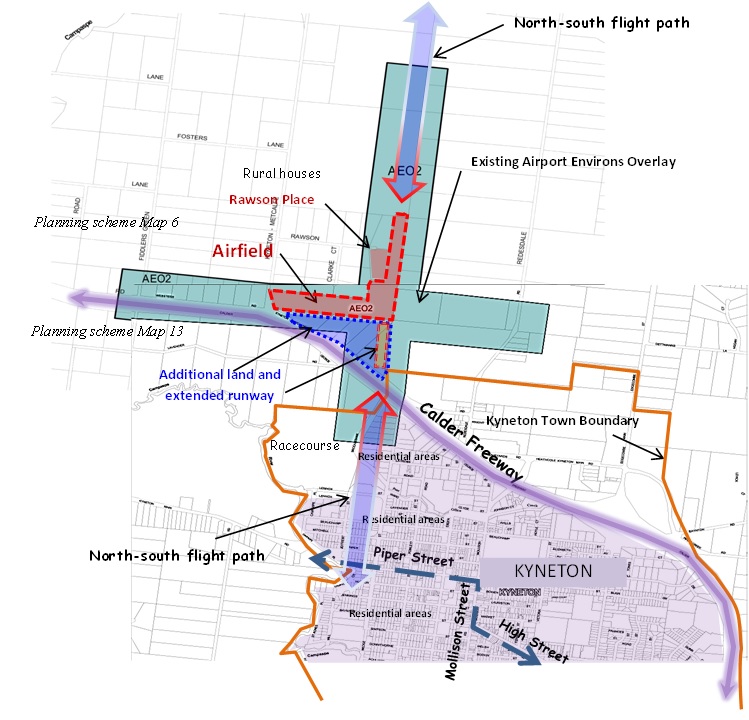
The Masterplan says operation of the site is revenue neutral and external funding is required for upgrades (page 19). Sounds familiar. Not surprising either, if 2012 financial arrangements are still in place. The June 2012 Council agenda said (page 145):
"At present the financial operations of the airfield are quite simple. The airfield pays rates which are retained by the Council for use in its normal operations.
The Council receives approximately $8,500 from the hanger site leases and these funds are returned to the Kyneton Aero Club, as a means of assisting with their operational costs."
Instead of introducing rent and increasing user charges so ratepayers aren't in essence subsidising airfield operations and private clubs/businesses, the Masterplan plays the card of needing to accommodate fixed wing fire-fighting water bombers - and then "by the way" pops in increased flight training, more commercial and recreational hangars (additional to the existing 34), commercial helicopter operations, "airfield-related" commercial development, accommodation for fly-in, fly-out pilots (read, hotel/motel), and an air museum, although the "master plan" is short on details of all of it, for example, what does "aviation business" and "commercial precinct" mean?
Fire-fighting helicopters are already able to and do use the airfield when required. The Masterplan notes at page 7 that the jet fuel they use is not available at the airfield except via portable tankers, but doesn't propose installing permanent facilities. And although the 300 metre runway extension southwards towards the town is said to be needed to allow some fixed-wing water-bombers to land safely, the Masterplan itself states at page 17 that correction: a Piper PA-31-350 Navajo Chieftain the two larger water-bombers concerned could be used "if the north-south runway were extended by a further 65 metres".
Current flight operations, increased since 2014, are already driving people mad, and additional aircraft noise isn't limited to the immediate airfield environs. This major existing nuisance is turning Kyneton into the town you DON'T want to live in. With this Masterplan, it's set to get much, much worse. There are approximately 10,000 existing annual aircraft movements (take-offs and landings) and the Aero Club estimates there will be sufficient future demand for up to 30,000 annual movements (page 15)
The Masterplan claims expansion of the airfield and its commercialisation provides principally for broader community benefit i.e. water-bombers (page 22). However as the Masterplan states (page 2) that the airfield is used for recreational flying and flight training provided by the Kyneton Areo Club's flight school with only "occasional aerial fire-fighting activities undertaken by contractors on behalf of the CFA", any broader community benefits are immediately offset by comprehensive year-long community disbenefits, and that's before considering the imbalance of substantial existing and future benefits to private enterprise from cheap use of public land.
The Masterplan says these proposals also benefit adjoining landowners by allowing planes to be at greater height when flying over private properties (page 22), a statement which breath-takingly - again - overlooks the fact that extending the runway south to within 300 metres of town residential areas, heightens the impact on those town areas.
Council ties this clunker of a fantasy economics package together by proposing to rezone the airfield and its surrounds to... yet another Special Use Zone. Council also promises a "review" of the Design and Development and Airport Environs Overlays currently applied to the airfield, which, in Council's time-honoured practice, is likely to result in far fewer requirements for applicants/operators than now. Council will also "review" governance and operational matters for the airfield, but only after adopting the Masterplan (page 2).
Overall, the Masterplan is dishonest, ambiguous, incomplete and disingenuous - in other words, up to Council's usual standard. It ignores the residential development (including the town) already detrimentally impacted by current airfield operations - while planning for a three-fold increase in those impacts - as if they aren't an issue. The document, like Council's equally-deranged Tourism, Equine and Agribusiness Strategies, is blind to adverse impacts on others, and the environment. It promotes economic development and private interests over the community's interests, and on land owned by ratepayers. As shown during a 'consultation' in 2012, most of those who supported the airfield and its expansion live outside the Shire, leaving locals to live with the effects of their activities. Local concerns aren't taken seriously.
There are strong liability overtones for Council - and ratepayers - in expanding the airfield's operations in its current location, not only in terms of additional pollution over the town itself, but considering the extent of population in close proximity, an air crash at or around this uncontrolled airfield could have catastrophic consequences. The airfield has now outgrown its current location. Either its operations are curtailed and wound back to pre-2014 levels, or plans to relocate the airfield must start now, and with urgency.
COMMUNITY ACTION REQUIRED:
Put in a submission to Council objecting to the Masterplan by 5 June. Improvements to the airfield to improve fire-fighting capabilities, if considered necessary, can be achieved through much smaller scale changes, then increase rental and user charges so ratepayers benefit from existing airfield operations. Find out more about making a submission by going to http://www.mrsc.vic.gov.au/Council_the_Region/News_Media/Latest_News/Draft_Kyneton_Airfield_Master_Plan See Update at "MRRA Says" below.
In addition, send an email to the Minister for Planning richard.wynne@parliament.vic.gov.au asking that he not agree to any new planning scheme amendments from this Council, including implementing the Kyneton Airfield Masterplan. There must be no more changes to the Macedon Ranges planning scheme until legislation, policy and controls to protect Macedon Ranges are in place. Copy the email to Mary-Anne Thomas, MLA for Macedon mary-anne.thomas@parliament.vic.gov.au
MRRA Says:
UPDATE (29/5/16) Since posting this item, it has been learnt that estimated costs to Council for capital works and potential purchase of land could be up to $595,000 ($375,000 without land purchase). It is also emerging that while extending the runway may create capacity for a fixed wing (retardant/suppressant) fire bomber to land at Kyneton, there doesn't seem to be any official plan to use these planes at Kyneton airfield. A longer runway would enable larger planes related to commercial and recreational activities to land. If fixed wing bombers (single engine air tankers - "SEATs") aren't used or based at Kyneton, changes at the airfield would be a community cost benefiting commercial and recreational activities, without a community benefit.
According to the Kyneton Airfield Economic Opportunities Analysis (August 2014 - adopted by Council September 2014), governance arrangements for the airfield were recommended to be changed to a "most prudent" and more accountable Council-management plus Advisory Committee model, with a review of airfield governance to be undertaken in late 2014 / early 2015, and implemented by June 2015 (Council's service agreement with the Aero Club is identified as expiring in March, 2015). The Analysis also recommends preparation of an Air Operational Management Plan concurrently with preparation of the Masterplan. Council is instead addressing the Air Operational Management Plan after exhibition of the Masterplan (i.e. the Operational Plan has not been exhibited).
This looks like another of Council's poorly thought-through, poorly executed, single-minded economic development projects, with insufficient/incomplete information, and a notable absence of credible justification for making any change at the airfield. The Masterplan not only fails to address existing amenity problems created by airfield operations (and noted in the Economic Opportunities Analysis), it fails to even identify the close proximity of the airfield to the town proper and that with an extended runway, separation would be only 300m. Consequently, the town's residents are expected to continue to sacrifice residential amenity and subsidise changes that primarily benefit private commercial and recreational interests. Say 'NO' to this Masterplan.
UPDATE MACEDON RANGES PROTECTION 'ISSUES PAPER' Protection File
(10/3/16 - SP) Seems submissions on the Issues Paper for protection can only be made on-line so here's the link. Also seems there may be a few errors in the Issues Paper - if you find any please make a note of them in your submission.
MRRA Says:
There are already 5 amendments with panel hearings on the go. Soooo - what does Macedon Ranges council do? It puts another panel hearing (C110) right in the middle of them. The start date for the C110 full panel hearing (18 April) is in fact the same day as the last day of the hearings for the Kyneton Structure Plan. Then, along comes the Macedon Ranges Protection Advisory Committee (i.e. the big one), and C110 is now in the middle of all of this as well. Indecent haste, indeed. The other thing is, Council doesn't think there will be many people who want to appear before the C110 Panel, and has scheduled only a 4 - 5 day hearing. Council's presentation will take up at least one of those days.
Macedon Ranges Needs You! Here It Is - The Issues Paper For Protecting Macedon Ranges - Submissions Close 15 April
(9/3/16 - SP) This is the "big" one, and your chance to say "put Statement of Planning Policy No. 8 across the whole shire." And you'll need to say it, because Council is pressuring for its ghastly Localised Planning Statement (aka investment prospectus) and - hello? - it's in this Issues Paper as competition against SPP8. Which leaves us to ask, "what happened to legislation based on SPP8"?
The Issues Paper is quite long, inviting you to answer specific questions, and you can also make other comments as well. Absolutely critical that you do make a submission, though.
You will learn a lot from reading it before you begin to make comments, so please do take the time to get your head around it before picking up your pen! Any questions? Contact Elissa Bell from Planning Panels Victoria on (03) 9223 5317 or planning.panels@delwp.vic.gov.au. Click on the link below to go to the Department's website for information and get a copy of the Issues Paper, or click here for a copy. Submissions close 15 April, and a formal hearing is scheduled to start on 2nd May.
MRRA Says:
It's great to the Issues Paper out, but what a disappointment that the government has given that ghastly Localised Planning Statement such a prominent position - the promise was 'legislation based on Statement of Planning Policy No. 8', so what's going on? Get on it - with the ghastly LPS in here, there's a risk Council is hijacking protection - again. Tell your friends and groups they need to read the Issues Papers and make submissions.
CURRENT Macedon Ranges Protection Advisory Committee Members: Names and /strong>
(20/1/16 - SP) Committee make-up has a strong environmental flavour Protection File
The four members of the Macedon Ranges Protection Advisory Committee are now available (apparently on the Department of Environment, Land, Water and Planning's website but that website isn't (hasn't been) working recently).
The Advisory Committee membership is:
Brett Davis (Chair)
Sarah Carlisle
Mandy Elliott
Lisa Kendal
Click here for the full bio sheet.
CURRENT Macedon Ranges Protection Advisory Committee Members: Names and Bio
(20/1/16 - SP) Committee make-up has a strong environmental flavour Protection File
The four members of the Macedon Ranges Protection Advisory Committee are now available (apparently on the Department of Environment, Land, Water and Planning's website but that website isn't (hasn't been) working recently).
The Advisory Committee membership is:
Brett Davis (Chair)
Sarah Carlisle
Mandy Elliott
Lisa Kendal
Click here for the full bio sheet.
CURRENT Terms of Reference for Macedon Ranges Protection Advisory Panel Released
(8/1/16 - SP) Another welcome step towards protection, but where is the government's priority for Statement of Planning Policy No. 8 to be the basis for legislation?
MRRA hasn't yet been able to find a media release from the Minister for Planning announcing the Terms of Reference, or who the Advisory Committee members will be, but local Macedon MP Mary-Anne Thomas has made an announcement about the Terms of Reference on her Facebook page. MRRA received a copy of the Terms of Reference on 6 January from Mary-Anne’s office on 6 January. Download a copy from here Macedon Ranges Protection Advisory Committee Terms of Reference
The Macedon Ranges Protection Advisory Committee reports directly to the Minister, and its role is to identify what needs to be protected, from what, and how that protection will be delivered through both legislation and planning controls, and to make recommendations to the State government by July, 2016.
The Terms of Reference require the Committee to first research issues considering various documents and matters, and to prepare and exhibit an Issues Paper for public submissions. The Committee will then hold public hearings to hear from submitters. The Terms of Reference identify MRRA as one of the organisations the Committee specifically should consult.
MRRA Says:
Approval of the Terms of Reference and appointment of the Macedon Ranges Protection Advisory Committee is a major and welcome step in the protection-for-Macedon-Ranges process.
The Terms of Reference seem quite comprehensive, and have a strong focus on protection issues. The Committee's purposes include providing "advice to the Minister for Planning on an appropriate policy to support changes to the legislative framework to achieve protection for the Macedon Ranges and its unique natural attributes, high environmental values and distinctive rural character and townships".
All excellent, except... we thought the "appropriate policy" would be Statement of Planning Policy No. 8, because it is in effect the basis for this legislation process. As it was formerly State policy, is currently in the existing Macedon Ranges planning scheme, has been the basis for strategic planning here for 40 years, and continues to be recognised in policy, strategies and by planning panels, it must be the over-arching policy in the Advisory Committee's Terms of Reference.
Instead Statement of Planning Policy No. 8 is one of the documents the Committee must consider, but so too are Council's damaging draft 2014 Localised Planning Statement, and the 2014 Loddon Mallee South Regional Growth Plan - the growth plan developed without community consultation which says Macedon Ranges, with Bendigo, will take most of the future growth for the entire Loddon Mallee region. This appears to be a mistake – it’s the the tail wagging the dog! The policies in these other documents are what Macedon Ranges needs to be protected from.
MRRA has alerted Mary-Anne Thomas to our concerns, and has asked the Minister to explain why Statement of Planning Policy No. 8's status as the basis for legislation has been overlooked in the Terms of Reference. Meantime, we will assume SPP8 has over-arching priority for the upcoming Advisory Committee inquiry.
CURRENT Woodend Residents Win VCAT Case Against Coles Express Petrol Station
(24/12/15 - P) VCAT says 'no, no, no, not like that Mr. Coles Express' - how sweet it is Petrol Station file
As news broke last Tuesday (22/12/15) that Coles Express' appeal against Macedon Ranges Council's refusal of its application for a petrol station had been upheld at VCAT, Woodend (and other) residents rejoiced. Coles Express proposed to put the petrol station on a pyramid-shaped, steep, small piece of land, currently occupied by an old house, pedestrian accesses between High Street and the Woodend station, and a lot of mature exotic trees. To accommodate the petrol station, Coles Express ended up with a 4 metres high concrete wall facing the station access road. Despite being proposed to be painted an array of green colours, and with climbing plants, VCAT found all were unacceptable, including the fact that there wasn't even enough room to plant climbers on the site and they would be on someone else's land. A metre high fence proposed on top of the concrete wall only added to the problem. The way the petrol station interacted with High Street and the remaining median strip was also criticized, and overall, the proposal was considered not appropriate in a key gateway location. VCAT said these and other findings on urban design were sufficient to make a determination that a permit be refused, without visiting other issues including traffic. Read the VCAT decision.
MRRA Says:
Brilliant. What people were saying all along, but still totally brilliant. Congratulations to Settle Woodend, and all who supported them and helped with the substantial funding needed.
CURRENT Council Meeting On 16 December Didn't Disappoint - So, So, So Many Reasons To Sack And Investigate A Council
( 22/12/15 - C) What a farce our "local government" has become. Why are Macedon Ranges' residents still waiting for someone to take action?
This is a long report. Please go to either 16/12/25 Council Meeting Report Council & Councillor Performances File
CURRENT Reminder: Council's C110 Rural Living Land-Grab Amendment Submissions Close December 23
( 13/12/15 - P) Amendment C110 - the disgrace Macedon Ranges Shire Council calls planning. Just a couple of lines from you objecting to and asking for C110 to be abandoned will do. Rural Living file
Submissions on this amendment are due two days before Christmas. To make a submission, send an email to mrsc@mrsc.vic.gov.au, with Amendment C110 in the subject line, objecting to the rezoning of farming land, much smaller lot sizes, removing subdivision restrictions from already subdivided land, and the damage to landscapes these greedy C110 changes will produce. Copy your submission to the Minister for Planning, and Macedon MLA Mary-Anne Thomas (see letter below for email details).
Macedon Ranges Shire Council website: \http://www.mrsc.vic.gov.au/Planning_Building/Planning_for_Our_Future/Planning_Scheme_Amendments/Amendment_C110
MRRA Says:
At the Community Forum on protecting Macedon Ranges in Gisborne on 18/11/15, Ms. Sophie Segafredo (Council's Director of Planning) advised, in response to complaints people hadn't been notified about Amendment C110, that Council had sent out over 2,000 letters. Seeing how there were over 14,000 households in the Shire in 2011, 2,000 letters doesn't seem enough to be able to say Council has "consulted" - at least, not consulted "the community", just some in the community. Were you one of the lucky ones, or just one of the rest of us Council didn't want to know about C110?
The more you read, the worse it gets. Not only is Council reducing existing 40ha and 8ha subdivision sizes to 4ha and 2ha, many new houses won't have to get a planning permit. Wait... Council is also applying Development Plan Overlays across HUGE areas of the rural land it is allowing to be subdivided, and that Overlay takes away your rights to be notified, object to or appeal at VCAT against permit applications for any houses that might still need a permit, or commercial, tourism and other development. Yessirree, Council's plan is to not only carve up rural areas because that's what some real estate agents and some greedy landowners want, and chop up the land into blocks with room for a pony because that's what Council's irrational Equine Strategy says, the Shire is also being carved up so commercial and tourism development can flourish without accountability through a normal planning process, courtesy of the Development Plan Overlay.
The last-minute inclusion of Farming Zone rezoning at Kyneton and slashing subdivision sizes at Romsey (both reduced from 40ha to 2ha) is being done without community consultation or strategic assessment, and heightens perceptions that C110 is definitely not about what you know, but who you know.
Here's a letter MRRA sent to local papers this week about C110 asking residents to make a submission (copy to the Minister for Planning and Mary-Anne Thomas). Please do so.
Alert to Macedon Ranges’ residents:
Can you please object to Council’s “Rural Living” land-grab, Amendment C110? It’s wrong in so many ways.
Council is consulting and listening to some more than others.
Council is ignoring its adopted growth strategy. Amendment C110 puts an additional 1,000 people in the Shire.
Amendment C110 intensifies existing, and creates new, housing opportunities in rural areas by dramatically lowering existing subdivision sizes, removing existing restrictions on subdivision of already subdivided land, and rezoning farming land.
Council wants this new unsewered housing development in the sensitive rural landscapes at the Shire’s southern gateways, from south of Gisborne to Riddells Creek; on high quality agricultural soils at Romsey, and in a drinking water catchment at Kyneton.
This type of development has long been identified as a threat to Macedon Ranges’ values. It depletes agricultural potential, creates land use conflicts and additional demand for infrastructure and services in rural areas, and irreparably damages the environment and landscapes this Shire relies on for tourism. It’s the complete opposite of “protecting” Macedon Ranges – it’s what Macedon Ranges needs to be protected from.
It’s almost Christmas and Council is counting on you being too busy to notice or object. Prove them wrong by putting in a short submission by 23 December (mrsc@mrsc.vic,gov.au) telling Council to abandon Amendment C110, copy to the Minister for Planning (richard.wynne@parliament.vic.gov.au), and Macedon MLA Mary-Anne Thomas (mary-anne.thomas@parliament.vic.gov.au).
Some Outrageous Moves At Council Meeting 16 December Woodend: ALERT TO ALL RESIDENTS - It's A Full Agenda. And We Do Mean "Agenda".
(13/12/15 - C) Structure Plan amendments, yet another new amendment (C109), Daly Nature Reserve, a massive subdivision proposal in Kyneton, Hanging Rock Environment Mgt Plan... Council & Councillor Performances File
At next Wednesday's Council meeting, the last for 2015, there's almost something for everyone:
Be at the Council meeting next Wednesday at the Norma Richardson Hall, 15 Buckland Street Woodend (behind St Mary's Anglican Church, near the primary school), 7.00pm.
MRRA Says:
We know Council hasn't responded properly to our submission on C99 at Kyneton, because part of Council's response is talking about the Riddells Creek amendment, C100. Plenty remains wrong with both of these amendments, but Council doesn't want to know about it.
Council has at least admitted population figures at Riddell and Kyneton were manipulated/manufactured, but it still hasn't reinstated policy that Kyneton is a District Town now, growing to a Large District Town in 2036 (that will be because Council wants Kyneton to be much, much, much more than a piddly old Large District Town...)
MAJOR ALERT FOR KYNETON RESIDENTS - Council Meeting 16 December In Woodend
( 13/12/15 - P) Development Plan cooked up by Council and the Developer (no community consultation) up for approval: 341 lots, from 200 m2, south of Campaspe River Kyneton Subdivision File
This ghastly proposal - which couldn't be more "not Kyneton" - is the product of arrangements between Council and the developer, and it shows.
Hundreds of tiny lots (more than 600m2 is rare, and top size (1 lot) is 800 m2). It's over-development epitomised, and would be even in metro Melbourne. First the former hospital site (maximum development), and the former pool site (maximum development) and now THIS. 200 square metre lots? 200 SQUARE METRE LOTS??
It explains plenty, though. In Amendment C99, Council did not change the zone for this land or add any additional planning controls to protect character. Quite the opposite. In Amendment C99, Council is rolling back the requirements of the existing Development Plan Overlay schedule on this land by replacing it with a shrunken Development Plan Overlay schedule, deleting things like high standards and replacing them with soft options and private arrangements for development contributions. In Amendment C99, Council also declined to apply the Significant Landscape Overlay south of the Campaspe River recommended in the Structure Plan, and instead of applying the Development Contributions Plan Overlay it prepared for Amendment C99 to fund a variety of infrastructure projects around the town, C99 instead focuses only on building a bridge over the river Campaspe, now to be partly paid for by this development ($5,000 per lot = $1.7 million - who is paying for the rest, we ask?).
Another dodgy aspect of this Development Plan is, once it is approved by Council, no-one in the community will have any rights to be notified of, object to or appeal at VCAT against any planning permit applications for this development. An approved Development Plan extinguishes all community rights. And Council knew that all along.
MRRA Says:
What a dirty, dirty trail of secrecy, deception and advantage. There's a word for what this Council is doing, and we as a community need to start singing it from the rooftops until someone who can or will do something about it starts listening to us.
It is crystal clear Council couldn't care less about character. All it's interested in is development and growth, which plays out in a rolling series of deceptions and lies to the community and favours for mates. As someone on MRRA's Facebook page said, "Is Kyneton the new Sunbury?". No, not just Kyneton. This Council wants the whole Shire to be the new Sunbury. It's community doesn't, but Council cares about community about as much as it cares about protecting character.
Be at the Council meeting next Wednesday at the Norma Richardson Hall, 15 Buckland Street Woodend (behind St Mary's Anglican Church, near the primary school), 7.00pm.
CURRENT 'Protecting Macedon Ranges' Community Forum, Gisborne: Minister For Planning Impresses With Strong Commitment To Protect
(24/11/15 - SP) Expert Panel to be appointed, community to have its say about legislation, what it values, and protection Protection 2015 file
Last Wednesday's Community Forum in Gisborne attracted around 120 people. The Minister for Planning, Richard Wynne, and Mary-Anne Thomas, MLA for Macedon attended. Four local community panelists presented their views and hopes for protection (Rebecca Stockfield, Barry Mann, Christine Pruneau and Krista Patterson-Majoor). Sophie Segafredo represented Macedon Ranges Council.
The Minister for Planning, Richard Wynne, advised the forum that the State government is now starting the process to protect Macedon Ranges with legislation, and it wasn't a matter of if, but how, protection would be delivered. The Minister is now setting up Terms of Reference and an Expert Panel (expected to be completed by the end of December). The Panel will begin public hearings starting around the end of January - at a venue in the Shire - to allow the community to have its say about what it values and wants protected. The Expert Panel will report to the Minister.
The Minister, and his commitments and comments - confirmed by local MP Mary-Anne Thomas - were all well received. All questions were directed to the Minister or Sophie Segafredo, including several questions about suspending current Structure Plan and particularly the C110 Rural Living amendments, pending the outcome of the government's Expert Panel process, with another asking if the economic beneficiaries would be analysed. See the Minister's media release. See MRRA Secretary Christine Pruneau's speech.
MRRA Says:
After years of community being ignored and belittled by Council, what a breath of fresh air it was having the Minister (no less) listening to and interested in what the community has to say. A most unusual and exciting experience - people are still pinching themselves. The forum was a resounding success, and our thanks to the Minister and Mary-Anne Thomas for organising it. It was great to see the Minister in Gisborne, and to get such a resounding and direct commitment from, er, 'the horse's mouth', so to speak.
Community speakers gave some poignant local context and insights into issues and values and shared, with the community audience, a priority and passion for protecting the environment. On the other hand, Council's claims of extensive consultation, good planning and priority for protecting environment were not well received. The step-too-far for Council may have been claiming the Localised Planning Statement [LPS] it prepared in 2014 protects Macedon Ranges, 'too far' because this damaging document was the catalyst for the State government's commitment to properly protect Macedon Ranges with legislation. A poor choice for claiming environmental credibility, indeed.
MRRA supports requests made from the audience for current planning scheme amendments to be suspended pending completion of protection processes. There are seven current amendments. It is imperative these be assessed against protection for Macedon Ranges, and especially the rural living Amendment C110, which proposes changes that are completely opposite to the previous Rural Living Strategy adopted by Council in September 2008, various Panel recommendations, Statement of Planning Policy No. 8, and the government's intentions to protect Macedon Ranges. No wonder Council is in such a rush with it. MRRA will be asking the Minister to suspend this amendment, and we urge everyone else to as well.
This is a once-in-lifetime opportunity for the community to promote dramatic change in what happens here, and protect the Shire's environment. As MRRA said in its '14 Points' speech: "Our Council is going in a different direction, so it is up to this community to encourage and support the State government to make strong protection happen, ASAP." Get on board, be part of making it right. This is the most important decision in Macedon Ranges in 40 years. Please be involved, and make sure you have your say.
In closing, our thanks and congratulations to Secretary Christine Pruneau, and our members, for their magnificent contributions to the Forum.
CURRENT Graham Hackett Is Macedon Ranges Shire's 2016 Mayor
(24/11/15 - C) John Connor is Deputy Mayor. John Letchford is bereft.
Having the previous week had a stalking charge against him withdrawn by police in Kyneton Magistrate's court, and a misuse of a mobile phone charge dismissed, Graham Hackett last Wednesday replaced Jennifer Anderson as the Shire's Mayor. Cr. Hackett aced out Cr. John Letchford who, the week before, was quoted in the Star Weekly as apparently assuming he would win.
MRRA Says:
Ahhh... the vagaries of politics, and loyalties and... choice. We hear those who supported Cr. Letchford (he and Crs Jukes, McLaughlin and Ellis) are not well pleased at the outcome. Our guess is there will be pay-back aplenty in the Council chamber next year, given the past performances of some and disappointment with the Mayoral election result. After a year of someone sensible and representative as Mayor, we fancy the community will soon notice some differences. Congratulations to Cr. Anderson who, under trying circumstances and without majority support, did make a positive difference. Her community-orientated and fair approach to being Mayor (and Councillor) will be a hard act to follow.
Only 343 days to go before we can get a new council, and a new CEO.
CURRENT Action Required Council's "From Outer-Space" Rural Living 'Strategy': Amendment C110 Is Now On Exhibition. Submissions Due 23 December
(24/11/15 - P) Will it go down as the worst example of 'planning' in Macedon Ranges Shire? In history? It should... It's self-interested madness. Make sure you get your objection in. Rural Living file
Documentation for Amendment C110 is now available from Council's website http://www.mrsc.vic.gov.au/Planning_Building/Planning_for_Our_Future/Planning_Scheme_Amendments/Amendment_C110 or by going to Planning Scheme Amendments Online. There are 29 amendment documents to download on Council's website, plus the infamous rural living 'strategy' (which by now must be a real estate agents' dream come true), as well as the 50mb Background document. And a "fact" sheet (not to be relied on).
Council is allowing just over 1 month for comments on C110, which proposes to turn existing Rural Living zones into semi-suburban areas through significant reductions in minimum lot sizes (40ha to 4ha, 8ha to 2ha), and by removing existing Section 173 (legal) agreements and Design and Development Overlay 13 (both of which prohibit further subdivision of already subdivided rural living zoned land), from Gisborne South to Riddells Creek. That is, the area that, until this Council, has been preserved for over 40 years as the rural buffer between the metropolitan boundary and Mt. Macedon.
If that wasn't enough, and it never is, Council is also doing an ad hoc rezoning of Rural Living Zone 1 (40ha) to 2ha in Romsey (NOT in the draft 'strategy', and Class 1 agricultural land), PLUS another 270ha in Kyneton is also popped into C110 (203ha Farming zone, 68ha Rural Living 5) to be rezoned to 2ha (even though Coliban Water has said it won't support rural living development in the Eppalock Special Water Supply Catchment, and the Kyneton Structure Plan said Kyneton has sufficient existing zoned land to last until 2036). Quite a financial windfall, for some.
Oh, and the Jacksons Creek escarpment (you know, all that undeveloped land you see along Jacksons Creek at Gisborne when you go over the big freeway bridge, coming from Melbourne?), Council has that down for 1ha subdivision, even though the Gisborne Outline Development Plan says it's to be left as it is. The heritage property, Gisborne Park near the Calder Freeway, is also to be subdivided.
Submissions can be made to Council's inappropriately named Strategic Planning and Environment department, Macedon Ranges Shire Council, PO Box 151, Kyneton VIC, 3444, or by email mrsc@mrsc.vic.gov.au.
MRRA Says:
What can you say about a piece of work like this!?! Has it got to 'it's plain old corruption' yet? Yes? No? If nothing else, this amendment puts the way this Council operates, and everything this Council really stands for - a Council doing whatever it or its mates want - right in the spotlight. C110 is about as far away from the concept of planning as you can get. There is nothing honest that justifies this amendment, and it won't stop houses being built in rural areas, it will just put a whole lot more (some say 1,000) UNSEWERED houses in what used to be rural areas, as well as on-going houses in rural areas. All this extra growth wasn't in the Macedon Ranges Settlement Strategy, either - it's all additional and unplanned. Breath-taking in its audacity, it will only be the beginning. The rest of the Farming and Rural Conservation zones will be on Council's radar. High growth, greed, land speculation. It will irreversibly damage Macedon Ranges, and tourists to the Shire will be greeted by hundreds of acres of houses, with (a la Hyacinth Bucket) room for a pony. It's what you get when you rezone all of this land because that's what real estate agents, and your Equine Strategy, say should be done. Council's headlong rush to get it all done before State level protection is introduced is sickening, but typical of the way this Council operates.
BTW, did you know Macedon Ranges Council adopted a Rural Living Strategy in 2008? That Strategy recognised the damaging impact of rural living development, confined it, and back-zoned some rural living zones to farming zone. This Strategy never saw the light of day after Council adopted it, but its adoption date does tell us when the rot started in the back rooms at Council.
Make a submission, and make sure you say 'no'.
CURRENT Uh-oh... What's Going On With The Amendment C107 Commercial Rezoning In Woodend?
(2/11/15 - P) We don't know... but Council's strange behaviour certainly raises eyebrows and questions Woodend Structure Plan File
At last Wednesday's Council meeting, Amendment C107 was on the agenda at item PE2. The decision before Council was where the amendment went next. MRRA objected to this amendment, and is apparently the only objector.
Here's the background:
Council adopted the Woodend Structure Plan in October last year. That Structure Plan said "over the next 15 years" the town would need 1.1 ha of new commercial zoned land, and identified options that could be considered. The Plan also said apply a Design and Development Overlay to the town's commercial zone to ensure the town centre's character is protected in future development.
Council then prepared Amendment C98 to put everything in the Woodend Structure Plan into the Shire's planning scheme - everything, that is, except the commercial rezoning which Council instead transferred to a separate amendment (Amendment C107). The problem with this is that the Design and Development Overlay to be applied to this land isn't in Amendment C107 - it's in the main C98 amendment, which will take longer to get into the planning scheme.
MRRA objected to this arrangement because, as the commercial rezoning is proposed well in advance of Amendment C98, the new commercial land won't have the Design and Development Overlay needed to protect character until C98 is finally approved. MRRA asked for the Overlay to be included with Amendment C107, or for Amendment C107 to be transferred to the main C98 amendment, but Council hasn't done this.
Council is running 6 amendments related to town Structure Plans at the moment, and they are all going to the same planning panel hearing in February 2016 - except Amendment C107. Council has a separate panel hearing for C107 in January. MRRA met with a Council officer, and asked Council in writing to transfer Amendment C107 to the same panel hearing as the other five amendments.
Council claims it needs to 'accelerate' the commercial rezoning in Amendment C107 so it can refuse to extend an existing planning permit for units on part of the land. But as the commercial zone allows units, rezoning the land from residential to commercial doesn't give Council an advantage. The solution to Council's 'problem' remains the same as it is now: just say 'no' to another extension of the permit.
At last week's council meeting, the Mayor put forward a motion to move Amendment C107 to the same panel hearing as the other five amendments, but 7 of 9 Councillors voted that down before voting to forge ahead with a separate planning panel hearing for Amendment C107.
In the debate in Council chamber over this agenda item, Cr. Letchford apparently observed that the objection was 'typical MRRA', asked who in MRRA is a qualified planner, and accused MRRA of being a secret society, of not operating democratically, of being totally opposite to democracy, of being run by a dictator who doesn't consult, and of not having minutes. He apparently had some support from Cr. Jukes. MRRA was also blamed for causing Council to have to run a separate planning panel which, it was claimed, would cost ratepayers in the order of $10,000 - $20,000 - including expert legal and planning advice Council would need to pay for.
Quite apart from the obvious vote of no confidence in Council's planning staff this represents, there is no set fee for a planning panel - costs depend on the nature of the amendment. As a single issue amendment, C107 would likely take no more than a single day ($2,000 - $3,000?), and even those costs could have been avoided by simply sending Amendment C107 to the same panel hearing as the other five amendments. As Council has decided to run this commercial rezoning as a separate amendment, with a separate planning panel, any additional costs to ratepayers are Council's responsibility.
MRRA Says:
Some at Council seem to think MRRA operates the way Council does. Not so - that would require a significant reduction in MRRA's standards. We do have minutes, and we do take collective decisions and actions, but we are at a complete loss working out why a community group or anyone else in the community needs to have/be a qualified planner before Council will consider and respect their views.
With this latest example in a long history of personalised and often vitriolic attacks on various members of the community he disagrees with, Cr. Letchford has again demonstrated a deep misunderstanding of the role and responsibilities of a Councillor. If he cannot desist from these attacks, how can he be considered an appropriate person to be a Councillor?
As for Amendment C107, only Council knows the real reason process is being bypassed to fast-track this commercial rezoning ahead of the planning controls for it in Amendment C98.
CURRENT Final Rate Capping and Variation Framework Released by Essential Services Commission
(2/11/15 - C) It's a document that appears more strongly influenced by Councils than community Rates Capping File
At over 150 pages, this report is not light reading but it does seem thorough.
The first thing to understand is that the Framework isn't about stopping Councils from increasing rates, it's about capping (limiting) how much rates can be increased. The original thinking behind this was to encourage Councils to reassess their spending priorities (what they spend rates on). Hasn't gone down well with Councils, and as only two quotes from individuals (presumably community members) made it into the Framework report, it appears to overwhelmingly respond to Councils rather than community views.
Although the final proposed Framework does impose a rates cap, it also contains a variations process that allows Councils to 'permanently' vary (i.e. bypass) the rates cap for up to 4 years (which is a whole Council term), or 'temporarily' vary it (primarily for a single year). This means Councils can potentially avoid the rates cap altogether. Applications for variations are to be made to the Essential Services Commission, which will determine whether to accept or refuse a Council's application. There are standards about what a Council has to do to have a variation approved, including standards for consulting communities on rates cap variations - but none of these standards are mandatory.
You can access the final Framework document by going to the ESC's website http://www.esc.vic.gov.au/Home - Latest Publications.
MRRA Says:
All up, although on paper it imposes an additional layer of accountability and transparency for higher rate increases, the Framework doesn't seem to do a lot to encourage a rethink of spending priorities, and from a community perspective it's a fairly disappointing outcome. If this Framework is accepted/adopted by the State government, we will all just have to 'suck it and see' how it works in practice. Unfortunately, we already know how that usually goes in Macedon Ranges Shire, and we won't be holding our breath waiting for a responsible response - the ink's probably already dry on Council's first application for a variation.
CURRENT Coles Takes Woodend Petrol Station Refusal To VCAT
( 10/8/15 - P) Details sketchy, but anticipate some form of action needed in September Petrol Station file
After waiting two months since Macedon Ranges Council refused its application for a very awkward, very ugly petrol station next to the railway station in Woodend, Coles Express has lodged an appeal at VCAT. No further information is currently available. Although Council has apparently been given notice of the appeal, it appears Woodend residents that objected to the proposal have not yet been given notice. The latest is that objectors should receive notice by 12th August, and possibly a preliminary hearing at VCAT on 28th August.
CURRENT Council's Lighter-Than-Air Response To MRRA's Submission On The 2015/16 Draft Budget - And MRRA's Response
(13/7/15 - C) Mmmm. Does it seem a tad yuddah-yuddah and lacking specifics to you? Budget File MRSC response to MRRA MRRA response to MRSC
Macedon Ranges Council has sent MRRA (and apparently all other submitters) a response to our submission on the 2015/16 draft budget. In our submission we asked for some hefty information to be provided, including but not limited to:
Please provide a full five year accounting of Council’s borrowings, loan arrangements and commitments, repayments, how the Local Government Funding Vehicle loan correlates with previous/existing loans, and what liabilities this loan exposes the Shire to.
Please identify additional interest costs to ratepayers from borrowings used to repay debt.
Please provide a comprehensive explanation of inconsistencies in the scope, costs and funding for these projects (Gisborne Office Extension, Hanging Rock Infrastructure Development, and Kyneton Landfill Rehabilitation).
Please clarify if the various figures for total borrowings in the draft Budget are correct.
Please provide full justification and explanation of Non-Monetary Contributions income, for the years 2013/14 , 2014/15 and 2015/16, including identification of new roads and new subdivisions (and any other income sources) that have produced the "Contributions - Non Monetary" income in these respective budgets.
Please provide information for all 2014/15 and 2015/16 Hanging Rock income, including amounts, sources and what any of this money is being spent on.
Please also provide information about income and expenditure of the $250,000 annual State government funding for Hanging Rock.
Please identify all adopted Plans and Strategies the 2015/16 Budget's actions and spending are implementing.
Please provide full information on all transfers to and from Financial Reserves during the 2014/15 financial year, where additional funds come from and what those transferred from Reserves are spent on.
Why aren’t dollar amounts shown this year for Debt Commitment and Total Debt Ratios?
Please identify what dollar amounts were used to calculate Total Debt Ratio this year.
MRRA Says:
We received several pages of typing, but not the information we requested. Where to now, we ask ourselves...
CURRENT $14 Million Debt, Rates' Capping, A Deteriorating Financial Situation, A Potentially Bursting Housing Bubble - And Now, Targeted Consultation and A White Elephant Equine Centre
(23/6/15 - C) Lucky us - Macedon Ranges just about has it all. Feeling better off? Didn't think so, and the latest Community Satisfaction Survey results confirm this Council needs to get back to what the community expects it to do...
Only three Councillors put the community first at the 27 May council meeting. Six supported much narrower interests. Here's an overview from MRRA reps' notes of how the debate went about Council supporting the not-needed Equine Centre financial juggernaut.
In response to Cr. Anderson's questions, Macedon Ranges' economic development officer Kylie Lethbridge confirmed half the people who responded to Council's online survey were from outside the Shire (using postcode as the basis for assumptions). 95.6% were in favour. Estimated costs to Council for the Equine Centre so far are around $100,000, with another $100,000 - $150,000 cost to pursue the project.
Cr. Piper moved and Cr. Anderson seconded an amended motion, replacing officer recommendations for actions with recommendations for reports to be made back to Council before further spending - i.e. full financial costings of proceeding with the equine centre, including estimated officer time, any in-kind support, council costs to undertake a full risk assessment and subsequent further studies or business cases required.
Cr. Piper's motion also included that Council acknowledge that a full risk analysis including (but not limited to) risks such as environmental, situational, strategic, operational, financial and commercial, is required to assess council's risk appetite and whether a business case is viable. A further change in Cr. Piper's motion was that officers provide the above reports without spending any more Council money on the items/actions listed in the officer's recommendation.
Cr. Piper said she was not against equine but concerned as a councilllor about best practice - there is no risk analysis about Council's risk. The dollar spend isn't itemised. The Centre is not an essential service of council. Ratepayers are $14 million in debt. She wants to see in a report what liability this project is going to be on Council in future. Even though the Feasilibity Study says proposed arrangements are minimal risk to Council - Council has $14 million debt, and rate capping. She wants to know what is 'minimal risk', and couldn't support the equine centre without any details.
Cr. Jukes - against. The business case covers details. It's not a small project - State if not National significance. Jobs, additional support from State, tourism. Facility has a $9.9 million per annum economic impact. As for targeted consultation - it was well advertised and a lot of positive feedback. 91% thought it was a good way to go (forward-looking in Australia). Business - have done forecasts to cater for such a facility. Go back to State government, work with, get funding for. Environment issues - need a site, not determined yet, general area only identified. Those he spoke to, plenty of them out there willing to back it up.
Cr. Hackett - against. Public consultation resulted in 989 respondents to Council's survey. 36 didn't like it, 95.4% loved it. Re cost - equine activities are one of the highest spending - should not be neglected. $9 million annual economic impact, 300 jobs. Have to now put business plan. Have done the consultation.
Cr. Letchford - against. Said something about roads, rates and rubbish, and the Intergenerational Report, and if Council applied risk strategy to pools, we wouldn't have any. Advocating for 97% , if didn't move it forward would be advocating for 3%. This is creating wealth - have to be innovative and bring something forward.
Cr. Anderson - very high risk. The equine centre project isn't about horses or emotion. For council, it's about risk. There are too many risks. Not supported by the planning scheme or Amendment C84 (both say protect this area from development). Potential to lose other grants if State funds this. There are a lot financial assumptions, must have other things. Potentially taking money away from existing needs. Consultation was biased, 50% of respondents were from outside the Shire. Council advertised the Feasibility Study through REIN and Facebook to other horse-focussed sites, targeted the equine industry. In the end it's a centre without exclusive community use. Building cost is massive, not sustainable, consultation is compromised, if someone out there wants it go for it, but don't commit ratepayers to it.
Cr. Mowatt Not against it in principle, but where is due diligence? Enough is enough - this and Council's debt level - do risk assessment first then do business case and then to State government.
Cr. McLaughlin - Risk assessment - still need to do business case first before risk assessment. Will bring $9.9 million into local community, fantastic economic development opportunity.
Cr. Hackett - community consultation was thorough, ads in paper, not biased. $98,000 investment already, it's spot on, capitalise on the investment. Cr. Anderson: officer confirmed Council targeted horse industry Facebook sites and REIN.
Cr. Anderson - Have already given a thorough list of risks. Prefer risk analysis first - would hope that risk and budget implications would be at the top of the agenda, don't want huge risk, meet standards - that's our job.
Cr. Piper: The debate isn't about risk or costs, it's about making decisions - 101 decision making.
Cr. Piper's amended motion was put and lost. Cr. Anderson requested a division: For - Crs. Anderson, Mowatt, Piper. Against - Crs. Connor, Hackett, Jukes, Letchford, Ellis and McLaughlin.
Cr. McLaughlin then moved the officer's recommendation, with amendments. Cr. Anderson then moved (Cr. Piper seconded) a further amendment - that council requests the State government to provide all financial and other support and undertake the development of a full business case for the equine centre in the Macedon Ranges incorporating a community access model. Cr. Anderson said she wanted this put in because of concerns about the $38,000 already spent, how much more in costs? All ratepayers are affected.
Cr. Connor then moved, (Cr. Letchford seconded) a procedural motion, that Cr. Anderson's amendment be put (i.e. immediately). It was so put, and lost. Cr. Letchford requested a division: For - Crs Anderson, Mowatt, Piper. Against - Crs Connor, Letchford, Ellis, Hackett, McLaughlin, Jukes.
The meeting then returned to Cr. McLaughlin's amended motion. Cr. Letchford spoke to the motion and noted that the $38,000 Council has spent was only about $1 per ratepayer - gosh, you would think it would break the bank, and that less than 10 objections were received on environmental grounds. This is business moving forward, Council's ahead of the game. Stakeholders in the south of the Shire - haven't heard objections. Hume etc are looking for value adding.
Cr. McLaughlin finished by saying it was a great and important issue, do it step by step. Risk - budget and debt are not the result of one single decision.
The motion before Council (i.e. Cr. McLaughlin's motion with amendments, seconded by Cr. Letchford)) was then put and carried. Cr. Anderson requested a division: For - Crs Connor, Letchford, Ellis, Hackett, McLaughlin, Jukes. Against - Crs Anderson, Mowatt, Piper.
MRRA Says:
And now you have a fair idea of why the good ship "Macedon Ranges" is sinking. Only 3 of our 9 councillors consistently tried to do their job and put ratepayers' interests first. The rest?
There was a whiff of bullying when some of the chaps challenged Cr. Anderson saying she couldn't move an amendment, but the governance officer said she could.
As for the statistics of how many love this proposal, by the time the debate finished, it had started to sound like Pick A Number. On reflection, it reminded us of Council's budget in many ways...
The officer's report said 789 surveys were received, 741 people (95.2%) supported the pony equine centre, and 718 were involved in equine activities within the Macedon Ranges (Council had previously said 80% of respondents were "general residents" but apparently not). Interestingly, of the 12,810 people Council claims received Facebook notifications about the Feasibility Study (hmmm... don't recall MRRA getting one), only 622 (some 4.9%) clicked on posts to find out more. Council didn't say how many of the thousands notified, or how many of the hundreds clicking on posts, lived in Macedon Ranges.
The overall impression is that some of our councillors seem to see themselves as high flyers - you know, the types that get their thrills playing the stock market. Maybe that's why the huge risks around this dud equine centre seems so sexy, that and the fact that Council is playing it with someone else's money. Council would of course prefer to play with the State government's money, but we are hoping the State government is much, much smarter than Council seems to think it is.
While roads, rates and rubbish apparently aren't nearly as sexy as the pony venture, if more of our Councillors focussed on what a Council and Councillors are supposed to do, maybe Council wouldn't be looking down the barrel of Community Satisfaction Ratings like these:
only 52% community approval for Council's performance on consultation and engagement, and on community decisions;
only 51% approval for sealed roads;
only 50% approval for town planning policy and 48% for planning permits;
Rock-bottom was - you probably guessed already - maintenance of roads only 47% and roadside slashing only 46%.
That won't change while we have 6 of 9 Councillors prioritising economic empire-building instead of responsible governance, or while Council pours more and more of our budget into big pet projects like this useless, expensive, over-the-top equine centre while cutting back on what counts.
By the way, none of the councillors declared a conflict of interest in voting on this proposal.
Council's 2015/16 Budget: A Mountain of Debt and a Deteriorating Financial Position (25/5/15 - C) Make a submission before 11am on 29 May, and send copies to Mary-Anne Thomas, the Minister for Local Government, and Councillors. 2015/16 Budget
As they say in the States, "It's your money, Ralph". This time, it's YOUR money and Council is spending and borrowing lots of it. Too much in fact to be sustainable. Then we get to what Council is spending it on... See MRRA's report. Make a submission.
(27/4/15 - SP) Minister says he can't say it any clearer: Labor will legislate to protect this iconic and historic region. We will use Statement of Planning Policy No. 8 as the basis for legislative protection. That's what the government said it would do, and that's what it will do.
On Tuesday 21 April, four MRRA representatives and Macedon MLA Mary-Anne Thomas met with Minister for Planning, Richard Wynne.
MRRA requested a meeting with the Minister early last December, shortly after the State election. Unfortunately, the Minister fell ill, and the delay pending his recovery sees planning now running 3 months behind.
Issues raised with the Minister included:
The Minister asked us to tell him about our Council, so we did. Council’s inconsistent planning decisions about houses on rural land, the importance of protecting drinking water catchments, and the recent Macedon VCAT decision were raised, along with concerns about various policy changes Council is pursuing.
In response to our question - when would the process to produce legislation begin - the Minister said it had not started as yet and he couldn’t give us dates at this stage.
He did however confirm several times that the government's commitment and intent was strong. Its election policy for Macedon Ranges will be delivered, and he couldn’t say it any clearer – the government will legislate to protect Macedon Ranges, and Statement of Planning Policy No. 8 will be the basis for that legislation.
MRRA Says:
Although we and many others in the Macedon Ranges' community would have liked to hear that the process to protect was about to roll out, we take on board both the Minister's commitment to deliver legislation, and that planning programs are presently delayed. Having now ‘gone to the top’, at this stage there isn’t a lot more to be done other than accept, wait, watch, and remind.
The Association thanks the Minister, his staff, and the Departmental people involved. We also thank Mary-Anne Thomas for her support.
CURRENT Council Set To Launch 2015/16 Budget, Council Plan and Strategic Resource Plan - and another almost 5% rate rise
(28/4/15 - C) Special Council Meeting tomorrow night (29/4/15) 7.00pm, Gisborne Shire Offices to endorse exhibition of budget documents Budget File
With the State government introducing rates' capping next year, strong concerns are held that Councils may try to 'stock up' on rates' income this year, before rate capping begins. See the article in today's Herald Sun at
The State government has said it wants Councils to refocus on spending money on what a Council is supposed to spend money on (i.e. services and benefits to ratepayers) instead of 'empire-building', and from next year (2016/2017 Budget) Councils will need to keep rate rises to the level of inflation (currently +1.2%).
In this year's (2015/2016) Budget, Macedon Ranges Council proposes to lift the rate (the 'cents in the dollar' amount it applies to the value of your property to calculate how much you pay) by around 4.85%, in order to collect an additional $2.6 million (total $41.9 million) over what it collected last year.
MRRA Says:
The Budget, the rate increase, the Council Plan, and the Strategic Resource Plan all warrant fairly close scrutiny. You will have about a month to get your head around them.
This is your chance to check out which 'empire-building' projects our Council proposes to waste our rates on next year (recent examples of profligate spending include the Hanging Rock over-development, the Equine 'Everything' Centre, and Gisborne Shire Office 'renovations'). Be on guard for money Council proposes to borrow, as well.
Draft Budget documents are available as attachments to tomorrow night's Special Council Meeting agenda (be aware that these may be changed before adoption by Council) from Council's website at http://www.mrsc.vic.gov.au/Council_the_Region/About_Council/Meeting_dates_Agendas_Minutes/Meeting_Agendas_Minutes/29_April_2015?doc=agenda or you can wait until Council formally exhibits the adopted draft Budget documents.
Either way, you are entitled to disagree with the rate and charges Council has come up with, what it is spending our money on, and what it is borrowing money for, and to ask Council to make changes (not that Council has shown any great propensity to listen to ratepayer objections).
Oh, and tucked away at the back of the Budget (in the Appendices) are Council's 'an-arm-and-a-leg' Fees and Charges, which is what Council charges you to use your assets and obtain Council services. No publicity about these of course (not even m entioned), and no comparison with current fees and charges, but a good income augmenter for Council.
CURRENT "Alternative Futures For Melbourne's Peri-Urban Region" Project Launched: A Proposal To Restrict Loss Of Rural Land To Rural Living
(28/4/15 - P) Go back to prescriptive planning and tenement controls to protect rural land Peri Urban file
The recently-launched "Alternative Futures" report is now available. You can download a copy of it from http://www.periurbanfutures.com/ It has been produced by an RMIT-auspiced project team headed by Michael Buxton and Trevor Budge, with funding support from the previous (Bracks/Brumby) Labor government.
MRRA Says:
It's a large report, physically and conceptually, which tackles the need to make changes if rural (as opposed to rural living) land is to continue to exist. It introduces several scenarios for protection, including re-introduction of planning controls many areas had until the Kennett government introduced the Victoria Planning Provisions in the late 1990s. Macedon Ranges Shire is one of the areas this report addresses in detail.
The report finds that growth that would otherwise occur on rural land (i.e. small rural lots) can be accommodated in regional cities and towns. The good news for Macedon Ranges Shire is that its 2011 Settlement Strategy already does that - directs growth (until 2036) into our towns and sets a concurrent 'no-growth' scenario for the Shire's rural balance. Not that some Councillors seem to have read it, or care, as they ignorantly keep on approving houses in rural areas, precisely where this Council's own Settlement Strategy says they are not to be approved.
Proposed controls in the Alternative Futures report would - through planning controls - make it crystal clear what can, and what can't, be done, which would be a very welcome and urgently needed change from the current serendipity of whether individual decision-makers like an application on the day.
CURRENT Cr. Letchford's Response to MRRA's Equine Centre Submission
(13/4/15 - C) No obvious connection in the Councillor's harangue to the Local Government Act's Section 76BA (c) requirement for councillors to "treat all persons with respect and have due regard to the opinions, beliefs, rights and responsibilities of... other persons" Equine File
MRRA put in a submission to Council on the Equine Centre Feasibility Study, and copied it to all Councillors and MLA for Macedon, Mary-Anne Thomas. MRRA received polite acknowledgements of receipt of the submission from Crs. Mowatt, Piper and Anderson (these last two also confirmed they value community consultation and participation). In contrast, we received this response from Cr. John Letchford.
It's not the first time the Councillor has vented on MRRA (we hear others in the community have been similarly treated for voicing an opinion, particularly one that doesn't correspond with the Councillor's position). This type of harassment and bullying behaviour against members of the community - be it by email or in chamber - falls well outside State law governing Councillor behaviour.
Councillors are required to bring an open mind to decisions, otherwise they can be said to be conflicted, and can't vote. While his Councillor colleagues gave no indication of where they stood on this issue, Councillor Letchford's comments and defence of this proposal point to someone who has already made up his mind on this issue - he surely can't intend to claim he brings an 'open mind' to the matter when it comes before Council, can he?
Will Councillor Letchford act appropriately by forfeiting his vote on this proposal?
MRRA Says:
Back around 2005/2006, MRRA used have a record of events - called the Letchford Files - on this website. Some are now saying it's time to dust it all off and update it. Tell us what you think mrra.sec999@gmail.com
CURRENT Yay! Macedon Over-Development Rolled By VCAT
(13/4/15 - P) VCAT finds it difficult to understand Macedon Ranges' planning policy in Amendment C84 so sticks with the existing planning scheme to say 'no' to this truly awful, out-of-character over-development Macedon File
Residents in Macedon and elsewhere are very pleased with VCAT's decision that this awful development proposal, at 19 Victoria Street, just didn't cut it in Macedon. Previously refused by Council, VCAT Members Cindy Wilson and Ann Keddie found the application failed primarily (and rather dramatically) on character, intensity, context and bushfire grounds
See the full decision Macedon Property Developments P/L v Macedon Ranges SC [2015] VCAT 333 (26 March 2015) Below are some extracts and their location within the document:
paragraph 41 Macedon is a "special and distinctive rural settlement"
paragraph 43 "the spaciousness apparent in the residential areas of the town is reflected in the commercially zoned area."
paragraph 44 "its [the development's] intensity is more akin to what you might find in a suburban activity centre"
paragraph 50 "The extent of built form internally to the site we find excessive in a context where the site cover is low to moderate"
paragraph 52 "Unlike a metropolitan Melbourne setting we do not find imperatives in the Scheme to maximise opportunities for urban consolidation."
paragraph 55 "Bedroom 2 within dwellings 9-13 and 16 have no windows. Instead these six rooms are provided with an openable skylight. It is our view that the absence of outlook from these rooms will result in poor amenity for future residents and is unacceptable on a site with the advantages of a large size, corner location and in a small rural town setting."
paragraph 56 "We find the layout of dwelling 15, a small, one bedroom/studio apartment above retail space facing Margaret Street, poorly resolved. It contains a living room relying on borrowed light from a bedroom window located some 7 metres away, an outcome we think provides unacceptable amenity."
paragraph 57 "Eight other bedrooms are provided with highlight windows,... layout results in compromised access to daylight and outlook."
paragraph 67 "This [bushfire related] issue exemplifies the difficulties in ensuring a dense development can achieve landscaping that is an appropriate response to fire protection yet still contribute to the landscape character existing and sought for the area and adds another layer that contributes to our conclusion that the proposal is too intense for the site and context."
MRRA Says:
Bravo. This piece of sheer suburbia was begging to be knocked off. Perfect example of someone trying to suck every cent of profit out of this piece of land - and everyone and everything else be damned. Well done to the Macedon 'mob'. Enjoy it but also be on guard for a minutely changed set of 'amended' plans in a future application.
One more thing. VCAT's concerns with "mixed messages" in Amendment C84 reflect and confirm MRRA's long-held concerns about policy and policy changes in that amendment:
"We find mixed messages in the proposed planning policy relating to growth for Macedon. In the adopted MSS under Amendment C84, there is a specific reference to ‘no change’ in population for Macedon up to 2036 and an objective that seeks to minimise development due to the high fire risk. At the same time, there is also clear direction to provide for infill development within the township boundaries with specific reference to the review land as a key site." paragraph 20
Clear as mud.
CURRENT Macedon Ranges Council Initiates "Meet Mayor & Councillors" Nights
(16/3/15 - C) Read the fine print before getting too excited: it's one-off, at the four main towns only, and you need an appointment for up to 20 minutes one-on-one time with a Councillor. Meet Councillors File
Macedon Ranges Council is starting what it calls "Meet Your Mayor & Councillors" evenings. Not much information on Council's website but click here for what details are available.
MRRA Says:
Here we go, Council pretending it consults, when all this does is reconfirm Council only consults exclusively.
Hmm. Not quite the anyone-welcome, no-appointment-necessary, anyone-can-speak Ward Meetings held until 2008, is it... Oops, that would mean Councillors having to face the unwashed, being asked awkward questions in public without necessarily knowing the answers, and being a tad more transparent, accountable and electorate-friendly than now.
Wonder if the CEO and officers will be honorary "Councillors" for the purpose of being at these meet-and-greet nights?
Go along if you are keen, and if you can get in.
CURRENT Council's Less-Not-More-For-Community Consultation Framework Sails Through Council With Minor Change
(24/12/14 - C) Council will now re-think charging residents to obtain copies of documents it puts out for exhibition/comment Consultation File
At last Wednesday's Council meeting (17th) Council predictably adopted a Consultation Framework that makes it easier for Council to pick and choose who, how and if it consults. A summary of submissions received was not provided in either the officer's report to Council or its attachments.
MRRA Says:
The change, to rethink charging residents for copies of the documents they are to comment on, was timely. Someone in the gallery asked a question about this issue. Council had told them it would cost $46 for a copy of the Mt. Macedon Village Centre Study (produced by Council in A3 size) when that document was on exhibition.
It's a bit rough (is it consultation?) when residents have to pay (a lot) to see something they are supposedly invited to comment on, because it has been printed at a paper size most people can't print. And rude too, when you think of the thousands of dollars frittered away on pet projects with ephemeral if any benefits, like Council's sister city relationship with Tokai.
CURRENT Mt. Macedon Village Centre Study - Adoption Of Study And Subsequent Amendment Deferred Until More Work And Consultation Done
(24/12/14 - P) This time, unusually, 5 Councillors put a spoke in the Council's usual pattern of token consultation and speed-of-light preparation of a usually crappy planning scheme amendment Macedon/Mt Macedon File
All the officer's recommendation proposed was for Council to (a) adopt the study and (b) run an amendment. No mention of the Development Guidelines that were supposed to be prepared, or any detail of all controls proposed for the very large, and very icky, Special Use Zone some at Council apparently long for.
Those Councillors for noting (not adopting) the Study, and deferral to allow further work and consultation: Anderson (Mayor), Piper, Mowatt, Connor, Hackett. Those against: Letchford, Jukes, Ellis, McLaughlin.
MRRA Says:
Interesting vote. The deferral could be a first step in - potentially - doing something better than how things are traditionally done in Macedon Ranges. We live in hope. At least tourists won't be fried as soon as they might have been if the whole substandard package had been moved ahead last week. Well done to those Councillors who, for whatever reasons, supported further consultation. Doesn't solve the existing problems though: all those ad hoc (unlawful?) "events" going on at Mt. Macedon, and incessant and increasing music/crowd noise and traffic are making the Mount the place not to be for either tourists or residents. A pudding already over-egged...
CURRENT Uh--oh. A Resignation From Villawood
(24/12/14 - P) What's going on with Stuart Bonnington? Villawood File
The following public notice appeared in the 16/12/14 edition of the Midland Free Press (also the previous Friday's Guardian). Mr. Bonnington has carved out a reputation in Woodend as a person acting for Villawood. Now it seems the marriage between Villawood and Mr. Bonnington is over.
MRRA Says:
What's going on? We don't know! It all comes across as a very formal - if not legal - notice. Like the ones you used to see saying someone or another would no longer be responsible for debts incurred in their name. One story circulating is that Mr. Bonnington may be trying to make peace with the Woodend community because he wants to live there. Mmm. That would be too little, and far too late. Local scuttlebut has it that Mr. Bonnington has been a self-confessed agent for the Villawood developers. Finding anyone who has anything good to say about him would be akin to meeting someone giving away $1,000. Shall we say... RARE. Hopefully it signals the demise of Villawood (or Davies Hill Pty Ltd), which would be an extraordinarily excellent (and other superlatives) thing.
CURRENT Upper House Results From Recent Election Finally Available
(16/12/14 - SG) Bit of a surprise too 2014 State Election File
The Victorian Electoral Commission has finished counting for the Victorian Upper House. The one of interest to Macedon Ranges is the Northern Victoria Region. The results are as follows:
1 Liberal (Wendy Lovell)
1 National (Damian Drum)
2 ALP (Steven Herbert and Jaclyn Symes)
1 Shooters and Fishers Party (Daniel Young)
MRRA Says:
Congratulations to the winners. Daniel Young is a local resident of the Romsey area. MRRA didn't get a response from the Shooters and Fishers Party to its questions of where did parties and candidates stand on protecting Macedon Ranges, so we will be knocking on Mr. Young's door shortly.
Both Labor's Steven Herbert and Jaklyn Symes are new to the Upper House, and the Northern Victoria Region.
Another local resident, Amanda Millar (aka St. Amanda) who fought hard to stop Council's manic plans for Hanging Rock, did not get elected. Many have commented to MRRA that Ms Millar provided a level of Upper House representation not previously known, but greatly appreciated, in the local area. While welcoming Mr. Young and other new representatives, it does look like they will have big shoes to fill in terms of meeting the local community's expectations for local representation.
CURRENT Mary-Anne Thomas (ALP): New Member For Macedon
(16/12/14 - SG) Some surprises in results 2014 State Election File
You could say it's been all over bar the shouting because the result for the Lower House seat of Macedon was declared over a week ago. Nevertheless it represented a successful transition for Labor, from long-serving member Joanne Duncan to Mary-Anne. It's an election that saw the Greens Party do exceptionally well in the Macedon district, including winning the Taradale booth on (election day) primary votes (almost 30%) over both Liberal and Labor candidates. Strong Greens results were also seen in Daylesford, Hepburn, Malmsbury and Woodend, amongst others (well over 20% of primary vote). Liberal candidate Donna Petrovich won some 17 of 28 booths on primary vote, but only 11 of 28 booths after distribution of preferences. The final count saw Labor prevail with 53+% of the vote.
MRRA Says:
Welcome to Mary-Anne, and congratulations.
Now... let's work together to protect Macedon Ranges! And with such a ghastly Council like the one we have in Macedon Ranges, that protection can't come a moment too soon.
CURRENT Council's "In The Rural Living Zone". Well, It's Some Sort Of Zone But More Like One From Outer Space...
(16/12/14 - P) Psst...don't ever call it a strategy or even planning: greed, ignorance, misrepresentation and empire-building are closer to the mark (MRRA Submission) Rural Living File
Comments on Council's salivating plans for unsewered rural residential development as far as the eye can see closed last Friday. The good news is that it's soooo bad, so blatantly not strategic planning, it's unlikely to go anywhere. The bad news is ratepayers have bankrolled it - more waste of our money. See MRRA's submission
MRRA Says:
Your rates squandered, again. Utterly appalling planning standards, and we are paying for this rubbish. The mis-representation, twists and omissions in this open-ended endorsement for putting rural living everywhere verily take your breath away.
At what point does the cavalry arrive and stop this self-interested takeover of planning in Macedon Ranges? Is there any time at which way too much will be enough?
One for IBAC, we think.
P.S. Profound apologies - we earlier made the mistake of calling this document a Strategy (i.e. as in a strategic document). Now we realise it's just Council's wish-list report to Council.
CURRENT Woodend Estates. Woodend... What?! Is This A Retirement Village - Or Just A Whopping 300 Unit Residential Development Come Resort In A Rural Zone?
(10/11/14 - P) Brochure says "it will be like living on a cruise ship". Yep, that description pretty much nails living on this floodplain. Woodend Retirement Village
The recent "launch" of this development comes 7 years after it was approved by VCAT (after also being approved by Macedon Ranges Council in 2006), which means, luckily for the applicant, Council has obviously kept the permit 'alive' by extending it, of necessity several times. At the launch, a company representative apparently presented Mayor Jukes with a hamper of goodies in deep appreciation for the cups of coffee and assistance the Mayor had provided to get the development to fruition. Lucky Mayor, too.
The companies behind the development are Prestige Lifestyle Estates P/L and Woodend Estates P/L, which say "Woodend Estate will comprise 300 villas and apartments, recreational amenities, retail, food and beverage outlets and medical facilities", and "Once completed, Woodend Estate will include 205 independent living villas, more than 90 aged care apartments, a 10-bed specialist care facility, a network of walking tracks, BBQ areas, parklands and children’s play grounds."
Prestige Lifestyle Estates also says: "Uniquely, our Estates will be managed by experienced members of the Hospitality industry, including entertainment and travel managers, providing a rewarding lifestyle for over 55s and their families.", while the Prestige Lifestyle Estate's vision includes "creating superior quality resorts throughout Australia for the middle to upper income market."
Stage 1 apparently consists only of "luxury 2 & 3 bedroom villas" (newspaper ads); "The luxury villas and exclusive activities Pavilion will comprise the first stage of Woodend Estate. Another 150 villas will be built over the next 3 years and it is anticipated these villas will be for lease only." (Woodend Estate website); or "48 luxury villas" (Prestige Lifestyle Estates website). The Woodend Estates' website says these luxury villas are "priced from just $399,000", which (48 units x $400,000) returns at least $19.2 million for Stage 1. No timeframe is given for when the aged care/retirement village facilities approved and required for this retirement village will be constructed, so far it's just luxury villas over "the next 3 years".
Stage 1 of the development is being advertised heavily (full page, full colour), and pitched as a great investment opportunity: "Woodend Estates is a prime residential investment opportunity in the Macedon Ranges" (Woodend Estates website), and "Stage 1 provides a range of opportunities for long-term property investors or those keen to secure a short-term investment that can become a long-term home."
The development made news in the Sydney Morning Herald recently - and Villawood got in on the act, with Mr. Rory Costelloe quoted as saying "The need for retirement options was a constant refrain at the community meetings his company holds in Woodend – although some people in the town are vehemently against greenfield and infill developments. People say they really need retirement options. A lot of people who live out of Woodend on large properties and farms want to move into town."
.
MRRA Says:
Oodles of 'resort' and 'residential' - even families and children - but where's the 'retirement' in this 'village' development? Where are the aged care facilities? The big earner luxury villa units are up first, and second, but no mention of the facilities aged and infirm people need that are to be included in this approved development. Those facilities are what played to decision-makers' heart-strings and got it approved... yet they are nowhere in sight.
Instead it's all luxury, elite, top investment, verrry expensive - and the sales pitch almost sounds too good to be true. Perceived highlights are glowingly and amply covered; what's missing is the multitude of down-sides that exist.
If you want to live here, you are going to have to LOVE freeway noise. Because the Calder Freeway is right next door - in fact it is the property's eastern boundary. Yes, yes, there's a noise mound but it is hardly going to be birds twittering and wind in the trees stuff, is it? Then there's the large freeway ramp which fills most of the northern (frontage) boundary - it's the ramp that lifts traffic to the Mt. Macedon Road overpass across the freeway. All that noise and over-looking, but the bummer is, you can't actually get on the Freeway here (it's Mt. Macedon Road overpass, not interchange), so it's off to Romsey Road for freeway access (via the Woodend township or Boundary Road). With those towering earthworks wrapping around two sides, unlike the ads there might not be much of a view to Mount Macedon for some either.
Distance from most things that count is cause for pause. If not an avid walker or bike rider, it's a car trip (or the bus the development is supposed to run) to get to Woodend's High Street, community facilities and the railway station.
Something new residents would need to consider is whether they are comfortable settling in Woodend, one of the 52 towns in Victoria that are officially classified as having extreme bushfire risk (it's the potential for a catastrophic bushfire from the south-west to consume the town that does it). And those trees on the development site? Very tricky cutting them down: Eucalyptus aggregata, Black Gums, endangered, listed on the Flora and Fauna Guarantee, State level conservation significance - might even involve the Federal government through the Environment Protection and Biodiversity Conservation Act.
And then, of course, there's the flooding. Always the flooding. The site is as flat as, except for the creek that runs through it, and there's a 900 to 950 ha catchment south of the site feeding the flooding problems. The developer's consultants said, in their report to VCAT in 2007, that "the volume of water stored within the site during the 100 year storm event is in the vicinity of 15,000 to 20,000 cubic metres." (page 9), and "the flow width through the site is considerable given the flow volume, limited capacity of the incised drainage channel and flat nature of the floodplain." (page 10) The answer? "...a 'parallel' storage channel or basin to the east of and adjacent to the existing watercourse area". (page 11) Oh-oh. That wouldn't be the lake shown in some of the early publicity material, would it? Problem is, of course, if it's a lake it ain't a retarding basin (which is supposed to be empty when it starts to rain), and won't retard the floodwaters. C'est la vie - can't have everything.
Something else. Although Woodend's a sleepy little country town, this development is anything but, in character. As tightly packed as Melbourne to country eyes, and very high density for Woodend. Somewhat wall-to-wall, really, so checking the site plan is a must. Another thing - the housing style shown on the Woodend Estates' website - particularly the 'at ground level' bit - doesn't quite gel with what Council approved in 2006, and who knows how it relates to requirements for dwellings to be up to 1 metre above ground level. Check that too.
Research, research, research.
This mammoth development wasn't counted in available land supply in either the Macedon Ranges Settlement Strategy 2011 or the Woodend Township Structure Plan adopted by Council this year, and is set to soak up a fair chunk of the growth projected for Woodend, without having to build another house anywhere else. With three hundred 2 and 3 bedroom units, even using an estimate of 2 persons per household, that's potentially 600 people accommodated (even more if the Settlement Strategy's or Structure Plan's higher persons per household figure is applied). This isn't good news for the self-interests who are saying the land supply in Woodend has been under-estimated.
Even so, it seems pretty clear that this development is much more than a response to any local Woodend demand and needs. It's about property investment and attracting new people from outside the town. It's doing pretty much what Villawood hoped to do - creating a brand new growth market.
And speaking of Villawood - aced out again, by the looks of it, on the residential and retirement village fronts. Not needed, go away. Shoo!
CURRENT Woodend Community Prevails As Council Rejects Villawood's Latest Development Proposal On 7 to 1 Vote
(25/10/14 - P) Lone-voiced objector, Cr. Letchford again defends Villawood, calls Woodend community the "Town of No", and was the only vote for Villawood's application - until a division was called. Then he sided with the Nays and it became a unanimous 'NO'. Golf Course HIll/Villawood Woodend Structure Plan
At last Wednesday's Council meeting (22/10/14), only three of 14 reports were dealt with in chamber, and the latest Villawood application to rezone its large tract of Farming and Rural Conservation zoned land was one of them. Cr. Connor moved the officer's recommendation to refuse, saying he has heard the message about what the community wants, and the Woodend Township Structure Plan was accepted. It was time to get it in the planning scheme and get it done. Cr. Anderson seconded the motion. Cr. Mowatt said it was neither the time nor the place to consider Villawood's request, and one of the Structure Plan's key thrusts is to investigate growth options inside the town boundary before investigating any outside. He said it was clear where we [Council] are at - we knock it back tonight.
With Villawood representatives in the gallery, Cr. Letchford then took the floor to put what he rather whimsically described as an analytical and philosophical perspective, which rapidly deteriorated into taking a slice off the Woodend community which, it seems, doesn't know what it is missing by rejecting Villawood's proposal. Cr.Letchford again trotted out the old chestnut about not having (Villawood's) new greenfields growth areas means suburban infill everywhere instead. He seemed to say that the community's position was untenable, and not taking Villawood in Woodend increased growth pressures on Gisborne and other towns; that the Structure Plan's population and land supply numbers are [as always] all wrong; available land is under-estimated; landowners are land-banking; the negative effects of population growth have been over-estimated/over-stated; and saying no to Villawood was taking a populist position. He pointed out that Villawood's wasn't a new application, it had been there before. Philosophically perhaps, he asked why would Council say no to new reserves? Why refuse an application that posed no cost to Council? He said it was Villawood which was being threatened, alleging various acts of vandalism against them. The Councillor's comments were interrupted by calls from the gallery for points of order, and from Councillors, as Cr. Letchford wandered off topic again and again, despite several warnings from the Mayor. Cr. Letchford rounded his speech off by saying that 'community's views' weren't the whole community's views, and he hadn't seen a plebiscite.
Cr. Anderson countered, saying it was wrong to claim moving this amendment forward would have no cost to Council. It would, in fact, trigger costs to Council in officer time and representation at a panel. There is an endorsed Structure Plan. There had been a community reference group, including Villawood representatives, that had accepted the analyses, accepted the constraints. The Woodend Structure Plan stands, it's time to put it in the planning scheme.
The vote was then taken, with Crs. McLaughlin, Anderson, Piper, Jukes, Hackett, Connor and Mowatt (7) FOR the officer's recommendation to refuse; Cr. Letchford (1) against. Cr. Morabito was absent. A division (which records how each Councillor voted in the minutes) was called. After the seven Councillors FOR were named, and it came time to record who voted AGAINST, Cr. Letchford changed his vote from AGAINST to FOR, making it a unanimous 8-0 decision to refuse.
During the course of the (very short) meeting, a Villawood representative asked firstly to address the chamber (but was denied), and then at Question Time, asked Council ("in the interests of procedural fairness") to exhibit Villawood's proposal so people could see its merits (request refused).
MRRA Says:
Wooo. Superlative triple gold medal and unlimited elephant stamps backflip from Cr. Letchford, which rightly reaped instant, audible contempt from the gallery. What a cracker performance! Although execution was sloppy, the extreme degree of difficulty would surely make it impossible for people of conviction to emulate. And... and... could it be that the good Councillor's belated but overtly overwhelming desire to not go down in the official record as Villawood's sole supporter places him in the same camp as those low-life nay-sayers from the "Town of No" he so frequently and contemptuously condemns? Hmm, might be a close call - too late, and those nay-sayers from Woodend just might not want him on their side. P.S. Dear Woodend - fellow 'people from the Town of No' - wear it with pride. MRRA does.
Here again was confirmation that Villawood will whinge, misrepresent, bully, threaten and manipulate ad nauseam, to get what it wants. The Woodend community is painted as some hotbed of anarchistic vandals and thugs, allegedly damaging and threatening Villawood. Why would anyone bother? That vacant, lonely-looking Villawood shopfront tells everyone all they need to know. Conveniently forgotten by Villawood is that for the best part of 10 years (when reports of plans for a 1,000 lot subdivision first began circulating) Villawood has darkened, invaded, derided, misled, threatened, smacked down and parachuted its agents into the Woodend community - and, obviously, has lobbied decision-makers hard - in order to enrich itself by turning its sow's ear of a speculative land purchase into a self-serving silk purse. Villawood's proposals have never been about Woodend, they have been about Villawood opening up a new lucrative, greenfields housing market, outside the town boundary, not because it's needed, but because that's where their land is.
Another defeat, another threat. Villawood's latest craw-sticking utterance is that if it doesn't get what it wants, someone worse - an aggressive big-time developer - might buy the land. Really? With Villawood's litany of failures, could anyone else be so lacking in nouse and financial acumen?
As for Villawood persisting with self-serving claims that there is only a noisy minority in Woodend opposed to its aspirations, MRRA's reading of community sentiment is that an army of Woodend residents would walk over hot coals to get to a plebiscite to vote against Villawood and its proposals. BRING IT ON.
Click here to see the Guardian's report http://www.elliottmidnews.com.au/story/2645404/better-the-devil/?cs=1479 (To open link, RIGHT CLICK and then click open link in new tab)
CURRENT The Good "People Of The Town Of No" Set The Record Straight
(6/10/14 - P) Residents know it should be the Town of KNOW, not NO, you know... LPS file C89 Council Performances
At the September 24 Council meeting, Cr. Letchford called members of the Macedon Ranges' community "the people from the Town of No". Why? Because those people (i.e. most of the submissions to the exhibited Localised Planning Statement, and MRRA) did not support Council's damaging LPS and instead wanted Statement of Planning Policy No. 8 to be retained, au contraire to the Councillor's pro-LPS stance. That and other nasties at the Council meeting have attracted some seriously uncomplimentary observations about the Councillor and the Council as a whole. However, there are some who insist the Councillor's slur on the community has been misinterpreted, and what he actually said was "the people from the Town of KNOW", as follows:
"I thought there was a reference at Council to the good citizens of the town of KNOW – the people who know:
about a propensity to advocate development at all costs
about the various behavioural traits of some who are supposed to be leaders
about indecision or reversal of decisions, in some cases multiple times, for no other reason than “it’s the right thing to do”
about how statements of fact can be used to mislead those who are not well informed because the facts have been distorted to suit an argument
about the ability of some who like to hear their own voice (ad nauseum) to the exclusion of all others
about those who don’t like to be criticised and then make the debate personal
about the ability of some to change position on an issue irrespective of the wind direction
about an inability to listen to the wishes of those that elect them because “they know better” and have “the full picture”
about consultation processes that are often used but never adhered too, particularly when the outcomes are contrary to the positions taken before the consultation"
MRRA Says:
It's the knowing, and what you know, that makes all the difference.
Donald Rumsfeld (former United States Secretary of Defense - Bush administration), when once asked about the lack of evidence linking the government of Iraq with the supply of weapons of mass destruction to terrorist groups, responded:
"As we know, there are known knowns; there are things we know we know. We also know there are known unknowns; that is to say we know there are some things we do not know. But there are also unknown unknowns—the ones we don’t know we don’t know."
The known knowns in Macedon Ranges Shire are that the people know what's going on at Council.
The known unknowns include not knowing what and/or who motivates Council to behave in the rock-bottom way it does.
The unknown unknowns - while unknown - could be anticipated to be just as bad as those known knowns and known unknowns we already know.
Council may think it knows (who knows?), but when it comes to knowing what counts to the community, the community knows Council doesn't know. Y'know?
CURRENT Macedon Ranges' Last Defence Against Over-development Removed As Council Adopts Its Damaging Localised Planning Statement
(1/10/14 - P) Outcome predictable, but Cr. Letchford 's derision of opposite community views went way past unacceptable LPS Council Performances
At last Wednesday's (24/9/14) Council meeting, Councillors Letchford, Jukes, Connor, Mowatt, Hackett, Piper, and McLaughlin voted to adopt Council's substandard and damaging Localised Planning Statement. Cr. Anderson opposed. Councillors Letchford moved, Jukes seconded. Cr. Morabito was absent.
Cr. Letchford proved a vociferous proponent of the deficient and damaging LPS, and did most of the talking. His opening and closing speeches constituted the majority of the debate and included him saying he felt privileged to be part of the LPS document; it was out-of-the-box thinking and better than Mornington Peninsula's LPS; it represented higher level thinking, and its adoption was a quintessential moment.
In relation to most community submissions on the exhibited LPS calling for Statement of Planning Policy No. 8 to be reinstated, Cr. Letchford attempted to quote Einstein, "Great spirits have always encountered violent opposition from mediocre minds", adding some [supporting SPP8] are so out of touch they think there is only one way to go; that those opposing and making melodramatic statements (shock and awe) just don't get it; and those still wanting SPP8 were "people from the Town of No". See also the Amendment C89 report.
In relation to Statement of Planning Policy No. 8, Cr. Letchford said when it was introduced people didn't want it; things had moved on from there - when SPP8 was introduced there were no mobile phones, a Valiant Charger won Bathurst [MRRA note: the Brock/Samson LH Torana actually won in 1975]; and Sunbury and Melton are no longer satellite towns. This LPS covers two areas not just one, and it delivers the State government's promise.
Cr. Anderson said while an improvement over the original, the LPS was not in keeping with community views. She added that the Mornington Peninsula LPS, not available when Macedon Ranges exhibited its LPS, had now been adopted by the Minister for Planning and contained the type of prescriptive language and policy Macedon Ranges' officers had said could not be included in Macedon Ranges' LPS. The LPS had not been subject to dynamic, interactive consultation, needs more workshopping, and doesn't reflect what the community wants, she said.
Cr. Mowatt said it would cost Council hundreds of thousands to retrofit Statement of Planning Policy No 8 into the planning scheme if is retained. The LPS, plus existing planning scheme controls, was an improvement on SPP8 because there were no planning controls when it was introduced.
Cr.Jukes reminded councillors that the Minister had extended time but wanted the adopted LPS by the end of the week (Friday).
MRRA Says:
Over to you, Minister Guy.
There are similarities to the Hanging Rock controversy here.
Council's defiant position (and spin), and Cr. Letchford's highly inappropriate attack on and dismissal of community puts the government (and for that matter, the State opposition) in a difficult place. The risk is that support for Council's LPS will be seen firstly as favouring a detested Council over community; secondly, as support for Cr. Letchford's position (which is remarkably similar to former Mayor Noel Harvey's and former Planning Minister Justin Madden's 2008 position); and thirdly, the government not delivering the protection it promised - i.e. an LPS as State policy, retaining Statement of Planning Policy No 8. The government's 2010 promise did not include changing or deleting Statement of Planning Policy No. 8, shrinking its policy area or excising towns and rural land from its policy area, as Council's LPS does.
A promise is a promise, and anything less or other than SPP8 applied in full to all of its existing policy area, as State policy, is a broken promise.
The minimum, urgent requirement is SPP8 applied to its policy area. The preferred outcome is replacement of Council's real estate/tourism brochure cum investment prospectus parading as "protective" policy with SPP8, applied to the entire Shire.
With regard to claimed costs of 'retrofitting' SPP8 into the planning scheme: Statement of Planning Policy No 8 is included in and is the basis for the Shire's existing planning scheme (and planning schemes before it). Consequently, having SPP8 as State policy in the Localised Planning Statement would not incur any additional costs with the existing planning scheme. The 'planning scheme' Councillor Mowatt refers to is Amendment C84. Council's admission that SPP8 would need to be 'retrofitted' into Amendment C84 confirms that Amendment C84 is not a policy-neutral translation of the existing scheme, as Council has always claimed. Further, as adopted by Council, Amendment C84 removes the "existing planning controls" Cr. Mowatt relies upon.
CURRENT Amendment C89: Council Does Everything It Can To Avoid The Scrutiny Of An Independent Panel
(1/10/14 - P) And Cr. Letchford attacks and blames MRRA. Wrongly. Again. C89 Council Performances
At last Wednesday's Council meeting, Councillors (on a 5-3 vote) decided to not refer a revised Amendment C89 to an independent panel but straight to the Minister for Planning for approval.
Council considers C89 to be a minor amendment which corrects anomalies in the Macedon Ranges planning scheme, changing zones and heritage overlays for more than 141 parcels of land. It is said to be needed to keep the planning scheme up to date and to remove impediments to development produced by scheme errors. Some of C89's changes respond to written and verbal requests for change from individual landowners.
Council received 19 submissions to the exhibited amendment, with several (including MRRA's) requesting changes. In this situation Council is obliged to either make the requested change, abandon all or part of the amendment, or refer it to an independent panel. Council opted to avoid a panel by abandoning several of C89's proposed changes; deleting another change (apparently an error); and making a late change to reduce an existing Heritage overlay and include a reference to an Incorporated Document, actions that were not part of the exhibited amendment. Council also requested the Friends of Daly Nature Reserve and others to withdraw their requests for C89 to rezone the Reserve to a conservation zone (as per Council's resolution of December 2012). When they didn't withdraw, Council declared their requests not relevant to C89, and a change not able to be included in the amendment at this late stage. With these actions Council achieved its objective of removing all grounds for Amendment C89 to be referred to an independent panel.
The main reason cited by Council for avoiding a panel was costs - claimed to be $10,000 for C89.
Cr. Letchford went further and claimed a C89 panel would cost Council $20,000, a cost incurred because of the "Town of No people" and the "people from the Town of No" [i.e. MRRA]. He said the amendment is a no-brainer, and If it went to a panel, ratepayers would be asking why this money couldn't be spent elsewhere. He said MRRA's submission defies sense, but Council could now move to the next round and make submissions public. People, the community, would be able to have a look [at MRRA's submission] and ask why this money could not be spent elsewhere.
Cr. Letchford in closing agreed with Cr. McLaughlin that Council business costs Council money (Cr. McLaughlin supported moving C89 to a panel), but then derided MRRA saying everything else had been resolved except this one submission and, seriously, it was about changing a word, or an overlay. The public can now have a look at the submission, and see the cost of a panel to the public purse is needless. Cr. Letchford made particularly scathing remarks about a C89 change (rezoning the Carlsruhe Freeway to RDZ1) he claimed was being abandoned as a result of MRRA's submission.
He went on to say If there were errors in the amendment, due diligence came into play through DTPLI (the Department of Transport, Planning and Local Infrastructure) and the Minister, and if C89 is wrong, the Minister can shoot it back [presumably to Council]. Cr. Anderson (who supported sending C89 to a panel) pointed out Council's position on late changes was inconsistent. Council supported late changes to Amendment C92 (Macedon Restructure Overlay) but was now saying it couldn't do the same with rezoning Daly Nature Reserve. Cr. Letchford countered Cr. Anderson by saying that C92 was a different process, different information; with C89, Council just wanted to get it correct.
Cr. Anderson questioned the officer present about the proposed Council resolution, which included delegating authority to officers to make changes to C89 after Council voted. The officer responded that the delegation meant only minor changes could be made, such as wording changes, but nothing material.
The motion to partly abandon Amendment C89, delete a change, alter another and forward the amendment to the Minister for approval was moved Cr. Letchford, seconded Cr. Mowatt. Cr. Anderson requested a division: FOR Crs. Letchford, Mowatt, Connor, Hackett and Jukes; AGAINST Crs. Anderson, McLaughlin and Piper. Cr. Morabito was absent.
MRRA Says:
We thought everyone knew the Planning and Environment Act requires submissions to an amendment to be publicly available. The good Councillor's threat to 'expose' MRRA's submission was not only inappropriate, but unnecessary. It's also eyebrow-liftingly interesting that Council is apparently not seen as having a role in the exercise of due diligence.
MRRA met with Council officers to discuss C89, and although documentation provided to MRRA helped clarify some issues, it also raised new ones. MRRA's concern with this amendment is that many corrections aren't or aren't sufficiently substantiated as genuine errors; the amendment itself contains errors; and some changes introduce new errors. Council officers partially acknowledged this by proposing to withdraw some changes for further consideration, and to add an additional (overlooked) planning control to another. Council's at-adoption withdrawal of a proposed Heritage Overlay change suggests yet another error. The Association was not comfortable with nominating winners and losers (doing so would still not have avoided a panel), or confident agreement reached with officers would survive the politics of the Council chamber. MRRA did not withdraw its submission, as requested by Council, because the amendment isn't reliable, and would benefit from the independent assessment and scrutiny only a panel would provide.
Council responded by abandoning most changes MRRA requested be withdrawn (Council officers had already recommended three of these be abandoned), assuming other concerns were resolved, and abandoning another change MRRA did not request be withdrawn - the Carlsruhe Freeway rezoning. Cr. Letchford wrongly criticised and blamed MRRA for this change being abandoned when the decision to abandon was Council's, and Council's alone. MRRA thinks it knows why Council chose to abandon. Council exhibited part of the proposed Road Zone [RDZ1] zone in the wrong place and was corrected by VicRoads, but there's more wrong. While C89 rezones the freeway itself to RDZ1, C89 fails to remove the existing Public Acquisition Overlay which was applied before the freeway was built to identify land required to be purchased for its construction. As proposed, C89 would leave the Carlsruhe freeway with both RDZ1 zoning, and a redundant Public Acquisition Overlay. C89 also fails to rezone declared local roads constructed with the freeway, leaving them zoned Farming with the redundant Public Acquisition Overlay also still in place. A panel may have been able to correct this, but now Council will have to start all over again.
Several of the C89 changes Council is sending to the Minister for approval contain errors: remnants of zones being removed are left behind; one change is already the subject of a panel recommendation for it to not move ahead; a road rezoning exceeds the title, as does rezoning for another change; evidence has not been provided of private ownership of public-zoned land being rezoned to private zones; a wrong Heritage Overlay is being removed; one piece of land is left with two zones; and the late inclusion of reference to an Incorporated Plan in the Heritage Overlay schedule to protect trees pre-empts inclusion of that Incorporated Document in the planning scheme (it's not there now, and it's not proposed as part of C89). We wouldn't approve C89, for some obvious reasons.
A couple more things...
MRRA asked Panels Victoria about the cost of planning panels, and they kindly sent us a list of indicative panel fees. There is no set fee (such as $10,000) for a panel. Costs depend entirely upon the nature of the amendment. Council says C89 is minor amendment, but even using fairly generous expense estimates for a single member, two day panel hearing for C89, our calculation of potential panel costs fell short of $4,000 - a long way from Council's claim of $10,000 and Councillor Letchford's $20,000. Council needs to disclose contributory costs and justify these claims.
The Mayor's failure to intervene while Cr. Letchford belittled if not bullied community members in Council chamber reinforced already-strong community concerns about poor standards and process at Council meetings. Even if in attendance at the meeting, victims of such inappropriate behaviour do not have a right of reply - the Mayor has previously stated members of the gallery can be evicted if they speak.
As for Cr. Letchford, someone recently described the councillor as a bloviater (one who bloviates). Google throws up various dictionary definitions for bloviate, including: to talk at length, especially in an inflated or empty way. To speak or write verbosely and windily To discourse at length in a pompous or boastful manner. A key attribute to those that sell. To pretend to understand technical subject matter and sell it to others even dumber then oneself. While anyone can get it wrong at times, he seems to consistently excel at being misinformed, and in Chamber couples this with a belligerent and disrespectful attitude to any who hold a different view, behaviour which is noted as contributing to this Council's deplorable reputation. See also 1/10/14 Localised Planning Statement report
CURRENT Pigs Still Flying and Council Still Lying About Amendment C84
(1/10/14 - P) Adoption of Panel recommendations - Council's nose just keeps getting longer C84 Council Performances
In its July 2014 Shire Life newsletter (page 5, "Settlement Strategy: Amendment C84 adopted"), Macedon Ranges Council claimed "All of the [C84] panel's recommendations and revised wording were adopted by Council.".
Council grudgingly admitted that statement was not true in its September 2014 Shire Life newsletter (page 7, "Amendment C84 Update"),
clarifying that "Council adopted the amendment document attached to the Panel's report, but it was not practical to adopt some of the additional recommendations for reasons included in the Council report of 28 May, 2014." That statement isn't true either.
Panel Direction in the amendment document attached to the Panel's report: "Provisions relating to Rural Living areas, which are currently addressed in Clause 22.15 should be inserted, pending revision after adoption of a Rural Living Strategy", and "Identify Rural Living Policy area on the Rural Framework Plan". (page 9 of 84, Recommended MSS, Final Panel Report).
Council's response? Council deleted these Panel directions from the C84 Panel amendment document adopted by Council on 28/5/14 without telling anyone, including Councillors apparently. (Page 9 of 86, PE1, Attachment 5, Council Agenda, 28/5/14 Council meeting).
Panel Direction in the amendment document attached to the Panel's report: "Provisions relating to Rural Living areas/rural residential development, which are currently addressed in Clauses 22.17, 22.18. 22.15 should be reinstated, pending revision after adoption of a Rural Living Strategy." (page 31 of 84, Recommended MSS, Final Panel Report).
Council's response? In the document adopted by Council, this direction is crossed out and replaced with "Additional provisions relating to rural living will be included following adoption of Council's Rural Living Strategy." (Page 31 of 86, PE1, Attachment 5, Council Agenda, 28/5/14 Council meeting).
MRRA Says:
Deleting and replacing these Panel directions - in the Panel's document - removes existing rural land planning controls from the Macedon Ranges planning scheme, without the hassle of going through the proper process to do so. That's something 'Council' isn't telling the community or even, it appears, Councillors or the Minister for Planning.
CURRENT Put This In Your Diary: Council To Adopt Its Localised Planning Statement (Town Hall, Kyneton, Wednesday 24 September, 7.00pm)
(23/9/14 - SP) Don't miss the 'brothers' dodging, spinning and pontificating as they sell the Macedon Ranges, their surrounds and what you value, down the river LPS file
Tomorrow night's Council meeting will be a defining moment in the history of Macedon Ranges. Our <quote> democratically-elected community representatives <unquote> will decide whether to adopt Council's rehash of the recently exhibited Localised Planning Statement - the one that gets rid of Statement of Planning Policy No. 8 in favour of promoting pet projects, motherhood statements and damaging development.
A revised draft LPS available from Council's website, www.mrsc.vic.gov.au (meetings > agendas > 24 September > item PE4 attachment 1 of 5), seems to now propose TWO policy areas. It shrinks the existing Statement of Planning Policy No. 8 - Macedon Ranges and Surrounds policy area to about a third or less of the size it has been for the past 40 years (i.e. Council's new area includes Newham to Macedon only). It also (inanely) renames this wee scrap of land "The Range and The Rock" policy area but confusingly also calls it the Macedon Ranges and Surrounds area, and the Rock and the Ranges area). Ominously, unlike SPP8, Council's Range and Rock policy area excludes the main towns of Woodend, Gisborne, Riddells Creek, Romsey and Lancefield (i.e. towns and vast rural areas are no longer the 'surrounds' in Macedon Ranges and Surrounds). That's NOT Statement of Planning Policy No. 8.
The rewritten LPS nods to public pressure by adding some text selections at the Range and Rock segment which, once upon a time, may have had some relationship to SPP8 policy, but is now something else. Council's determination to not include the real SPP8, or maintain SPP8's "must" and "not" requirements, severely weakens existing policy. For example, SPP8's "There shall be no further subdivision [at Mt. Macedon and Macedon]..." is translated, firstly, as "Limit subdivision...", then "Avoid subdivision...", and we all know how well (not) Council does "avoid". That's NOT SPP8 policy, nor is using "priortise" when SPP8 says "shall be the primary concern".
Another major change is that the rest of Council's LPS - that is, Council's growth, economic development and equine/horses agenda - is now to be applied to the whole Shire, including the main towns (above) deleted from the SPP8 policy area. Council may think that's two policies for the price of one, but neither are acceptable.
There are also TWO unexplained LPS "Framework" plans that don't contain the same information. One says the shrunken SPP8 (Range/Rock) policy area is the "Special Policy area", the other calls it "The Range and The Rock". One plan has non-urban breaks around the southern and eastern boundaries, the other doesn't. Tylden and Darraweit Guim are missing from both, water supply reservoirs are called "lakes", native vegetation extent is shown as a few pale clumps and - wait for it - in a policy which is claimed to be about protecting the environment, the largest feature is the Calder transport corridor.
Unlike SPP8's clear, prescriptive policy statements, Council's LPS is a swirl of confusing if not incompatible utterances. The document doesn't seem to know what it's doing, and it's far from clear what is supposed to apply where. The version up for adoption includes tracked changes, not helped by text running off page 5.
The officer's report says "Most of the submissions request that SPP8 be reinstated as the preferred form of the adopted LPS". However, it then goes on to say retention of SPP8 in the LPS has not been the direction provided by the State government, which if true, raises a new set of obvious concerns:
"Many of them [submissions] also state that Council should comply with the Minister for Planning’s pre-election commitment that SPP8 would be put into State policy. However, this has not been the direction communicated to Council from the State Government over the life of the project. The extensive communications and consultation program provided by Council to the community and stakeholders around the intention of the project to provide a refreshed and modern statement has been very clear." 24/9/14 meeting agenda, page 51
N.B. There are those who would dispute Council's coupling of the adjective "extensive" with "consultation".
What: Ordinary Council Meeting
Where: Kyneton Town Hall, Mollison Street
When: Wednesday 24th September, 7.00pm
Why: Because you owe it to yourself to witness which Councillors do or don't support SPP8 and protecting Macedon Ranges. BE THERE.
Note: Other controversial items on the meeting agenda include Council's refusal to support State heritage protection for the east paddock at Hanging Rock (item PE3); Amendment C90 (the abandoned - not abandoned - but now recommended to be abandoned again amendment - item PE6), and Amendment C89 (item PE5) where Council is proposing a process that doesn't appear to be available in the Planning and Environment Act. The CEO's Review (item CX1) is there too, but it's confidential.
MRRA Says:
This embarrassing LPS as State policy? SPP8 policy area replaced with the shrivelled, nonsensically-named "Range and Rock" policy area? The garbled 'policy'? The not-self-explanatory, duplicated Framework plans? You can't be serious - 'tis all surely a joke??? This LPS confirms again that Council does pretty much everything badly.
Has anyone seen Mornington Peninsula's LPS? Holy Cow, it's actually an elegant and professionally-written Statement of Planning Policy, not an agenda-driven de facto local policy that (as someone pointed out) reads like an investment portfolio. Mornington manages to retain prescriptive language; Council's LPS deletes it (our money is on that not being an accident).
Most LPS submissions wanted Statement of Planning Policy No. 8 retained / reinstated. Council says no (and says the State government agrees). MRRA has asked the State government if Council's comment is accurate.
After the Council's appalling behaviour with Hanging Rock, Amendment C84, Vision 2025, Lancefield Community House, Riddells Creek supermarket, Villawood, Kyneton Mineral Springs RV poo-pit, public open space sales, and Daly Nature Reserve, etc. etc., we all know how it works in Macedon Ranges. An agenda is an agenda. Council has a whopper, and as we've all seen, promoting that agenda beats anything that works in the interests of community and environment.
Council has been, over time, quietly and methodically attempting to strip impediments to the type of (over) development some favour from this Shire's planning scheme. The final objective - the jewel in the crown - is to get an LPS (as State policy) that promotes Council's damaging development aspirations, and gets rid of SPP8. SPP8 is the "last man standing", the final impediment to Council's pet projects revving into freefall.
The betting is that most of this Council won't be able to help itself, and the numbers will be there to adopt this embarrassment. We will even hazard a guess at who will be leading the charge. Let's see...
Cr. John Letchford has speared out convoluted emails running on about Statement of Planning Policy No. 8 being a 40 year old document and those supporting it wanting to look backwards (a comment which left MRRA wondering where Cr. Letchford's gaze is focussed). Illogically, he claims keeping SPP8 in the planning scheme as local policy at existing Clause 22.01 (the Macedon Ranges and Surrounds policy) is a winner, apparently oblivious to 22.01 being mooted for future deletion, and the fact that Council is already proposing to amend it through the Macedon/Mt. Macedon Village Centre Studies). 22.01 was there when MRRA and the community asked for more protection. D'oh. By the way John, for completeness, it's the Macedon Massif, not the Macedon Massive.
What about the Mayor, Cr. Roger Jukes? Predictably a strong supporter of all things economic development, the almost dozen references to equine or horses, and other economic development priorities, in Council's LPS should be music to his heart. Apparently he too subscribes to SPP8 being too old.
What a coincidence! In 2008 former Macedon Ranges Mayor Noel Harvey (and supporter of Council's Hanging Rock development), and former (Brumby govt) Planning Minister, Justin Madden, likewise said SPP8 was a (then) 30 year old document, past its use-by date. The only option was to get rid of it. MRRA Extract Guy media release Harvey media release Hansard (Madden) Hansard (Guy)
In what appears to be a 'snap' situation, Crs. Jukes and Letchford seem to be parroting the Harvey/Madden script. That attempt to get rid of SPP8 spurred MRRA's 3,000 signature petition calling for SPP8 to be elevated to State policy. Do we have to produce another petition before decision-makers 'get it' that the people want Macedon Ranges protected by SPP8?
Strikes us it's more than past time to start asking pointy questions:
To Council - who is driving Council's agenda?
To State government and Opposition - when will the people of Victoria be given additional powers to reclaim their democracy when a Council acts like a cartel?
To State investigation agencies - how bad does it need to get before Macedon Ranges Council and administration is investigated?
To the Liberal/National Party - what are you going to do to deliver the State (LPS) Policy and Statement of Planning Policy No. 8 protection promised 4 years ago?
To the Labor Party - Is the Madden/Harvey objective of getting rid of Statement of Planning Policy No. 8 Labor policy for Macedon Ranges?
CURRENT MRRA Calls For Community To Reject Council's Localised Planning Statement: It's Not Statement of Planning Policy No. 8, And It's Not The Protection The State government Promised Us
(13/7/14 - P) Get to Council's "information session" on Monday July 14, 6.30 pm, Gisborne Council Chambers and inform Council you don't support this Localised Planning Statement... LPS file Council Performances
The Scenario:
Macedon Ranges Council recently ran a survey about what people value about Macedon Ranges, and received 1,100 responses, most of which wanted the environment protected and Macedon Ranges kept rural.
Council's draft Localised Planning Statement condemns Macedon Ranges to far less 'protection' than it has now - less than it had when we asked for more! It must be rejected. Macedon Ranges needs State policy that says protect this place, not develop it. MRRA Letter to Editor, local newspapers, July 2014 Bellarine Peninsula is also exhibiting a draft LPS, and even though Bellarine Peninsula doesn't already have a Statement of Planning Policy as Macedon Ranges does, its draft LPS seems more sincere if not protective than Macedon Ranges' LPS. Comparing Bellarine and Macedon Ranges, it also becomes clear that there is an LPS template, and restrictions on language that can be used, which doesn't necessarily allow what needs to be said, to be said.
What You Can Do
Government's 2010 policy for protection
Statement of Planning Policy No. 8 - Policy
MRSC draft Localised Planning Statement
MRRA Says:
People of Macedon Ranges, you are being shafted in all of this. Don't let it happen. This Macedon Ranges Council would like nothing better than to get rid of the "impediment" of Statement of Planning Policy No. 8, and this LPS is doing it. Do everything you can to stop that from happening. Without SPP8, Macedon Ranges as we know it will cease to exist.
UPDATE Woodend Township Structure Plan - Cr. Letchford Rescission Motion
(9/6/14 - P) Pressure sees Councillor withdraw motion to overturn adoption of the Structure Plan Woodend Township Structure Plan file / Amendment C84 file
Following the 5 to 3 vote at the 28/5/14 Council meeting to adopt the Woodend Township Structure Plan (over the objection of Crs. Letchford, Hackett and Morabito - see earlier report), Cr. John Letchford lodged a rescission motion against the resolution to adopt. The rescission motion attracted community outrage, particularly as the interests it appeared to serve were not those of the Woodend community.
Council's original 28/5/14 (adoption) motion now stands, and the Woodend Township Structure Plan 9 is officially "adopted" by Council.
MRRA Says:
And the winners, by a long way, are... community, and integrity.
CURRENT UPDATE The Macedon Ranges Shire's Mayor & Officer Relationship (aka The Mayor's Affair)
25/3/14 - C Too close for ratepayers' comfort? UPDATE (12/5/14 - C) : The CEO's letter to MRRA in response to this article Mayor File
MRRA has received a letter from the CEO of Macedon Ranges Shire, on Council's letterhead, objecting to and asking for this article be removed. The points of objection appear to be three facts provided in the letter. See the full letter. Here's our original story, with MRRA's responses to the CEO's facts.
It's no secret that Macedon Ranges' Mayor Roger Jukes, and Macedon Ranges Shire's Economic Development Manager Kylie Lethbridge, are in a relationship. To date neither has declared any conflict of interest when Ms Lethbridge's economic development reports and recommendations come before Council, and the Mayor votes on them. Indeed, for the Hanging Rock development proposal (28/8/13), the Mayor exercised a casting vote to break the deadlock and approve the alternative motion to exclude community consultation.
CEO's letter: The CEO's first fact states the Mayor used his casting vote on an alternate motion. Which is what MRRA said - the Mayor exercised his casting vote on the alternative motion.
Ms Lethbridge accompanied the Mayor and some councillors on their controversial trip to Tokai in Japan last year. Although the Mayor and councillors were eventually forced to cover at least some of their Tokai expenses, it appears ratepayers may have paid the council officer's costs.
CEO's letter: The CEO's second fact is that all councillors on the Tokai, Japan visit paid their own expenses personally. The Council motion* in the Minutes of the 22/5/13 meeting shows expenses to a limit of $1,500 were approved (i.e. to be paid by Council). * Alternative motion carried on the Mayor's casting vote. See 22/5/13 Council minutes
CEO's letter: This fact also says airfares, accommodation and some minor incidentals for the officer were approved and paid by Council. This responds to MRRA's query and confirms that Council (ratepayers) did pay the officer's costs.
There are also unconfirmed reports that the Mayor and Ms Lethbridge may have taken other economic development research trips away together (additional to Tokai). If correct, all ratepayers would be interested to know who paid for those trips.
CEO's letter: The CEO's third fact is that Council funds have not been used to pay for other research trips. This responds to MRRA's query and clarifies that Council has not paid for other research trips.
MRRA Says:
The CEO's letter was considered at an MRRA Committee meeting on 5/5/14. The Association's view is that the MRRA article addresses issues of public interest. After due consideration of the letter's content and "facts", the Association maintains its view: the Mayor and Ms Lethbridge's relationship, in terms of their Mayoral and Managerial positions at Council and in terms of potential for conflicts of interest in Council decision-making and expenditure of ratepayers' funds, is a matter of public interest. Ratepayers can make up their own minds.
How can there be no conflict of interest, you say?
It seems the Mayor's and Ms. Lethbridge's relationship is not considered to fit the Local Government Act's definition of 'domestic partner' (Section 78): "an unmarried couple in a relationship, where one or both provide domestic personal or financial support for the benefit of the other". N.B. The Act does not specifically address conflicts of interest issues for a relationship between a Council's Mayor and its Economic Development Manager.
Councillors are expected to make decisions with an open mind. If it is accepted - for the sake of argument - that Cr Jukes' relationship doesn't fall foul of the letter of the Act, does not declaring a conflict of interest meet the intent of the Act?
At Division 1A "Conduct and Interests", Section 76BA, General Councillor conduct principles, the Local Government Act says:
"...a Councillor must:
(a) avoid conflicts between his or her public duties as a Councillor and his or her personal interests and obligations, and
(g) ... act in a way that secures and preserves public confidence in the office of Councillor"
Cr. Jukes' problem is, if he won't declare a conflict of interest on votes relating to economic development matters (particularly those for which Ms Lethbridge has responsibility, such as Council's Hanging Rock development proposal, the Kyneton Mineral Springs recreational vehicle black water dump site, and now the emerging, rather large "world class equine facility"), how can anyone have confidence that he is in fact 'avoiding conflicts between his public duties and his personal interests', or acting appropriately as a Councillor?
You can comment at https://twitter.com/RangesResidents@rangesresidents or email mrra.sec999@gmail.com
CURRENT Rally Against Unacceptable Council Behaviour Sees Community Groups Unite
(31/3/14 - C) Rally says: No confidence in CEO, call for Minister for Local Government to intervene File
Despite rain, and an early 6.00pm start (ruling out many commuters), around 100 residents attended the Community Rally last Wednesday (26th), outside the Gisborne Council offices. They were joined by representatives of seven community groups - most of which formed last year - to protest against Macedon Ranges Council's behaviour, and particularly the lack of equality, respect and inclusion (consultation) in all Council operations.
Represented groups were (Macedon Ranges) Federation of Environment and Horticulture [FEHMR], Friends of Daly Nature Reserve [FoDNR], Getting Riddell Right [GRR], Hanging Rock Action Group [HRAG], Lancefield Park House group [LPH], (Macedon Ranges) Save Our Parks [MRSOP], and Macedon Ranges Residents' Association [MRRA].
Amid frequent calls of "shame" from the crowd, each group briefly described their specific issues, and spoke of related unacceptable behaviour by Council. This allowed all present to understand Council's bad practices aren't just happening with one issue, they are happening right across the Shire.
The Rally unanimously supported the following motions:
MRRA Says:
What an historic occasion: collective action by key community groups in the Shire, representing and adding their memberships to the protest.
Another really key outcome was that people became aware that, additional to each group's specific issues, there are common issues across and affecting all groups, including being made to access information under FOI, Council misinformation, failure to give appropriate notice, failure to consult, failure to listen to the community, and inappropriately bullying and belittling behaviour towards residents.
Council's response to the rally oozes its "we are doing nothing wrong" mantra by concluding that 100 out of 38,000 people is just a 'noisy minority'; the rest are happy with Council.
Wah!!! You can't be serious. Clearly, "Fortress Council" is so out-of-touch with its community (other than special friends, of course), it has completely lost touch with reality. And not only is "no consulting, insulting", it's equally offensive that Council is spending ratepayers' money paying someone to dream up blatantly arse-saving PR spin like that. These guys just aren't seeing the on-coming train.
CURRENT Independent Panel Report To Abandon Amendment C92 Overturned On Mayor's Vote
(31/3/14 - P) 'Favours for mates' amendment to go to Minister - four Councillors not only know better, they even speak for the CFA! Amendment C92 file
At last Wednesday's Council meeting, four councillors (Jukes, Letchford, Connor and Morabito) supported the Council officer's recommendation to overturn the independent Panel's report on Amendment C92 which recommended the amendment be abandoned. The motion to overturn was carried on the casting vote of the Mayor, Roger Juke (again). Cr. Hackett was missing.
An alternative motion to abandon the amendment, in line with the Panel's recommendation, was put by Cr. Jennifer Anderson, and supported by Crs. Piper, Mowatt and McLaughlin. Cr. Anderson's motion was also defeated on the casting vote of the Mayor.
Send an email to the Minister for Planning, Matthew Guy matthew.guy@parliament.vic.gov.au, asking that he not approve Amendment C92.
MRRA Says:
There were some gems of stupidity, ignorance and arrogance dropped out by Crs. Letchford and Jukes trying to justify keeping this amendment ticking over.
Cr. Letchford:
What do we say to the tourists and people already there.
Fires at Riddells Creek were not 1 metre high but 3 metres, can only be fought from the air.
If the yardstick in the panel report is applied, almost becomes no development, would have to look at planning scheme (including Woodend).
Kinglake is high bushfire risk, but people were allowed to rebuild, can live in risk environment.
Officer's report said intensive consultation with CFA for over 12 months.
The panel report didn't give clear direction on moving the amendment forward, left some things in doubt.
It was only a single member panel.
Cr. Jukes:
Did not accept that CFA inspection was based on a rough site assessment, was similar to a building permit assessment.
New development would likely meet requirements for approval.
The blind leading the blind?
Neither:
The Panel did in fact give crystal clear direction: that the amendment be abandoned.
Amendment C92 is wrong. It is not just that it doesn't come within a bull's roar of proper planning, or that it advantages individuals, MRRA found it is potentially corrupt. Someone wants it so bad, they are prepared to go to any lengths to get it, including putting people in danger, operating contrary to State policy, and throwing the Macedon Ranges planning scheme (and the panel report) out the window.
Hey, but when it's a favour for mates, and you've just got the numbers, don't let that stuff get in the way...
Are We All Rooned? Someone Asks The $64,000 Question: Should It Be An Ambulance Or A Fence?
(23/8/06 - E) "The water issues continue to amaze me. I would not have thought we could come this close to the edge of the cliff without somebody thinking about the fence that might be built for the future..."
Click here to see how somebody feels about the water crisis.


